Pelarigo Jailton Gregório, Machado Leandro, Fernandes Ricardo Jorge, Greco Camila Coelho, Vilas-Boas João Paulo
University Catholic Center of Quixadá-UNICATÓLICA, Quixadá, Ceará, Brazil.
Metropolitan College of Grande Fortaleza-FAMETRO, Fortaleza, Ceará, Brazil.
PLoS One. 2017 Feb 28;12(2):e0167263. doi: 10.1371/journal.pone.0167263. eCollection 2017.
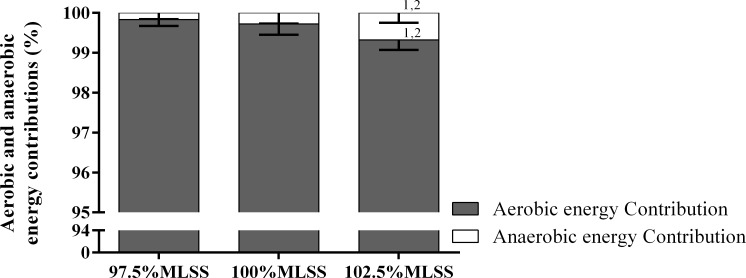
The purpose of this study was to examine the oxygen uptake ([Formula: see text]) kinetics and the energy systems' contribution at 97.5, 100 and 102.5% of the maximal lactate steady state (MLSS) swimming intensity. Ten elite female swimmers performed three-to-five 30 min submaximal constant swimming bouts at imposed paces for the determination of the swimming velocity (v) at 100%MLSS based on a 7 x 200 m intermittent incremental protocol until voluntary exhaustion to find the v associated at the individual anaerobic threshold. [Formula: see text] kinetics (cardiodynamic, primary and slow component phases) and the aerobic and anaerobic energy contributions were assessed during the continuous exercises, which the former was studied for the beginning and second phase of exercise. Subjects showed similar time delay (TD) (mean = 11.5-14.3 s) and time constant (τp) (mean = 13.8-16.3 s) as a function of v, but reduced amplitude of the primary component for 97.5% (35.7 ± 7.3 mL.kg.min-1) compared to 100 and 102.5%MLSS (41.0 ± 7.0 and 41.3 ± 5.4 mL.kg.min-1, respectively), and τp decreased (mean = 9.6-10.8 s) during the second phase of exercise. Despite the slow component did not occur for all swimmers at all swim intensities, when observed it tended to increase as a function of v. Moreover, the total energy contribution was almost exclusively aerobic (98-99%) at 97.5, 100 and 102.5%MLSS. We suggest that well-trained endurance swimmers with a fast TD and τp values may be able to adjust faster the physiological requirements to minimize the amplitude of the slow component appearance, parameter associated with the fatigue delay and increase in exhaustion time during performance, however, these fast adjustments were not able to control the progressive fatigue occurred slightly above MLSS, and most of swimmers reached exhaustion before 30min swam.
本研究的目的是检测在最大乳酸稳态(MLSS)游泳强度的97.5%、100%和102.5%时的摄氧量([公式:见原文])动力学以及能量系统的贡献。10名精英女子游泳运动员按照规定速度进行了三到五次30分钟的次最大强度恒定游泳 bout,基于7×200米间歇递增方案确定100%MLSS时的游泳速度(v),直至自愿疲劳,以找到与个体无氧阈相关的v。在持续运动期间评估了[公式:见原文]动力学(心脏动力学、主要和慢成分阶段)以及有氧和无氧能量贡献,前者在运动的开始和第二阶段进行研究。受试者表现出相似的时间延迟(TD)(平均值 = 11.5 - 14.3秒)和时间常数(τp)(平均值 = 13.8 - 16.3秒)作为v的函数,但与100%和102.5%MLSS(分别为41.0±7.0和41.3±5.4毫升·千克·分钟-1)相比,97.5%时主要成分的幅度降低(35.7±7.3毫升·千克·分钟-1),并且在运动的第二阶段τp降低(平均值 = 9.6 - 10.8秒)。尽管并非所有游泳运动员在所有游泳强度下都出现慢成分,但当观察到时,它倾向于随着v的增加而增加。此外,在97.5%、100%和102.5%MLSS时,总能量贡献几乎完全是有氧的(98 - 99%)。我们认为,具有快速TD和τp值的训练有素的耐力游泳运动员可能能够更快地调整生理需求,以最小化慢成分出现的幅度,该参数与疲劳延迟和运动期间疲劳时间增加相关,然而,这些快速调整无法控制在略高于MLSS时出现的渐进性疲劳,并且大多数游泳运动员在游泳30分钟前就达到了疲劳。