Parzych Katarzyna, Zetterqvist Anna V, Wright William R, Kirkby Nicholas S, Mitchell Jane A, Paul-Clark Mark J
Department of Cardiovascular Pharmacology, Vascular Biology, National Heart and Lung Institute, Imperial College London, London, United Kingdom.
Department of Clinical Sciences, Lund University, Malmö, Sweden.
FASEB J. 2017 Jun;31(6):2439-2445. doi: 10.1096/fj.201600256. Epub 2017 Feb 28.
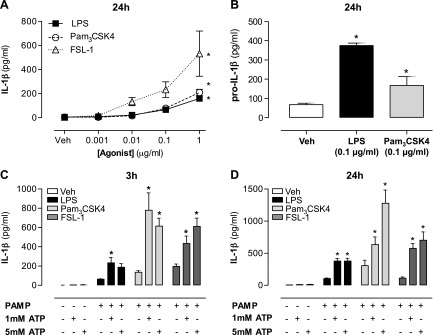
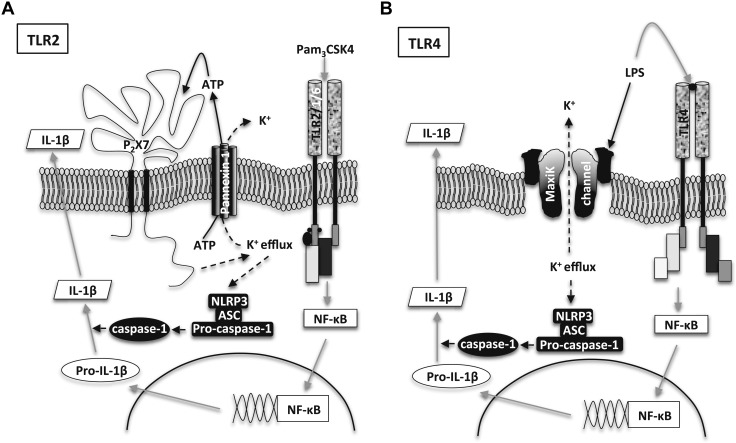
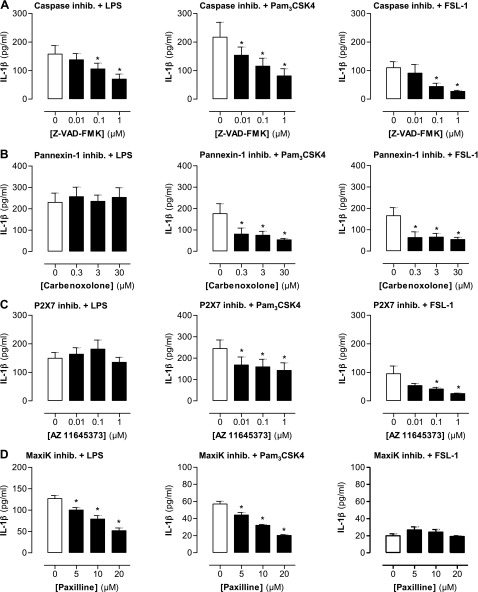
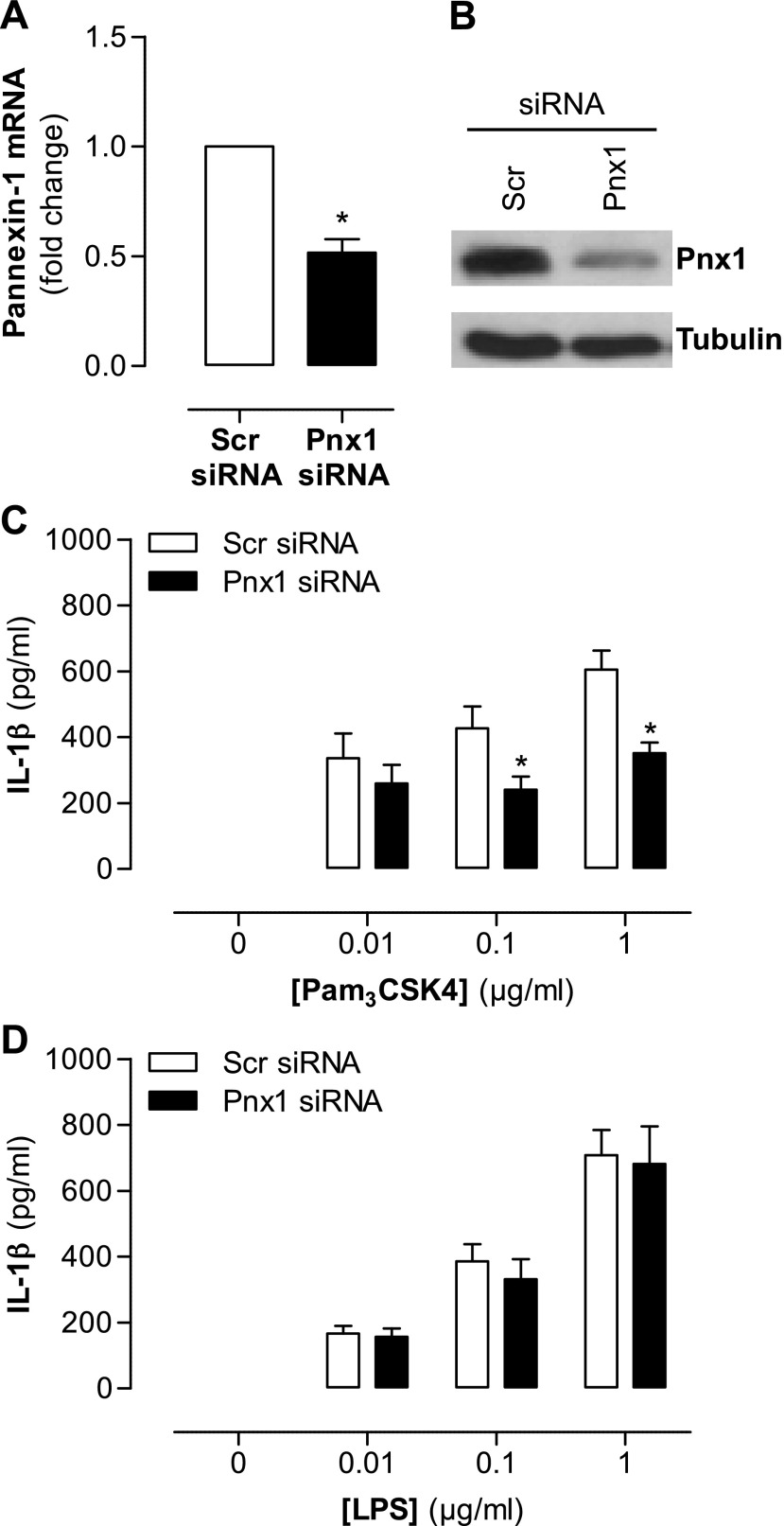
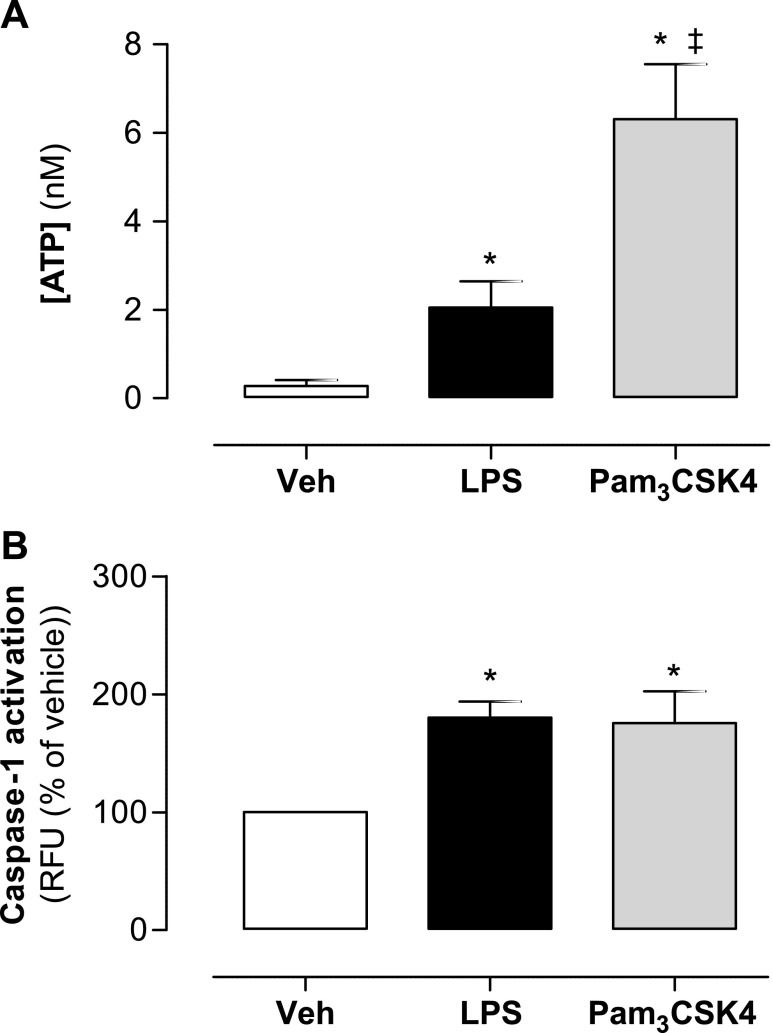
IL-1β release is integral to the innate immune system. The release of mature IL-1β depends on 2 regulated events: the induction of pro-IL-1β, generally NF-κB-dependent transduction pathways; and the assembly and activation of the NLRP3 inflammasome. This latter step is reliant on active caspase-1, pannexin-1, and P2X receptor activation. Pathogen-associated molecular patterns in gram-positive and gram-negative bacteria activate IL-1β release from immune cells TLR2 and TLR4 receptors, respectively. We found that pro-IL-1β and mature IL-1β release from human monocytes is stimulated by the TLR2 agonists PamCSK4 or FSL-1, as well as the TLR4 agonist LPS in the absence of additional ATP. TLR2 agonists required pannexin-1 and P2X receptor activation to stimulate IL-1β release. In contrast, IL-1β release stimulated by the TLR4 agonist LPS is independent of both pannexin-1 and P2X activation. In the absence of exogenous ATP, P2X activation requires endogenous ATP release, which occurs in some cells pannexin-1. In line with this, we found that LPS-stimulated human monocytes released relatively low levels of ATP, whereas cells stimulated with TLR2 agonists released high levels of ATP. These findings suggest that in human monocytes, both TLR2 and TLR4 signaling induce pro-IL-1β expression, but the mechanism by which they activate caspase-1 diverges at the level of the pannexin-1/ATP/P2X axis.-Parzych, K., Zetterqvist, A. V., Wright, W. R., Kirkby, N. S., Mitchell, J. A., Paul-Clark, M. J. Differential role of pannexin-1/ATP/P2X axis in IL-1β release by human monocytes.
白细胞介素-1β(IL-1β)的释放是固有免疫系统不可或缺的一部分。成熟IL-1β的释放取决于两个受调控的事件:前体IL-1β的诱导,通常依赖于核因子κB(NF-κB)依赖性转导途径;以及NLRP3炎性小体的组装和激活。后一步骤依赖于活性半胱天冬酶-1、泛连接蛋白-1和P2X受体的激活。革兰氏阳性菌和革兰氏阴性菌中的病原体相关分子模式分别通过Toll样受体2(TLR2)和Toll样受体4(TLR4)激活免疫细胞释放IL-1β。我们发现,在没有额外三磷酸腺苷(ATP)的情况下,TLR2激动剂PamCSK4或FSL-1以及TLR4激动剂脂多糖(LPS)可刺激人单核细胞释放前体IL-1β和成熟IL-1β。TLR2激动剂需要泛连接蛋白-1和P2X受体激活来刺激IL-1β释放。相比之下,TLR4激动剂LPS刺激的IL-1β释放与泛连接蛋白-1和P2X激活均无关。在没有外源性ATP的情况下,P2X激活需要内源性ATP释放,这在一些细胞中通过泛连接蛋白-1发生。与此一致,我们发现LPS刺激的人单核细胞释放相对较低水平的ATP,而用TLR2激动剂刺激的细胞释放高水平的ATP。这些发现表明,在人单核细胞中,TLR2和TLR4信号传导均诱导前体IL-1β表达,但它们激活半胱天冬酶-1的机制在泛连接蛋白-1/ATP/P2X轴水平上有所不同。——帕尔齐克,K.,泽特奎斯特,A.V.,赖特,W.R.,柯比,N.S.,米切尔,J.A.,保罗-克拉克,M.J.泛连接蛋白-1/ATP/P2X轴在人单核细胞释放IL-1β中的不同作用