Carmona-Fontaine Carlos, Deforet Maxime, Akkari Leila, Thompson Craig B, Joyce Johanna A, Xavier Joao B
Computational and Systems Biology Program, Memorial Sloan Kettering Cancer Center, New York, NY 10065;
Center for Genomics and Systems Biology, Department of Biology, New York University, New York, NY 10003.
Proc Natl Acad Sci U S A. 2017 Mar 14;114(11):2934-2939. doi: 10.1073/pnas.1700600114. Epub 2017 Feb 28.
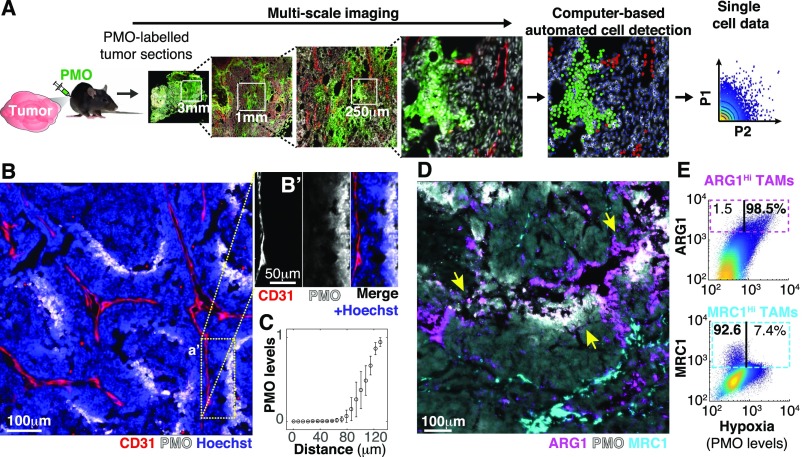
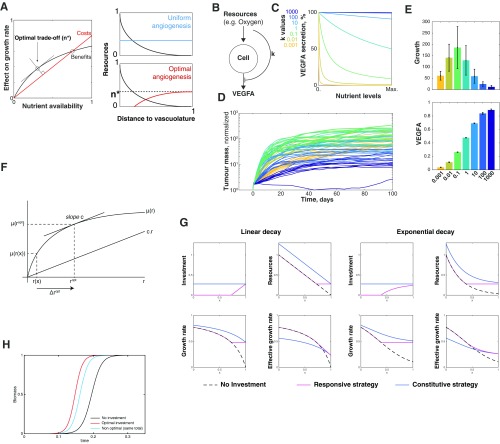
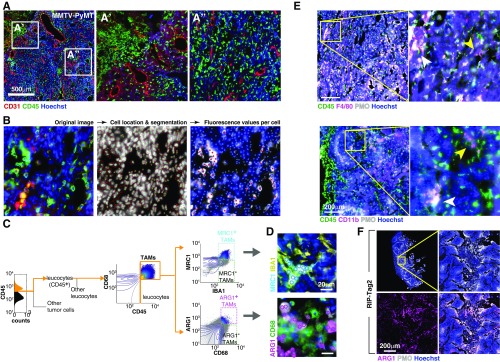
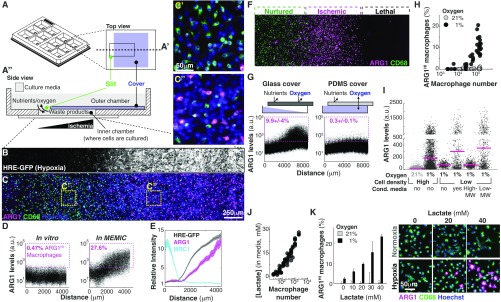
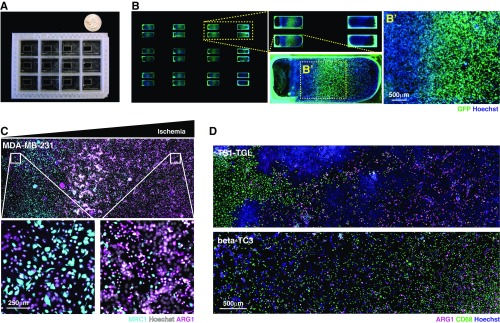
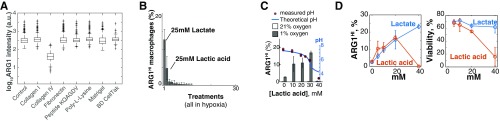
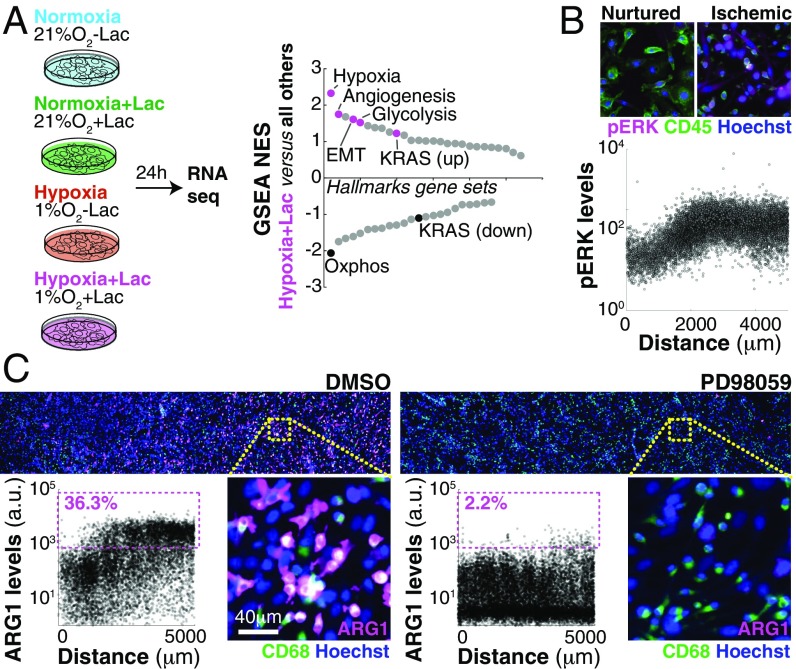
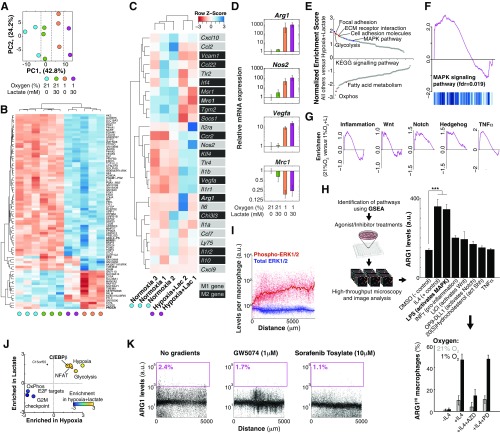
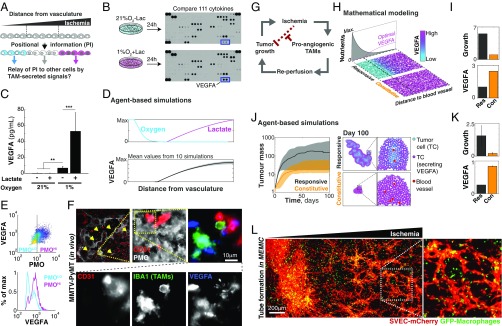
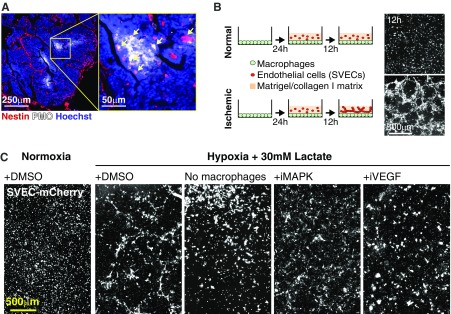
The genetic and phenotypic diversity of cells within tumors is a major obstacle for cancer treatment. Because of the stochastic nature of genetic alterations, this intratumoral heterogeneity is often viewed as chaotic. Here we show that the altered metabolism of cancer cells creates predictable gradients of extracellular metabolites that orchestrate the phenotypic diversity of cells in the tumor microenvironment. Combining experiments and mathematical modeling, we show that metabolites consumed and secreted within the tumor microenvironment induce tumor-associated macrophages (TAMs) to differentiate into distinct subpopulations according to local levels of ischemia and their position relative to the vasculature. TAMs integrate levels of hypoxia and lactate into progressive activation of MAPK signaling that induce predictable spatial patterns of gene expression, such as stripes of macrophages expressing arginase 1 (ARG1) and mannose receptor, C type 1 (MRC1). These phenotypic changes are functionally relevant as ischemic macrophages triggered tube-like morphogenesis in neighboring endothelial cells that could restore blood perfusion in nutrient-deprived regions where angiogenic resources are most needed. We propose that gradients of extracellular metabolites act as tumor morphogens that impose order within the microenvironment, much like signaling molecules convey positional information to organize embryonic tissues. Unearthing embryology-like processes in tumors may allow us to control organ-like tumor features such as tissue repair and revascularization and treat intratumoral heterogeneity.
肿瘤内细胞的基因和表型多样性是癌症治疗的主要障碍。由于基因改变的随机性,这种肿瘤内异质性常被视为混乱无序。在此,我们表明癌细胞代谢的改变会产生可预测的细胞外代谢物梯度,从而协调肿瘤微环境中细胞的表型多样性。通过结合实验和数学模型,我们发现肿瘤微环境中消耗和分泌的代谢物会诱导肿瘤相关巨噬细胞(TAM)根据局部缺血水平及其相对于血管系统的位置分化为不同亚群。TAM将缺氧和乳酸水平整合到MAPK信号通路的渐进激活中,从而诱导可预测的基因表达空间模式,如表达精氨酸酶1(ARG1)和C型甘露糖受体1(MRC1)的巨噬细胞条带。这些表型变化具有功能相关性,因为缺血巨噬细胞会触发邻近内皮细胞形成管状形态,从而在最需要血管生成资源的营养缺乏区域恢复血液灌注。我们提出,细胞外代谢物梯度作为肿瘤形态发生素,在微环境中建立秩序,这与信号分子传递位置信息以组织胚胎组织的方式非常相似。揭示肿瘤中类似胚胎发育的过程可能使我们能够控制诸如组织修复和血管再生等类似器官的肿瘤特征,并治疗肿瘤内异质性。