Trenchevska Olgica, Nelson Randall W, Nedelkov Dobrin
The Biodesign Institute, Arizona State University, Tempe, AZ 85287, USA.
Proteomes. 2016 Mar 17;4(1):13. doi: 10.3390/proteomes4010013.
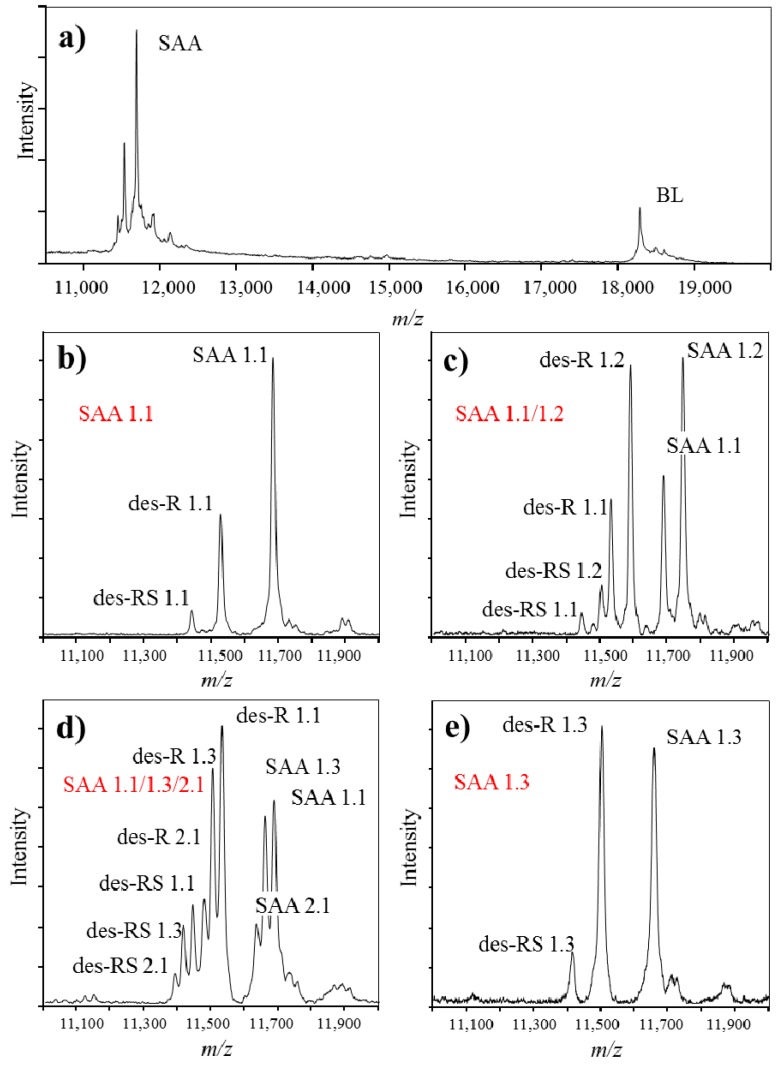
Proteins can exist as multiple proteoforms , as a result of alternative splicing and single-nucleotide polymorphisms (SNPs), as well as posttranslational processing. To address their clinical significance in a context of diagnostic information, proteoforms require a more in-depth analysis. Mass spectrometric immunoassays (MSIA) have been devised for studying structural diversity in human proteins. MSIA enables protein profiling in a simple and high-throughput manner, by combining the selectivity of targeted immunoassays, with the specificity of mass spectrometric detection. MSIA has been used for qualitative and quantitative analysis of single and multiple proteoforms, distinguishing between normal fluctuations and changes related to clinical conditions. This mini review offers an overview of the development and application of mass spectrometric immunoassays for clinical and population proteomics studies. Provided are examples of some recent developments, and also discussed are the trends and challenges in mass spectrometry-based immunoassays for the next-phase of clinical applications.
由于可变剪接、单核苷酸多态性(SNP)以及翻译后加工,蛋白质可以以多种蛋白质异构体的形式存在。为了在诊断信息的背景下阐明它们的临床意义,蛋白质异构体需要更深入的分析。质谱免疫分析(MSIA)已被设计用于研究人类蛋白质的结构多样性。MSIA通过将靶向免疫分析的选择性与质谱检测的特异性相结合,能够以简单且高通量的方式进行蛋白质谱分析。MSIA已用于单一和多种蛋白质异构体的定性和定量分析,区分正常波动和与临床状况相关的变化。本综述概述了质谱免疫分析在临床和群体蛋白质组学研究中的发展与应用。文中给出了一些近期进展的实例,还讨论了基于质谱的免疫分析在临床应用下一阶段的趋势和挑战。