High Pressure Collaborative Access Team (HPCAT), Geophysical Laboratory, Carnegie Institution of Washington, Argonne, Illinois 60439, USA.
Nat Commun. 2017 Mar 1;8:14562. doi: 10.1038/ncomms14562.
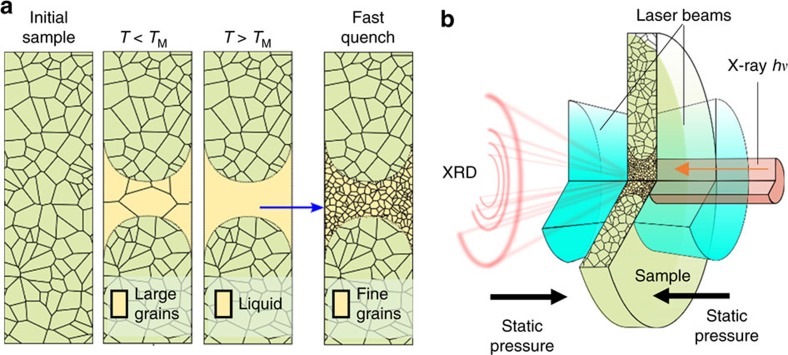
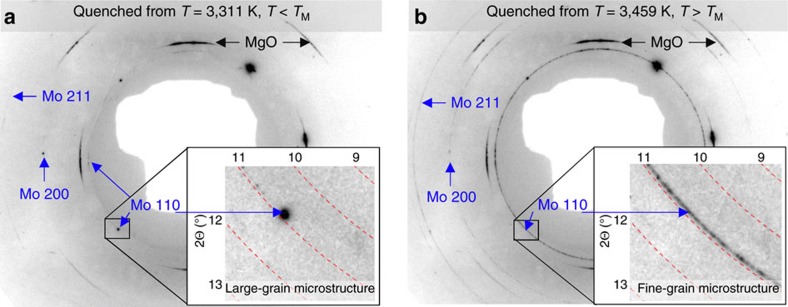
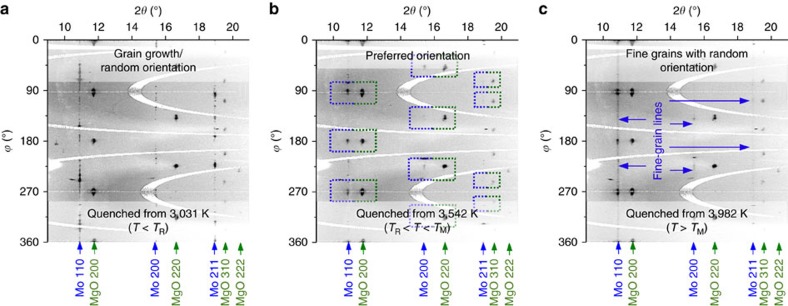
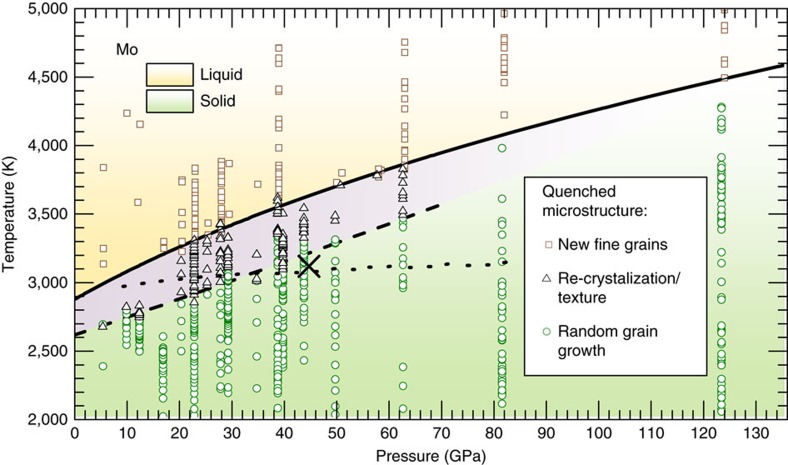
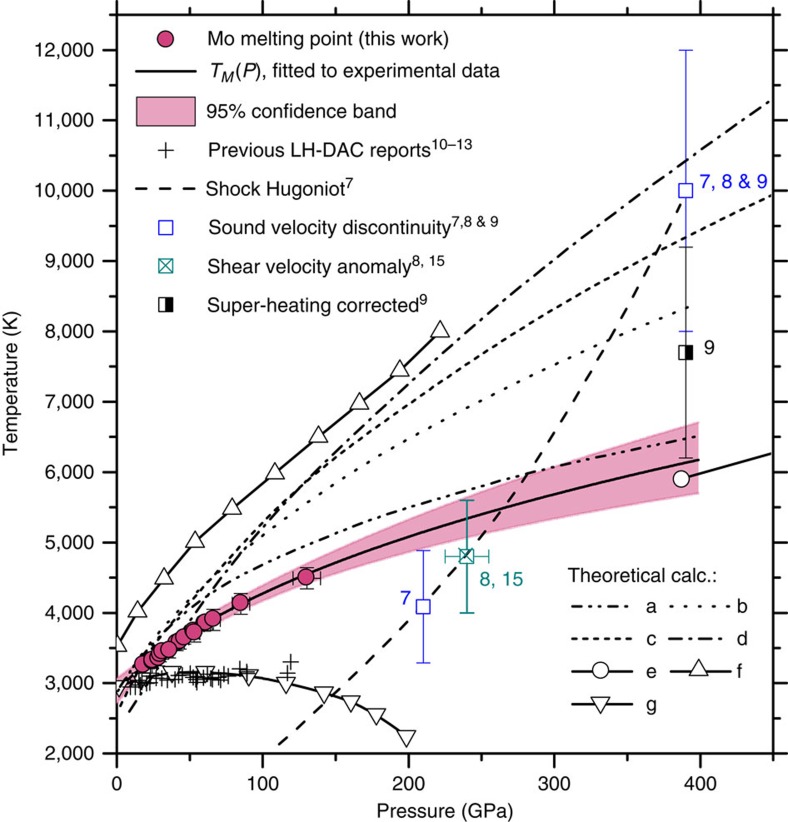
High-pressure melting anchors the phase diagram of a material, revealing the effect of pressure on the breakdown of the ordering of atoms in the solid. An important case is molybdenum, which has long been speculated to undergo an exceptionally steep increase in melting temperature when compressed. On the other hand, previous experiments showed nearly constant melting temperature as a function of pressure, in large discrepancy with theoretical expectations. Here we report a high-slope melting curve in molybdenum by synchrotron X-ray diffraction analysis of crystalline microstructures, generated by heating and subsequently rapidly quenching samples in a laser-heated diamond anvil cell. Distinct microstructural changes, observed at pressures up to 130 gigapascals, appear exclusively after melting, thus offering a reliable melting criterion. In addition, our study reveals a previously unsuspected transition in molybdenum at high pressure and high temperature, which yields highly textured body-centred cubic nanograins above a transition temperature.
高压熔融固定了材料的相图,揭示了压力对固体中原子有序性破坏的影响。钼就是一个重要的例子,长期以来人们推测钼在被压缩时其熔点会异常陡峭地升高。另一方面,之前的实验表明,钼的熔点随压力的变化几乎是常数,与理论预期有很大的出入。在这里,我们通过同步辐射 X 射线衍射分析晶体微结构,在激光加热金刚石压腔中加热和随后快速淬火样品,报告了钼的斜率较大的熔融曲线。在高达 130 吉帕斯卡的压力下观察到的明显的微观结构变化仅在熔融后出现,因此提供了一个可靠的熔融判据。此外,我们的研究还揭示了钼在高压高温下以前未被察觉的转变,在高于转变温度时,产生高度织构的体心立方纳米晶粒。