Shibuta Yasushi, Oguchi Kanae, Takaki Tomohiro, Ohno Munekazu
Department of Materials Engineering, The University of Tokyo, 7-3-1 Hongo, Bunkyo-ku, Tokyo 113-8656, Japan.
Faculty of Mechanical Engineering, Kyoto Institute of Technology, Matsugasaki, Sakyo-ku, Kyoto 606-8585, Japan.
Sci Rep. 2015 Aug 27;5:13534. doi: 10.1038/srep13534.
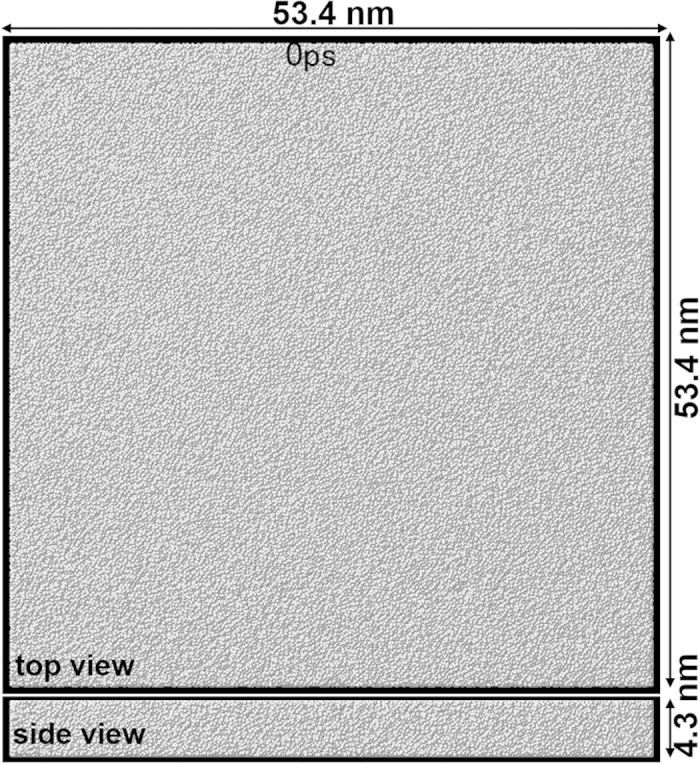
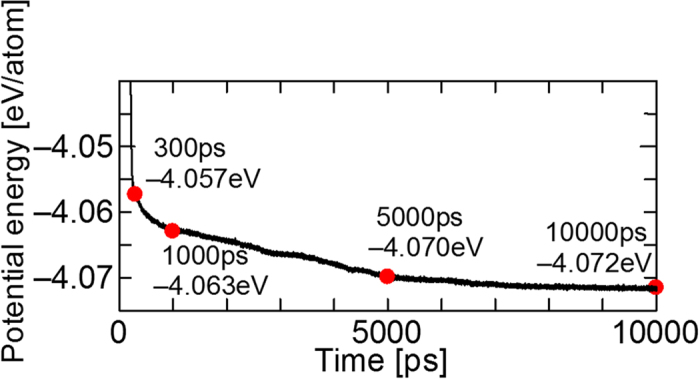
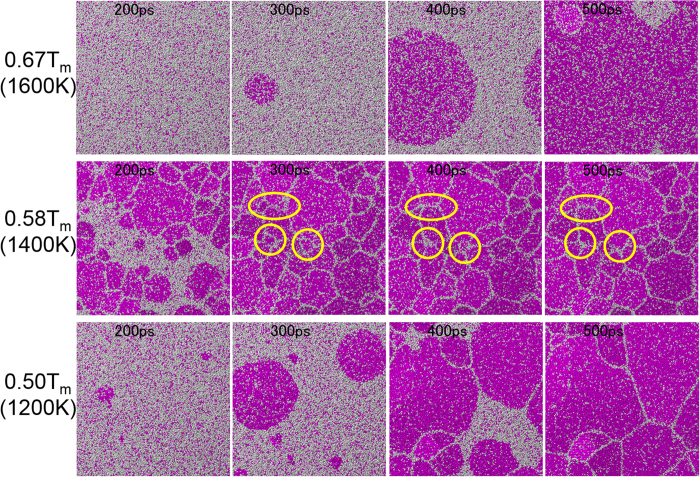
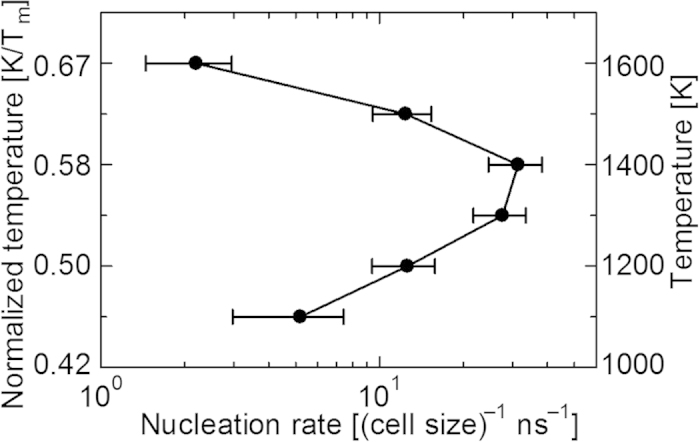
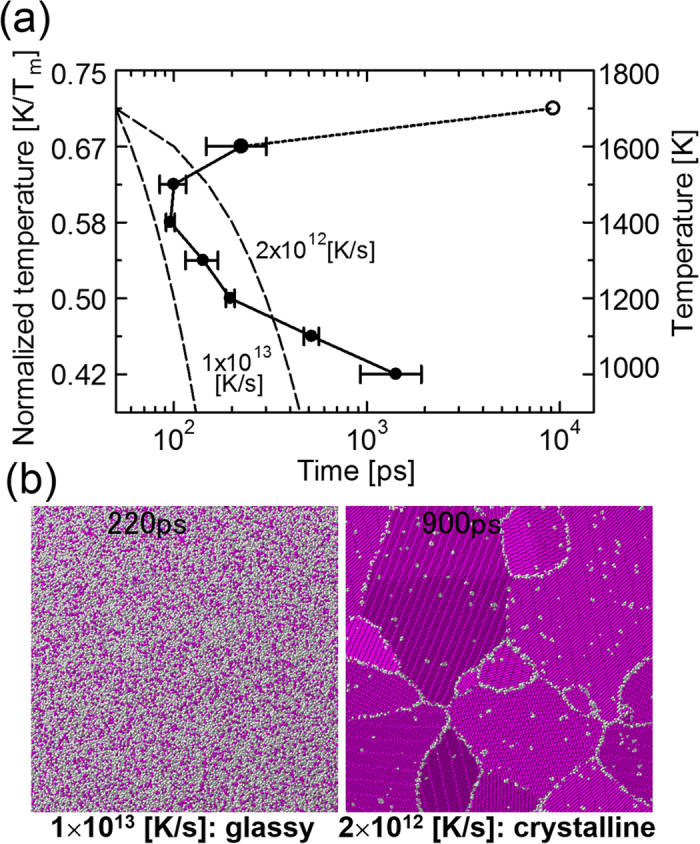
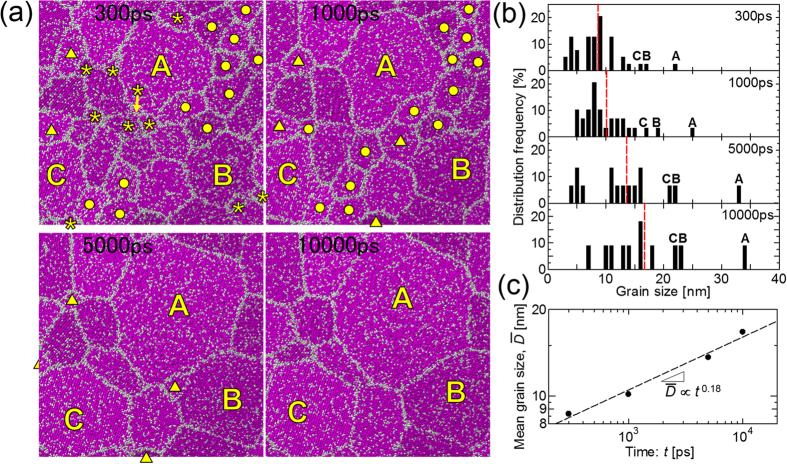
Homogeneous nucleation from an undercooled iron melt is investigated by the statistical sampling of million-atom molecular dynamics (MD) simulations performed on a graphics processing unit (GPU). Fifty independent instances of isothermal MD calculations with one million atoms in a quasi-two-dimensional cell over a nanosecond reveal that the nucleation rate and the incubation time of nucleation as functions of temperature have characteristic shapes with a nose at the critical temperature. This indicates that thermally activated homogeneous nucleation occurs spontaneously in MD simulations without any inducing factor, whereas most previous studies have employed factors such as pressure, surface effect, and continuous cooling to induce nucleation. Moreover, further calculations over ten nanoseconds capture the microstructure evolution on the order of tens of nanometers from the atomistic viewpoint and the grain growth exponent is directly estimated. Our novel approach based on the concept of "melting pots in a supercomputer" is opening a new phase in computational metallurgy with the aid of rapid advances in computational environments.
通过在图形处理单元(GPU)上进行的百万原子分子动力学(MD)模拟的统计抽样,研究了过冷铁熔体中的均匀成核。在一个准二维单元中,对一百万个原子进行纳秒级的五十次独立等温MD计算实例表明,成核速率和作为温度函数的成核孕育时间具有特征形状,在临界温度处有一个峰值。这表明在MD模拟中,热激活的均匀成核在没有任何诱导因素的情况下自发发生,而大多数先前的研究都采用了诸如压力、表面效应和连续冷却等因素来诱导成核。此外,超过十纳秒的进一步计算从原子角度捕捉了几十纳米量级的微观结构演变,并直接估计了晶粒生长指数。我们基于“超级计算机中的熔炉”概念的新方法,借助计算环境的快速发展,正在开启计算冶金的新阶段。