Møller Thea Palsgaard, Kjærulff Thora Majlund, Viereck Søren, Østergaard Doris, Folke Fredrik, Ersbøll Annette Kjær, Lippert Freddy K
Emergency Medical Services Copenhagen, University of Copenhagen, Telegrafvej 5, 2750, Ballerup, Denmark.
National Institute of Public Health, University of Southern Denmark, Øster Farimagsgade 5A, 1353, København K, Denmark.
Scand J Trauma Resusc Emerg Med. 2017 Mar 1;25(1):22. doi: 10.1186/s13049-017-0366-0.
Pre-hospital emergency care requires proper categorization of emergency calls and assessment of emergency priority levels by the medical dispatchers. We investigated predictors for emergency call categorization as "unclear problem" in contrast to "symptom-specific" categories and the effect of categorization on mortality.
Register-based study in a 2-year period based on emergency call data from the emergency medical dispatch center in Copenhagen combined with nationwide register data. Logistic regression analysis (N = 78,040 individuals) was used for identification of predictors of emergency call categorization as "unclear problem". Poisson regression analysis (N = 97,293 calls) was used for examining the effect of categorization as "unclear problem" on mortality.
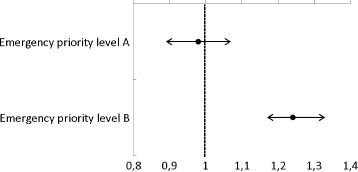
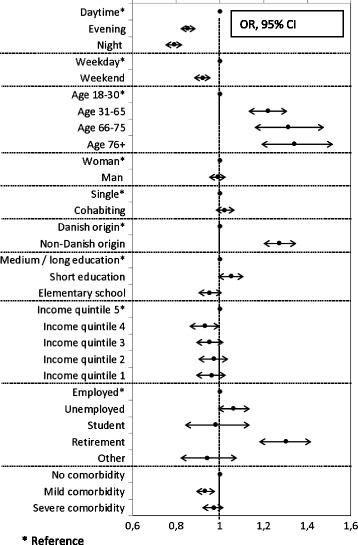
"Unclear problem" was the registered category in 18% of calls. Significant predictors for "unclear problem" categorization were: age (odds ratio (OR) 1.34 for age group 76+ versus 18-30 years), ethnicity (OR 1.27 for non-Danish vs. Danish), day of week (OR 0.92 for weekend vs. weekday), and time of day (OR 0.79 for night vs. day). Emergency call categorization had no effect on mortality for emergency priority level A calls, incidence rate ratio (IRR) 0.99 (95% confidence interval (CI) 0.90-1.09). For emergency priority level B calls, an association was observed, IRR 1.26 (95% CI 1.18-1.36).
The results shed light on the complexity of emergency call handling, but also implicate a need for further improvement. Educational interventions at the dispatch centers may improve the call handling, but also the underlying supportive tools are modifiable. The higher mortality rate for patients with emergency priority level B calls with "unclear problem categorization" could imply lowering the threshold for dispatching a high level ambulance response when the call is considered unclear. On the other hand a "benefit of the doubt" approach could hinder the adequate response to other patients in need for an ambulance as there is an increasing demand and limited resources for ambulance services.
Age, ethnicity, day of week and time of day were significant predictors of emergency call categorization as "unclear problem". "Unclear problem" categorization was not associated with mortality for emergency priority level A calls, but a higher mortality was observed for emergency priority level B calls.
院前急救需要医疗调度员对急救电话进行正确分类并评估急救优先级。我们调查了与“症状特定”类别相比,将急救电话分类为“问题不明”的预测因素以及分类对死亡率的影响。
基于哥本哈根紧急医疗调度中心的2年急救电话数据并结合全国登记数据进行基于登记的研究。逻辑回归分析(N = 78,040人)用于识别急救电话分类为“问题不明”的预测因素。泊松回归分析(N = 97,293个电话)用于检验分类为“问题不明”对死亡率的影响。
18%的电话登记类别为“问题不明”。“问题不明”分类的显著预测因素为:年龄(76岁及以上年龄组与18 - 30岁年龄组相比,优势比(OR)为1.34)、种族(非丹麦人与丹麦人相比,OR为1.27)、星期几(周末与工作日相比,OR为0.92)以及一天中的时间(夜间与白天相比,OR为0.79)。急救电话分类对A类急救优先级电话的死亡率没有影响,发病率比(IRR)为0.99(95%置信区间(CI)为0.90 - 1.09)。对于B类急救优先级电话,观察到有相关性,IRR为1.26(95% CI为1.18 - 1.36)。
结果揭示了急救电话处理的复杂性,但也意味着需要进一步改进。调度中心的教育干预可能会改善电话处理情况,而且基础支持工具也是可以修改的。“问题不明”分类的B类急救优先级患者死亡率较高,这可能意味着当电话被认为不明确时,应降低派遣高级别救护车响应的阈值。另一方面,“疑罪从无”的方法可能会妨碍对其他需要救护车的患者做出充分响应,因为救护车服务的需求不断增加且资源有限。
年龄、种族、星期几和一天中的时间是急救电话分类为“问题不明”的显著预测因素。“问题不明”分类与A类急救优先级电话的死亡率无关,但B类急救优先级电话的死亡率较高。