Ramani Sasirekha, Neill Frederick H, Ferreira Jennifer, Treanor John J, Frey Sharon E, Topham David J, Goodwin Robert R, Borkowski Astrid, Baehner Frank, Mendelman Paul M, Estes Mary K, Atmar Robert L
Baylor College of Medicine, Houston, Texas, USA.
The Emmes Corp., Rockville, Maryland, USA.
Clin Vaccine Immunol. 2017 May 5;24(5). doi: 10.1128/CVI.00571-16. Print 2017 May.
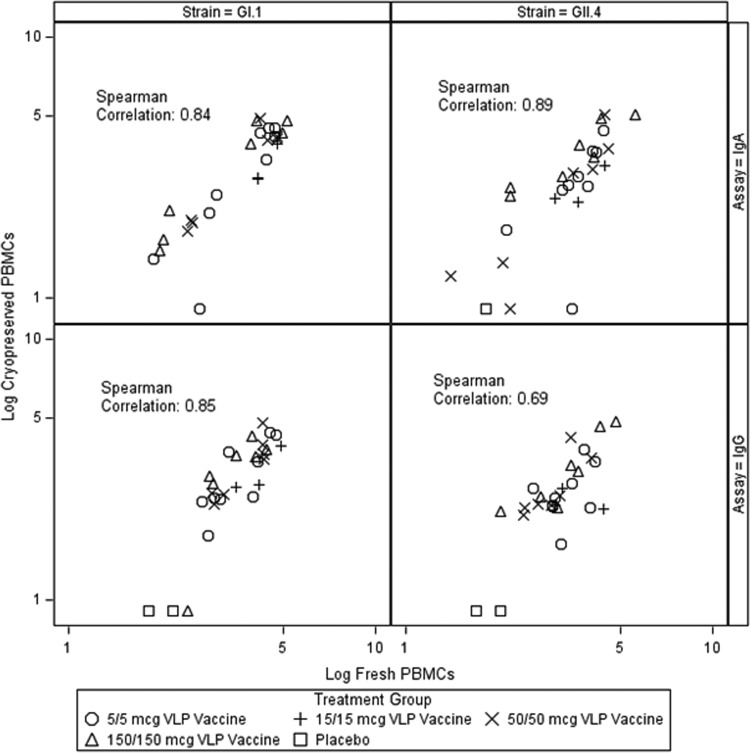
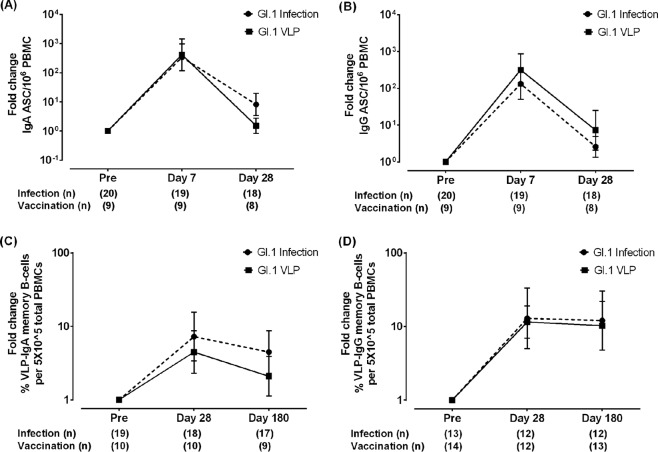
Human noroviruses (HuNoVs) are a leading cause of acute gastroenteritis worldwide. A virus-like particle (VLP) candidate vaccine induces the production of serum histo-blood group antigen (HBGA)-blocking antibodies, the first identified correlate of protection from HuNoV gastroenteritis. Recently, virus-specific IgG memory B cells were identified to be another potential correlate of protection against HuNoV gastroenteritis. We assessed B-cell responses following intramuscular administration of a bivalent (genogroup I, genotype 1 [GI.1]/genogroup II, genotype 4 [GII.4]) VLP vaccine using protocols identical to those used to evaluate cellular immunity following experimental GI.1 HuNoV infection. The kinetics and magnitude of cellular immunity to G1.1 infection were compared to those after VLP vaccination. Intramuscular immunization with the bivalent VLP vaccine induced the production of antibody-secreting cells (ASCs) and memory B cells. ASC responses peaked at day 7 after the first dose of vaccine and returned to nearly baseline levels by day 28. Minimal increases in ASCs were seen after a second vaccine dose at day 28. Antigen-specific IgG memory B cells persisted at day 180 postvaccination for both GI.1 and GII.4 VLPs. The overall trends in B-cell responses to vaccination were similar to the trends in the responses to infection, where there was a greater bias of an ASC response toward IgA and a memory B-cell response to IgG. The magnitude of the ASC and memory B-cell responses to the GI.1 VLP component of the vaccine was also comparable to that of the responses following GI.1 infection. The production of IgG memory B cells and persistence at day 180 is a key finding and underscores the need for future studies to determine if IgG memory B cells are a correlate of protection following vaccination. (This study has been registered at ClinicalTrials.gov under registration no. NCT01168401.).
人诺如病毒(HuNoVs)是全球急性胃肠炎的主要病因。一种病毒样颗粒(VLP)候选疫苗可诱导血清组织血型抗原(HBGA)阻断抗体的产生,这是首个被确定的预防HuNoV胃肠炎的相关保护因素。最近,病毒特异性IgG记忆B细胞被确定为预防HuNoV胃肠炎的另一个潜在相关保护因素。我们使用与评估实验性GI.1 HuNoV感染后细胞免疫相同的方案,评估了肌肉注射二价(基因组I,基因型1 [GI.1]/基因组II,基因型4 [GII.4])VLP疫苗后的B细胞反应。将对G1.1感染的细胞免疫动力学和强度与VLP疫苗接种后的情况进行了比较。二价VLP疫苗的肌肉免疫诱导了抗体分泌细胞(ASC)和记忆B细胞的产生。ASC反应在第一剂疫苗接种后第7天达到峰值,并在第28天恢复到几乎基线水平。在第28天接种第二剂疫苗后,ASC的增加幅度最小。接种疫苗后第180天,针对GI.1和GII.4 VLP的抗原特异性IgG记忆B细胞持续存在。B细胞对疫苗接种的反应总体趋势与对感染的反应趋势相似,即ASC反应对IgA的偏向性更大,记忆B细胞反应对IgG的偏向性更大。疫苗GI.1 VLP成分的ASC和记忆B细胞反应强度也与GI.1感染后的反应相当。IgG记忆B细胞的产生及其在第180天的持续存在是一项关键发现,强调了未来研究确定IgG记忆B细胞是否为疫苗接种后保护相关因素的必要性。(本研究已在ClinicalTrials.gov注册,注册号为NCT01168401。)