Gravells Polly, Grant Emma, Smith Kate M, James Dominic I, Bryant Helen E
Academic Unit of Molecular Oncology, Sheffield Institute for Nucleic Acids (SInFoNiA), Department of Oncology and Metabolism, University of Sheffield, Beech Hill Road, Sheffield, S10 2RX, United Kingdom.
Drug Discovery Unit, Cancer Research UK Manchester Institute, The University of Manchester, Wilmslow Road, Manchester, M20 4BX, United Kingdom.
DNA Repair (Amst). 2017 Apr;52:81-91. doi: 10.1016/j.dnarep.2017.02.010. Epub 2017 Feb 17.
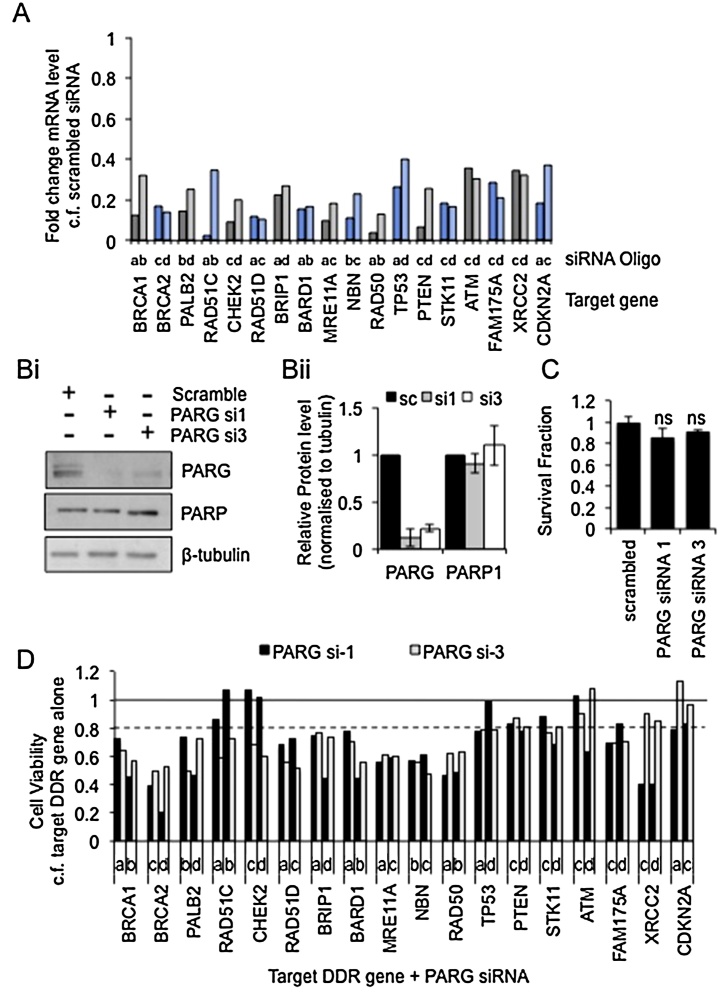
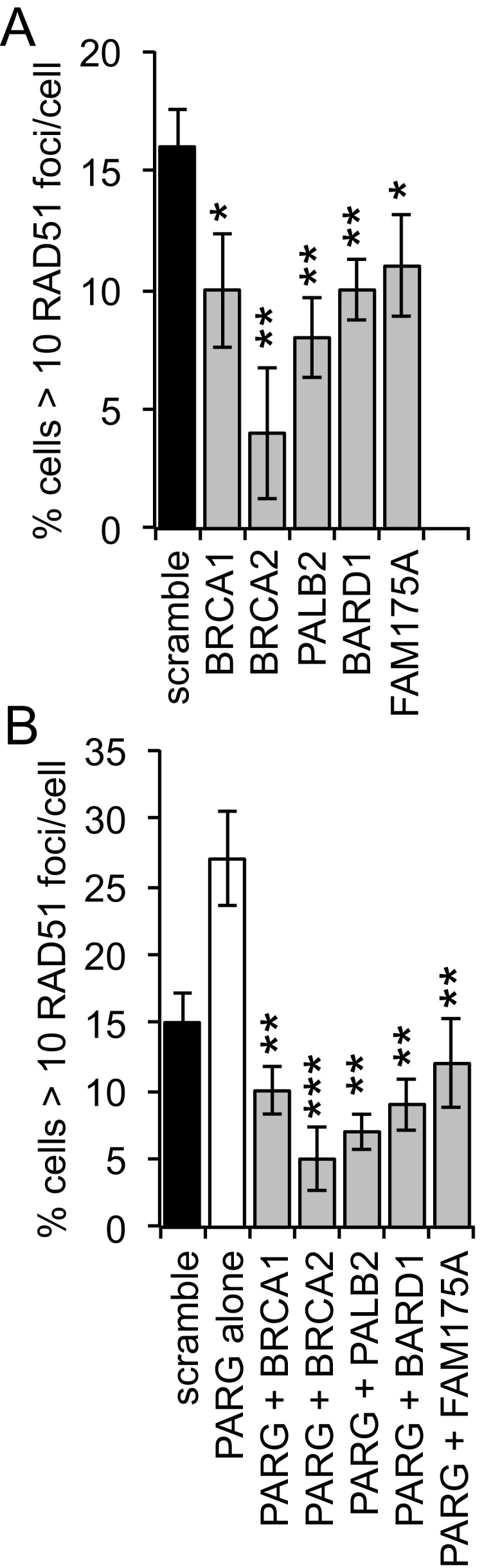
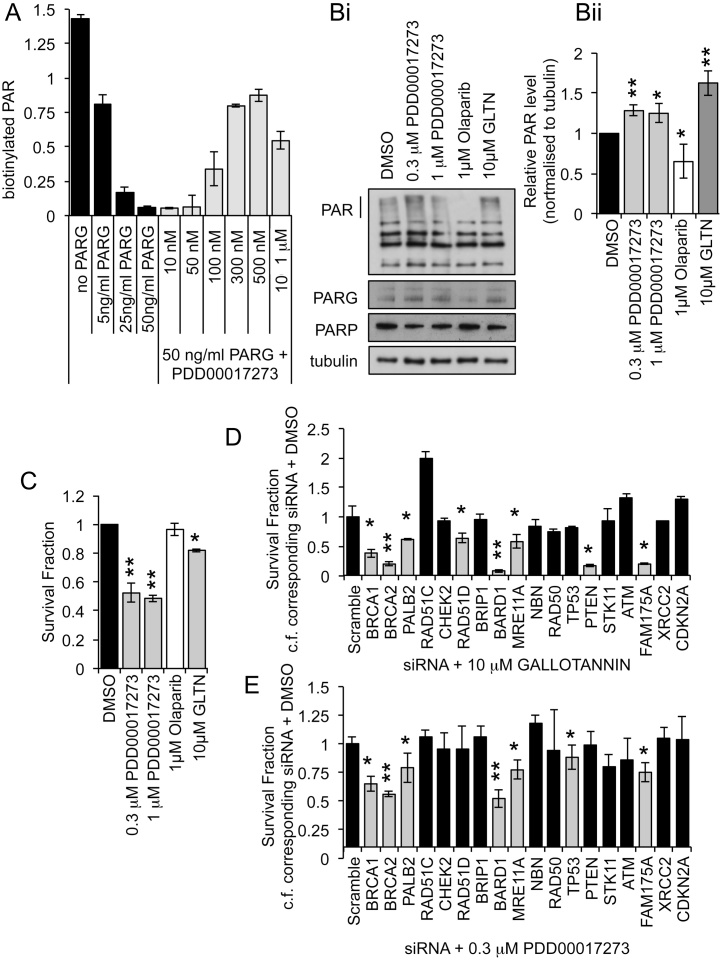
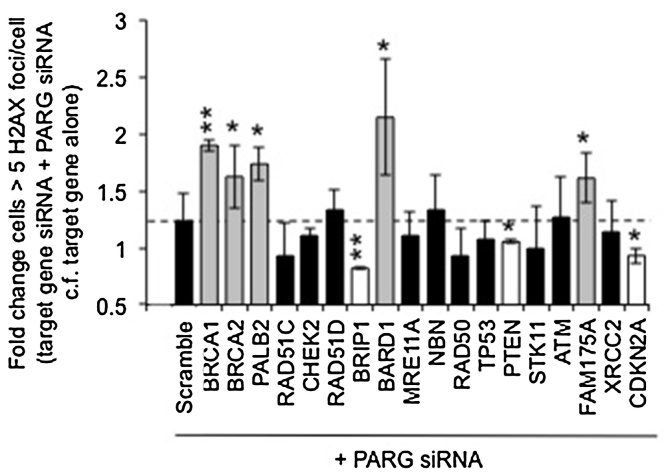
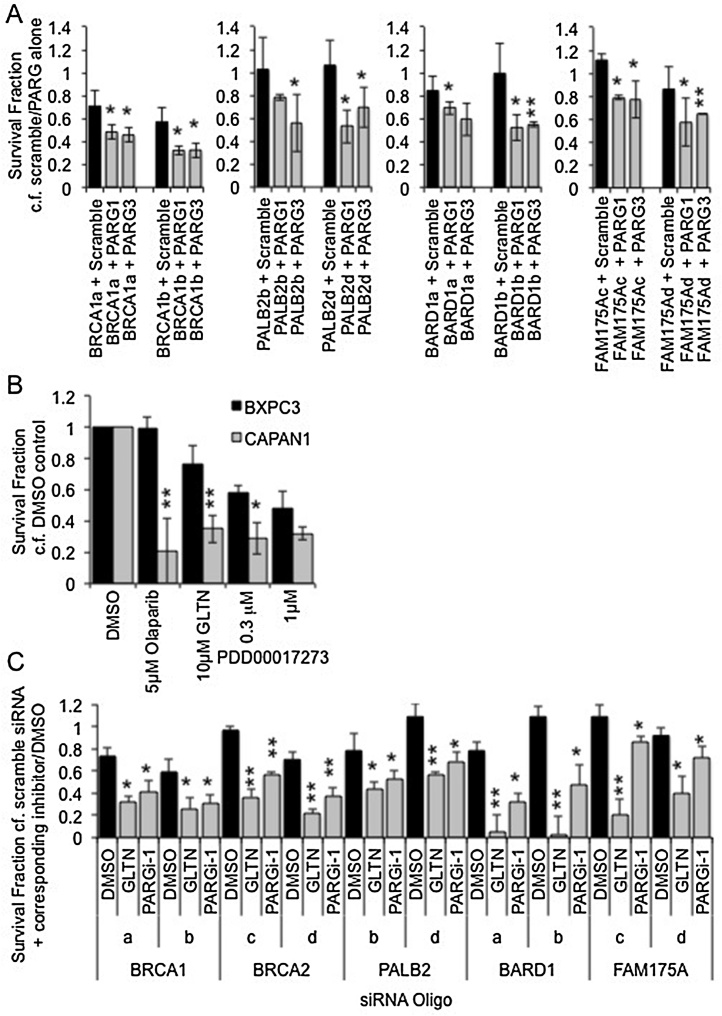
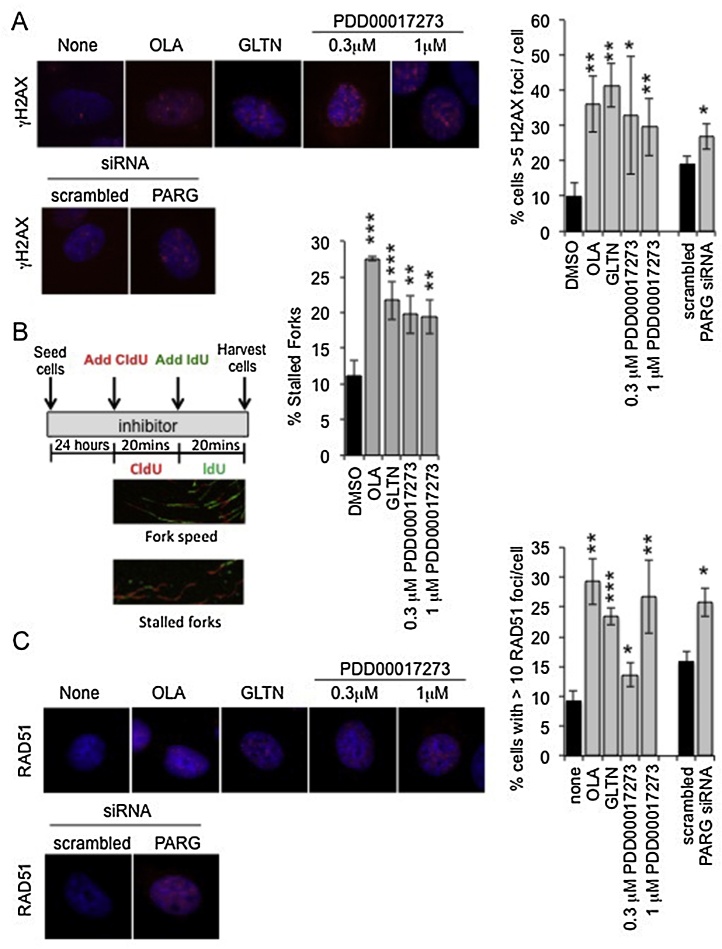
Poly(ADP-ribosylation) of proteins following DNA damage is well studied and the use of poly(ADP-ribose) polymerase (PARP) inhibitors as therapeutic agents is an exciting prospect for the treatment of many cancers. Poly(ADP-ribose) glycohydrolase (PARG) has endo- and exoglycosidase activities which can cleave glycosidic bonds, rapidly reversing the action of PARP enzymes. Like addition of poly(ADP-ribose) (PAR) by PARP, removal of PAR by PARG is also thought to be required for repair of DNA strand breaks and for continued replication at perturbed forks. Here we use siRNA to show a synthetic lethal relationship between PARG and BRCA1, BRCA2, PALB2, FAM175A (ABRAXAS) and BARD1. In addition, we demonstrate that MCF7 cells depleted of these proteins are sensitive to Gallotannin and a novel and specific PARG inhibitor PDD00017273. We confirm that PARG inhibition increases endogenous DNA damage, stalls replication forks and increases homologous recombination, and propose that it is the lack of homologous recombination (HR) proteins at PARG inhibitor-induced stalled replication forks that induces cell death. Interestingly not all genes that are synthetically lethal with PARP result in sensitivity to PARG inhibitors, suggesting that although there is overlap, the functions of PARP and PARG may not be completely identical. These data together add further evidence to the possibility that single treatment therapy with PARG inhibitors could be used for treatment of certain HR deficient tumours and provide insight into the relationship between PARP, PARG and the processes of DNA repair.
DNA损伤后蛋白质的多聚(ADP-核糖基化)已得到充分研究,使用多聚(ADP-核糖)聚合酶(PARP)抑制剂作为治疗药物是治疗多种癌症的一个令人兴奋的前景。多聚(ADP-核糖)糖苷水解酶(PARG)具有内切糖苷酶和外切糖苷酶活性,可切割糖苷键,迅速逆转PARP酶的作用。与PARP添加多聚(ADP-核糖)(PAR)一样,PARG去除PAR也被认为是修复DNA链断裂和在受干扰的复制叉处继续复制所必需的。在这里,我们使用小干扰RNA(siRNA)来显示PARG与BRCA1、BRCA2、PALB2、FAM175A(ABRAXAS)和BARD1之间的合成致死关系。此外,我们证明,缺失这些蛋白质的MCF7细胞对没食子单宁和一种新型特异性PARG抑制剂PDD00017273敏感。我们证实,PARG抑制会增加内源性DNA损伤,使复制叉停滞并增加同源重组,并提出正是PARG抑制剂诱导的停滞复制叉处缺乏同源重组(HR)蛋白导致细胞死亡。有趣的是,并非所有与PARP合成致死的基因都会导致对PARG抑制剂敏感,这表明尽管存在重叠,但PARP和PARG的功能可能并不完全相同。这些数据共同进一步证明了使用PARG抑制剂单一治疗某些HR缺陷肿瘤的可能性,并深入了解了PARP、PARG与DNA修复过程之间的关系。