Che Keying, Zhao Yang, Qu Xiao, Pang Zhaofei, Ni Yang, Zhang Tiehong, Du Jiajun, Shen Hongchang
Institute of Oncology, Shandong Provincial Hospital Affiliated to Shandong University, Jinan.
Department of Breast Surgery, Key Laboratory of Breast Cancer in Shanghai, Collaborative Innovation Center of Cancer Medicine, Fudan University Shanghai Cancer Center; Department of Oncology, Shanghai Medical College, Fudan University, Shanghai.
Onco Targets Ther. 2017 Feb 20;10:1039-1047. doi: 10.2147/OTT.S127762. eCollection 2017.
Gastric carcinoma (GC) is a highly aggressive cancer and one of the leading causes of cancer-related deaths worldwide. Histopathological evaluation pertaining to invasiveness is likely to provide additional information in relation to patient outcome. In this study, we aimed to evaluate the prognostic significance of tumor budding and single cell invasion in gastric adenocarcinoma.
Hematoxylin and eosin-stained slides generated from 296 gastric adenocarcinoma patients with full clinical and pathological and follow-up information were systematically reviewed. The patients were grouped on the basis of tumor budding, single cell invasion, large cell invasion, mitotic count, and fibrosis. The association between histopathological parameters, different classification systems, and overall survival (OS) was statistically analyzed.
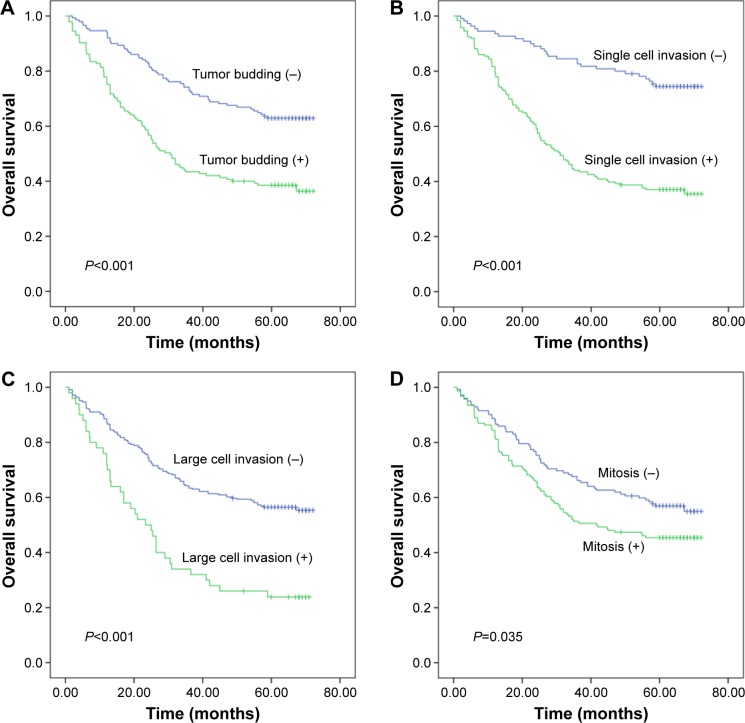
Among the 296 cases that were analyzed, high-grade tumor budding was observed in 49.0% (145) of them. Single cell invasion and large cell invasion were observed in 62.8% (186) and 16.9% (50) of the cases, respectively. Following univariate analysis, patients with high-grade tumor budding had shorter OS than those with low-grade tumor budding (hazard ratio [HR]: 2.260, <0.001). Similarly, the OS of patients with single cell invasion and large cell invasion was reduced (single cell invasion, HR: 3.553, <0.001; large cell invasion, HR: 2.466, <0.001). Following multivariate analysis, tumor budding and single cell invasion were observed to be independent risk factors for gastric adenocarcinoma (<0.05). According to the Lauren classification, patients with intestinal-type adenocarcinoma had better outcomes than those with diffuse-type adenocarcinoma (HR: 2.563, <0.001).
Tumor budding and single cell invasion in gastric adenocarcinoma are associated with an unfavorable prognosis.
胃癌(GC)是一种侵袭性很强的癌症,也是全球癌症相关死亡的主要原因之一。与侵袭性相关的组织病理学评估可能会提供有关患者预后的额外信息。在本研究中,我们旨在评估肿瘤芽生和单细胞侵袭在胃腺癌中的预后意义。
对296例具有完整临床、病理和随访信息的胃腺癌患者的苏木精和伊红染色切片进行系统回顾。根据肿瘤芽生、单细胞侵袭、大细胞侵袭、有丝分裂计数和纤维化对患者进行分组。对组织病理学参数、不同分类系统与总生存期(OS)之间的关联进行统计学分析。
在分析的296例病例中,49.0%(145例)观察到高级别肿瘤芽生。分别有62.8%(186例)和16.9%(50例)的病例观察到单细胞侵袭和大细胞侵袭。单因素分析后,高级别肿瘤芽生患者的OS比低级别肿瘤芽生患者短(风险比[HR]:2.260,<0.001)。同样,单细胞侵袭和大细胞侵袭患者的OS降低(单细胞侵袭,HR:3.553,<0.001;大细胞侵袭,HR:2.466,<0.001)。多因素分析后,肿瘤芽生和单细胞侵袭被观察为胃腺癌的独立危险因素(<0.05)。根据劳伦分类,肠型腺癌患者的预后优于弥漫型腺癌患者(HR:2.563,<0.001)。
胃腺癌中的肿瘤芽生和单细胞侵袭与不良预后相关。