• 文献检索
  • 文档翻译
  • 深度研究
  • 学术资讯
  • Suppr Zotero 插件Zotero 插件
  • 邀请有礼
  • 套餐&价格
  • 历史记录
应用&插件
Suppr Zotero 插件Zotero 插件浏览器插件Mac 客户端Windows 客户端微信小程序
定价
高级版会员购买积分包购买API积分包
服务
文献检索文档翻译深度研究API 文档MCP 服务
关于我们
关于 Suppr公司介绍联系我们用户协议隐私条款
关注我们

Suppr 超能文献

核心技术专利:CN118964589B侵权必究
粤ICP备2023148730 号-1Suppr @ 2026

文献检索

告别复杂PubMed语法,用中文像聊天一样搜索,搜遍4000万医学文献。AI智能推荐,让科研检索更轻松。

立即免费搜索

文件翻译

保留排版,准确专业,支持PDF/Word/PPT等文件格式,支持 12+语言互译。

免费翻译文档

深度研究

AI帮你快速写综述,25分钟生成高质量综述,智能提取关键信息,辅助科研写作。

立即免费体验

1至14岁儿童的睡眠习惯和模式及其与视频设备使用以及儿童傍晚和夜间活动的关系。

Sleep habits and pattern in 1-14 years old children and relationship with video devices use and evening and night child activities.

作者信息

Brambilla Paolo, Giussani Marco, Pasinato Angela, Venturelli Leonello, Privitera Francesco, Miraglia Del Giudice Emanuele, Sollai Sara, Picca Marina, Di Mauro Giuseppe, Bruni Oliviero, Chiappini Elena

机构信息

Family Pediatrician, Azienda Tutela della Salute (ATS) Città Metropolitana di Milano, Via Parada 32, 20854, Vedano al Lambro, MB, Italy.

Family Pediatrician, ULSS 6 Vicenza, Vicenza, Italy.

出版信息

Ital J Pediatr. 2017 Jan 13;43(1):7. doi: 10.1186/s13052-016-0324-x.

DOI:10.1186/s13052-016-0324-x
PMID:28257638
原文链接:https://pmc.ncbi.nlm.nih.gov/articles/PMC5347825/
Abstract

BACKGROUND

Sleep in childhood and adolescence is crucial for mental and physical health; however several researches reported an increasing trend towards a sleep deprivation in this age. Due to the lack of recent epidemiological studies in Italy, the aim of our study was to depict sleep habits and patterns in Italian children aged 1-14 years and to evaluate their relationships with video devices use (TV, tablet, smartphone, PC) and evening/night child activities.

METHODS

A structured interview was conducted during 2015 by 72 Family Pediatricians in 2030 healthy children aged 1-14 years by a cross-sectional survey named "Ci piace sognare". Total sleep duration was calculated, 2015 National Sleep Foundation Recommendations were used as reference. Optimal sleepers were defined children sleeping in own bed all night without awakenings. Multivariable median regression was performed to identify predictors of sleep duration and multivariable logistic regression for predictors of optimal sleep.

RESULTS

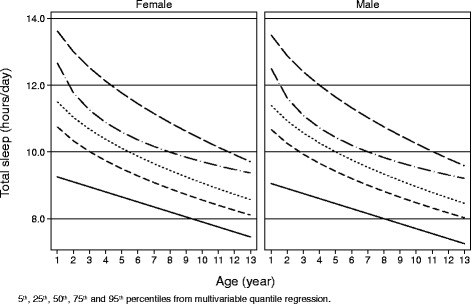
Total sleep duration and numbers of awakenings decreased with age. Only 66.9% of children had sleep duration in agreement with Recommendations (50% in 10-14 years group). Before sleeping 63.5% of children used video devices (39.6% at 1-3 years), 39.1% read, 27.5% drank and 19.5% ate. Bottle users at bedtime were 30.8% at 1-3 years, 16.6% at 3-5 years and 4.9% at 5-7 years. Overall, 23.4% of children changed sleeping place during the night, 22.4% referred sleeping problems in the first year of life. Video devices use was negative predictor of sleep duration (-0.25 h [95%CI:-0.35,-0.14], p < 0.001). Optimal sleep was inversely related with bedroom TV (OR 0.63 [0.50,0.79], p < 0.001), with sleeping disorders in the first year (OR 0.62 [0.48,0.80], p < 0.001)), with bottle use (OR 0.64 [0.44,0.94], p < 0.05) and posivively related with high mother's education level (OR 1.44 [1.11,1.88], p < 0.01).

CONCLUSIONS

About one third of 1 to 14 year Italian children sleep less than recommended, one half in teenage. Modifiable risk factors for sleep abnormalities such as video devices use, bedroom TV and bottle use should be target of preventive strategies for a correct sleep. Pediatricians should give priority to the identification of sleep disorders early in life.

摘要

背景

儿童和青少年时期的睡眠对身心健康至关重要;然而,多项研究报告称,这个年龄段的睡眠剥夺现象呈上升趋势。由于意大利近期缺乏流行病学研究,我们研究的目的是描述1至14岁意大利儿童的睡眠习惯和模式,并评估其与视频设备使用(电视、平板电脑、智能手机、个人电脑)以及儿童夜间活动的关系。

方法

2015年,72名家庭儿科医生通过一项名为“我们喜欢做梦”的横断面调查,对2030名1至14岁的健康儿童进行了结构化访谈。计算总睡眠时间,以2015年美国国家睡眠基金会的建议为参考。最佳睡眠者定义为整夜都睡在自己床上且无觉醒的儿童。进行多变量中位数回归以确定睡眠时间的预测因素,并进行多变量逻辑回归以确定最佳睡眠的预测因素。

结果

总睡眠时间和觉醒次数随年龄增长而减少。只有66.9%的儿童睡眠时间符合建议(10至14岁组为50%)。睡前,63.5%的儿童使用视频设备(1至3岁组为39.6%),39.1%的儿童阅读,27.5%的儿童喝东西,19.5%的儿童吃东西。1至3岁儿童睡前使用奶瓶的比例为30.8%,3至5岁为16.6%,5至7岁为4.9%。总体而言,23.4%的儿童夜间更换睡眠地点,22.4%的儿童表示在生命的第一年有睡眠问题。视频设备的使用是睡眠时间的负向预测因素(-0.25小时[95%置信区间:-0.35,-0.14],p<0.001)。最佳睡眠与卧室电视呈负相关(比值比0.63[0.50,0.79],p<0.001),与第一年的睡眠障碍呈负相关(比值比0.62[0.48,0.80],p<0.001),与使用奶瓶呈负相关(比值比0.64[0.44,0.94],p<0.05),与母亲的高教育水平呈正相关(比值比1.44[1.11,1.88],p<0.01)。

结论

1至14岁的意大利儿童中约有三分之一睡眠不足,青少年中这一比例为一半。视频设备使用、卧室电视和奶瓶使用等可改变的睡眠异常风险因素应成为正确睡眠预防策略的目标。儿科医生应优先在生命早期识别睡眠障碍。
https://cdn.ncbi.nlm.nih.gov/pmc/blobs/2d72/5347825/26ac62423871/13052_2016_324_Fig1_HTML.jpg

相似文献

1
Sleep habits and pattern in 1-14 years old children and relationship with video devices use and evening and night child activities.1至14岁儿童的睡眠习惯和模式及其与视频设备使用以及儿童傍晚和夜间活动的关系。
Ital J Pediatr. 2017 Jan 13;43(1):7. doi: 10.1186/s13052-016-0324-x.
2
Availability and night-time use of electronic entertainment and communication devices are associated with short sleep duration and obesity among Canadian children.加拿大儿童使用电子娱乐和通信设备的情况以及夜间使用情况与睡眠时间短和肥胖有关。
Pediatr Obes. 2013 Feb;8(1):42-51. doi: 10.1111/j.2047-6310.2012.00085.x. Epub 2012 Sep 7.
3
The use of entertainment and communication technologies before sleep could affect sleep and weight status: a population-based study among children.睡前使用娱乐和通信技术可能会影响睡眠和体重状况:一项基于人群的儿童研究。
Int J Behav Nutr Phys Act. 2017 Jul 19;14(1):97. doi: 10.1186/s12966-017-0547-2.
4
[The use of social media modifies teenagers' sleep-related behavior].社交媒体的使用改变青少年与睡眠相关的行为。
Encephale. 2018 Sep;44(4):321-328. doi: 10.1016/j.encep.2017.03.009. Epub 2017 Jun 8.
5
Children's Sleep Habits Questionnaire in Two Subpopulations from Cape Verde and Mozambique: Exploratory and Regression Analysis.佛得角和莫桑比克两个亚人群的儿童睡眠习惯问卷:探索性和回归分析
Acta Med Port. 2019 Oct 1;32(10):628-634. doi: 10.20344/amp.11841.
6
Television viewing and television in bedroom associated with overweight risk among low-income preschool children.观看电视及卧室里放置电视与低收入学龄前儿童超重风险有关。
Pediatrics. 2002 Jun;109(6):1028-35. doi: 10.1542/peds.109.6.1028.
7
Relationship between Sleep Habits and Nighttime Sleep among Healthy Preschool Children in Taiwan.台湾健康学龄前儿童睡眠习惯与夜间睡眠之间的关系
Ann Acad Med Singap. 2016 Dec;45(12):549-556.
8
[Analysis of parent-child sleeping and living habits related to later bedtimes in children].[与儿童晚睡相关的亲子睡眠及生活习惯分析]
Fukuoka Igaku Zasshi. 2012 Jan;103(1):12-23.
9
Sleep and new media usage in toddlers.幼儿的睡眠与新媒体使用。
Eur J Pediatr. 2019 Apr;178(4):483-490. doi: 10.1007/s00431-019-03318-7. Epub 2019 Jan 16.
10
National data showed that delayed sleep in six-year-old children was associated with excessive use of electronic devices at 12 years.国家数据显示,6 岁儿童睡眠推迟与 12 岁时过度使用电子设备有关。
Acta Paediatr. 2018 Aug;107(8):1439-1448. doi: 10.1111/apa.14255. Epub 2018 Feb 22.

引用本文的文献

1
Screen use in children - two sides of the coin: a critical narrative review.儿童使用屏幕——硬币的两面:一篇批判性叙述性综述
Dement Neuropsychol. 2025 Mar 17;19:e20240173. doi: 10.1590/1980-5764-DN-2024-0173. eCollection 2025.
2
How family sports behavior shapes adolescent sleep: mediating effects in causation.家庭体育行为如何塑造青少年睡眠:因果关系中的中介作用
Front Public Health. 2025 Jan 17;12:1518960. doi: 10.3389/fpubh.2024.1518960. eCollection 2024.
3
Behavioral and sociodemographic correlates of sleep duration among children in Samoa.

本文引用的文献

1
National Sleep Foundation's sleep time duration recommendations: methodology and results summary.美国国家睡眠基金会的睡眠时间建议:方法与结果总结
Sleep Health. 2015 Mar;1(1):40-43. doi: 10.1016/j.sleh.2014.12.010. Epub 2015 Jan 8.
2
Children and Adolescents and Digital Media.儿童、青少年与数字媒体。
Pediatrics. 2016 Nov;138(5). doi: 10.1542/peds.2016-2593.
3
Interactive vs passive screen time and nighttime sleep duration among school-aged children.学龄儿童的交互式与被动式屏幕使用时间及夜间睡眠时间
萨摩亚儿童睡眠时间的行为和社会人口学相关因素
Sleep Health. 2025 Feb;11(1):57-64. doi: 10.1016/j.sleh.2024.10.009. Epub 2025 Jan 1.
4
Association of digital media use with sleep habits in school children: A cross-sectional study.学龄儿童数字媒体使用与睡眠习惯的关联:一项横断面研究。
Sleep Med X. 2024 Jun 12;8:100117. doi: 10.1016/j.sleepx.2024.100117. eCollection 2024 Dec 15.
5
Daytime Sleepiness from Preschool Children's and Parents' Perspectives: Is There a Difference?从学龄前儿童及其父母的角度看日间嗜睡:有差异吗?
Children (Basel). 2024 May 8;11(5):568. doi: 10.3390/children11050568.
6
Evaluation of the association between excessive screen use, sleep patterns and behavioral and cognitive aspects in preschool population. A systematic review.学龄前儿童过度使用电子屏幕、睡眠模式与行为及认知方面之间关联的评估:一项系统综述。
Eur Child Adolesc Psychiatry. 2024 Dec;33(12):4097-4114. doi: 10.1007/s00787-024-02430-w. Epub 2024 Apr 2.
7
Change in screen time and overuse, and their association with psychological well-being among US-wide school-age children during the COVID-19 pandemic: analysis of the National Survey of Children's Health (NSCH) years 2018-21.新冠疫情期间美国学龄儿童的屏幕使用时间变化、过度使用及其与心理健康的关联:2018 - 2021年全国儿童健康调查(NSCH)分析
Child Adolesc Psychiatry Ment Health. 2024 Jan 13;18(1):9. doi: 10.1186/s13034-023-00688-7.
8
Excessive use of electronic devices among children and adolescents is associated with musculoskeletal symptoms, visual symptoms, psychosocial health, and quality of life: a cross-sectional study.儿童和青少年过度使用电子设备与肌肉骨骼症状、视觉症状、心理健康和生活质量有关:一项横断面研究。
Front Public Health. 2023 Jun 29;11:1178769. doi: 10.3389/fpubh.2023.1178769. eCollection 2023.
9
Sleep habits and sleep disorders in Italian children and adolescents: a cross-sectional survey.意大利儿童和青少年的睡眠习惯和睡眠障碍:一项横断面调查。
J Clin Sleep Med. 2023 Apr 1;19(4):659-672. doi: 10.5664/jcsm.10400.
10
Children talking about their sleep: a cross-sectional survey of differences by ethnicity and socioeconomic status in Aotearoa New Zealand primary schools.儿童自述睡眠:新西兰小学种族和社会经济地位差异的横断面调查。
J Clin Sleep Med. 2023 Jan 1;19(1):119-133. doi: 10.5664/jcsm.10264.
Sleep Health. 2015 Sep;1(3):191-196. doi: 10.1016/j.sleh.2015.06.007.
4
Duration of sleep at 3 years of age is associated with fat and fat-free mass at 4 years of age: the Southampton Women's Survey.3岁时的睡眠时间与4岁时的脂肪量和去脂体重相关:南安普敦妇女调查。
J Sleep Res. 2016 Aug;25(4):412-8. doi: 10.1111/jsr.12389. Epub 2016 Feb 23.
5
[Multi-center study on the effects of television viewing on sleep quality among children under 4 years of age in China].[中国4岁以下儿童看电视对睡眠质量影响的多中心研究]
Zhonghua Er Ke Za Zhi. 2015 Dec;53(12):907-12.
6
Sleep characteristics and cardiovascular risk in children and adolescents: an enumerative review.儿童和青少年的睡眠特征与心血管风险:一项枚举性综述。
Sleep Med. 2016 Feb;18:36-49. doi: 10.1016/j.sleep.2015.06.004. Epub 2015 Jun 23.
7
Impact of television on the quality of sleep in preschool children.电视对学龄前儿童睡眠质量的影响。
Sleep Med. 2016 Apr;20:140-4. doi: 10.1016/j.sleep.2015.06.005. Epub 2015 Jun 25.
8
Technology Use and Sleep Quality in Preadolescence and Adolescence.青春期前及青春期的科技使用与睡眠质量
J Clin Sleep Med. 2015 Dec 15;11(12):1433-41. doi: 10.5664/jcsm.5282.
9
Longitudinal study of sleep behavior in normal infants during the first year of life.对正常婴儿出生后第一年睡眠行为的纵向研究。
J Clin Sleep Med. 2014 Oct 15;10(10):1119-27. doi: 10.5664/jcsm.4114.
10
Television viewing, bedroom television, and sleep duration from infancy to mid-childhood.从婴儿期到童年中期的电视观看、卧室电视与睡眠时间
Pediatrics. 2014 May;133(5):e1163-71. doi: 10.1542/peds.2013-3998. Epub 2014 Apr 14.