Hicks Olivia, Burthe Sarah, Daunt Francis, Butler Adam, Bishop Charles, Green Jonathan A
Department of Earth, Ocean and Ecological Sciences, School of Environmental Sciences, University of Liverpool, Liverpool L69 3GP, UK
Centre for Ecology & Hydrology, Bush Estate, Penicuik, Midlothian EH26 0QB, UK.
J Exp Biol. 2017 May 15;220(Pt 10):1875-1881. doi: 10.1242/jeb.152710. Epub 2017 Mar 3.
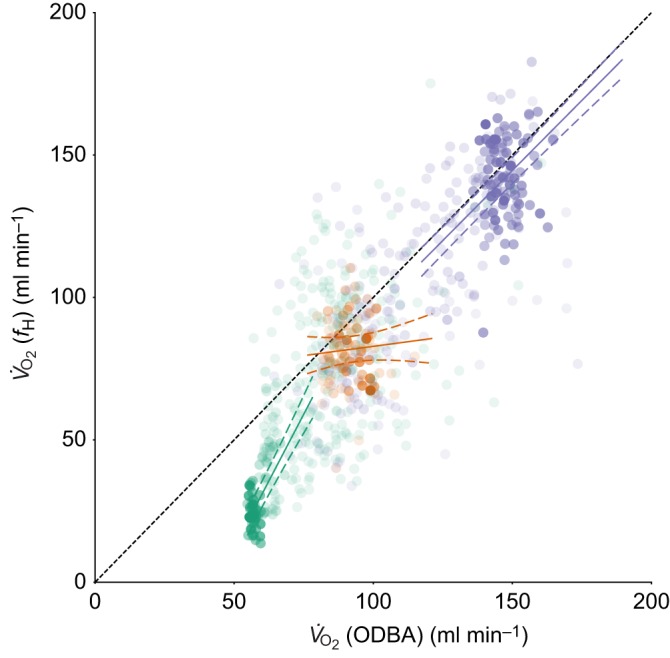
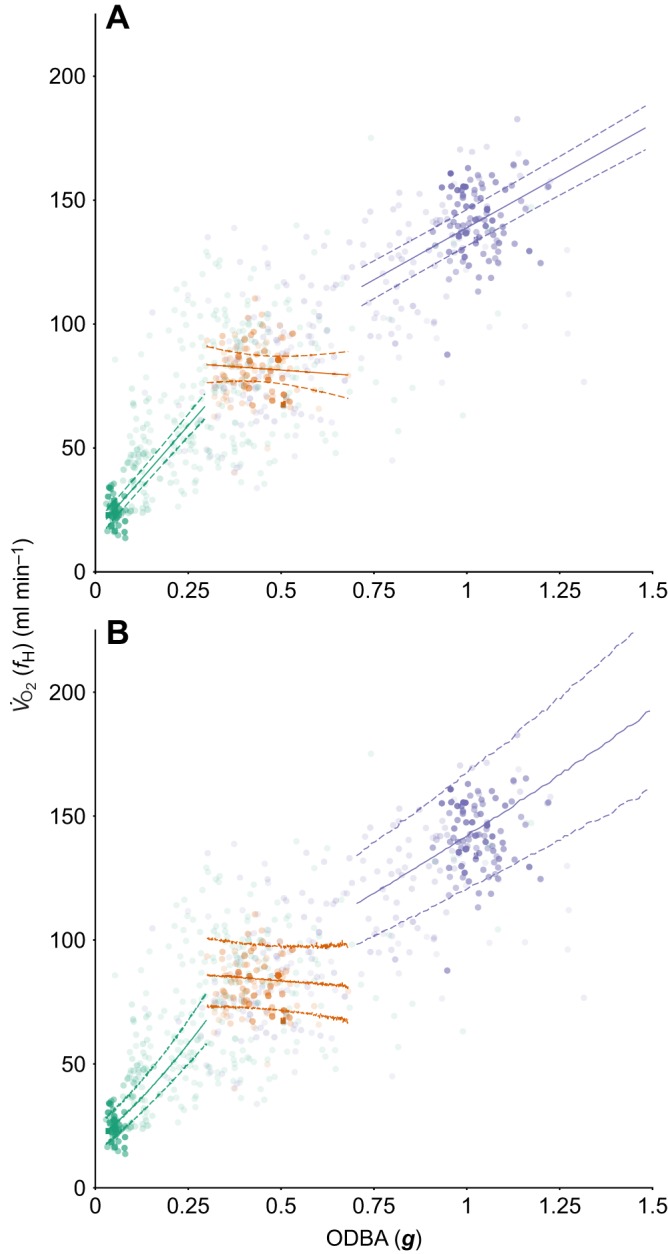
Two main techniques have dominated the field of ecological energetics: the heart rate and doubly labelled water methods. Although well established, they are not without their weaknesses, namely expense, intrusiveness and lack of temporal resolution. A new technique has been developed using accelerometers; it uses the overall dynamic body acceleration (ODBA) of an animal as a calibrated proxy for energy expenditure. This method provides high-resolution data without the need for surgery. Significant relationships exist between the rate of oxygen consumption ( ) and ODBA in controlled conditions across a number of taxa; however, it is not known whether ODBA represents a robust proxy for energy expenditure consistently in all natural behaviours and there have been specific questions over its validity during diving, in diving endotherms. Here, we simultaneously deployed accelerometers and heart rate loggers in a wild population of European shags (). Existing calibration relationships were then used to make behaviour-specific estimates of energy expenditure for each of these two techniques. Compared with heart rate-derived estimates, the ODBA method predicts energy expenditure well during flight and diving behaviour, but overestimates the cost of resting behaviour. We then combined these two datasets to generate a new calibration relationship between ODBA and that accounts for this by being informed by heart rate-derived estimates. Across behaviours we found a good relationship between ODBA and Within individual behaviours, we found useable relationships between ODBA and for flight and resting, and a poor relationship during diving. The error associated with these new calibration relationships mostly originates from the previous heart rate calibration rather than the error associated with the ODBA method. The equations provide tools for understanding how energy constrains ecology across the complex behaviour of free-living diving birds.
心率法和双标记水法。尽管它们已被广泛应用,但并非没有缺点,即成本高、具有侵入性且缺乏时间分辨率。一种使用加速度计的新技术已经开发出来;它将动物的整体动态身体加速度(ODBA)用作能量消耗的校准替代指标。这种方法无需手术即可提供高分辨率数据。在许多分类群的受控条件下,氧气消耗率( )与ODBA之间存在显著关系;然而,尚不清楚ODBA在所有自然行为中是否始终是能量消耗的可靠替代指标,并且在潜水恒温动物潜水期间其有效性存在特定问题。在这里,我们在欧洲鸬鹚的野生种群中同时部署了加速度计和心率记录器( )。然后利用现有的校准关系对这两种技术中的每一种进行特定行为的能量消耗估计。与基于心率的估计相比,ODBA方法在飞行和潜水行为期间能很好地预测能量消耗,但高估了休息行为的成本。然后我们将这两个数据集结合起来,生成了一个ODBA与 的新校准关系,该关系通过基于心率的估计来考虑这一点。在所有行为中,我们发现ODBA与 之间存在良好关系。在个体行为中,我们发现ODBA与 在飞行和休息时存在可用关系,而在潜水时关系较差。与这些新校准关系相关的误差大多源于先前的心率校准,而非与ODBA方法相关的误差。这些方程为理解能量如何在自由生活的潜水鸟类的复杂行为中限制生态提供了工具。