Li Ming, Li Shanhu, Liu Biao, Gu Meng-Meng, Zou Shitao, Xiao Bei-Bei, Yu Lan, Ding Wei-Qun, Zhou Ping-Kun, Zhou Jundong, Shang Zeng-Fu
School of Radiation Medicine and Protection, Medical College of Soochow University, Collaborative Innovation Center of Radiation Medicine of Jiangsu Higher Education Institutions, Suzhou, Jiangsu, 215123, People's Republic of China.
Laboratory of Medical Molecular Biology, Beijing Institute of Biotechnology, Beijing, 100850, People's Republic of China.
J Exp Clin Cancer Res. 2017 Mar 4;36(1):39. doi: 10.1186/s13046-017-0508-2.
Non-small cell lung cancer (NSCLC) is the most commonly diagnosed type of lung cancer that is associated with poor prognosis. In this study we explored the potential role of p53-induced gene 3 (PIG3) in the progression of NSCLC.
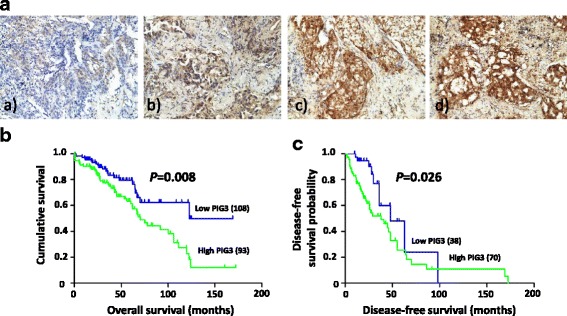
Immunohistochemistry was used to determine the expression levels of PIG3 in 201 NSCLC patients. We performed in vitro studies and silenced endogenous PIG3 by using specific siRNAs that specific target PIG3. Immunofluorescent staining was performed to determine the effect of PIG3 on mitotic progression in NSCLC cells. The growth rates of microtubules were determined by microtubule nucleation analysis. Cell proliferation and chemosensitivity were analyzed by CCK8 assays. Annexin V staining and β-galactosidase activity analysis were used to evaluate PIG3 deficiency-related apoptosis and senescence, respectively.
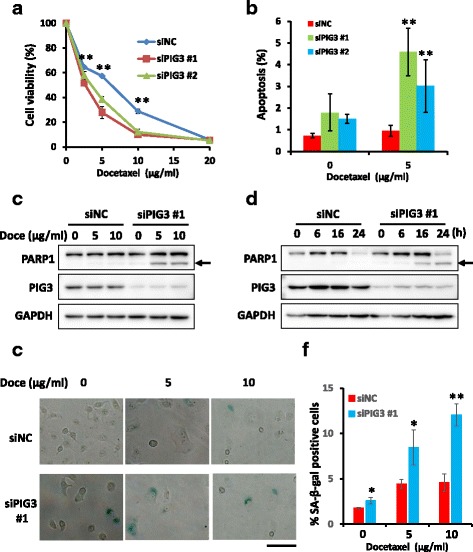
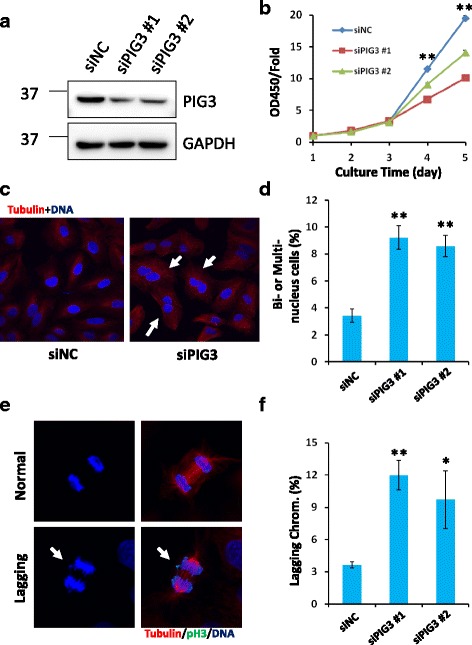
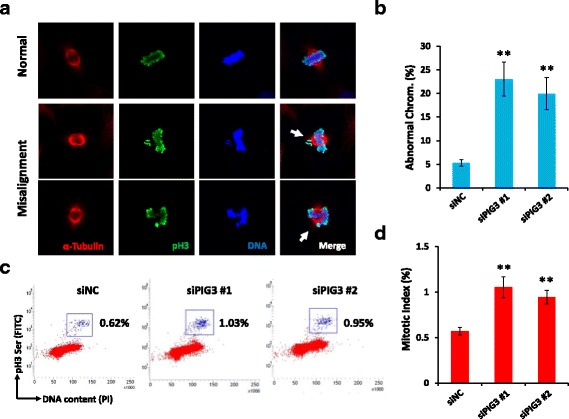
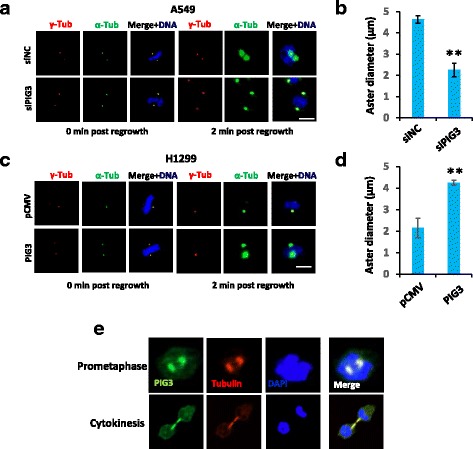
PIG3 expression levels negatively correlated with overall survival and disease-free survival of NSCLC patients. Knock down of PIG3 resulted in repressed proliferation of NSCLC cells and increased aberrant mitosis, which included misaligning and lagging chromosomes, and bi- or multi-nucleated giant cells. In addition, PIG3 contributed to mitotic spindle assembly by promoting microtubule growth. Furthermore, loss of PIG3 sensitized NSCLC cells to docetaxel by enhancing docetaxel-induced apoptosis and senescence.
Our results indicate that PIG3 promotes NSCLC progression and therefore suggest that PIG3 may be a potential prognostic biomarker and novel therapeutic target for the treatment of NSCLC.
非小细胞肺癌(NSCLC)是最常见的肺癌诊断类型,其预后较差。在本研究中,我们探讨了p53诱导基因3(PIG3)在NSCLC进展中的潜在作用。
采用免疫组织化学法检测201例NSCLC患者中PIG3的表达水平。我们进行了体外研究,使用特异性靶向PIG3的小干扰RNA(siRNA)沉默内源性PIG3。进行免疫荧光染色以确定PIG3对NSCLC细胞有丝分裂进程的影响。通过微管成核分析确定微管的生长速率。采用CCK8法分析细胞增殖和化学敏感性。分别用膜联蛋白V染色和β-半乳糖苷酶活性分析评估PIG3缺乏相关的凋亡和衰老。
PIG3表达水平与NSCLC患者的总生存期和无病生存期呈负相关。敲低PIG3导致NSCLC细胞增殖受抑,异常有丝分裂增加,包括染色体排列紊乱和滞后,以及双核或多核巨细胞。此外,PIG3通过促进微管生长有助于有丝分裂纺锤体组装。此外,PIG3的缺失通过增强多西他赛诱导的凋亡和衰老使NSCLC细胞对多西他赛敏感。
我们的结果表明PIG3促进NSCLC进展,因此提示PIG3可能是NSCLC治疗的潜在预后生物标志物和新型治疗靶点。