Ramezani Mahboobeh, Shamsabadi Fatemeh T, Shahbazi Majid
Department of Genetics, School of Advanced Technologies in Medicine, Golestan University of Medical Sciences, Gorgan, Iran.
Medical Cellular & Molecular Research Center, Golestan University of Medical Sciences, Gorgan, Iran.
Heliyon. 2024 Jul 10;10(14):e34075. doi: 10.1016/j.heliyon.2024.e34075. eCollection 2024 Jul 30.
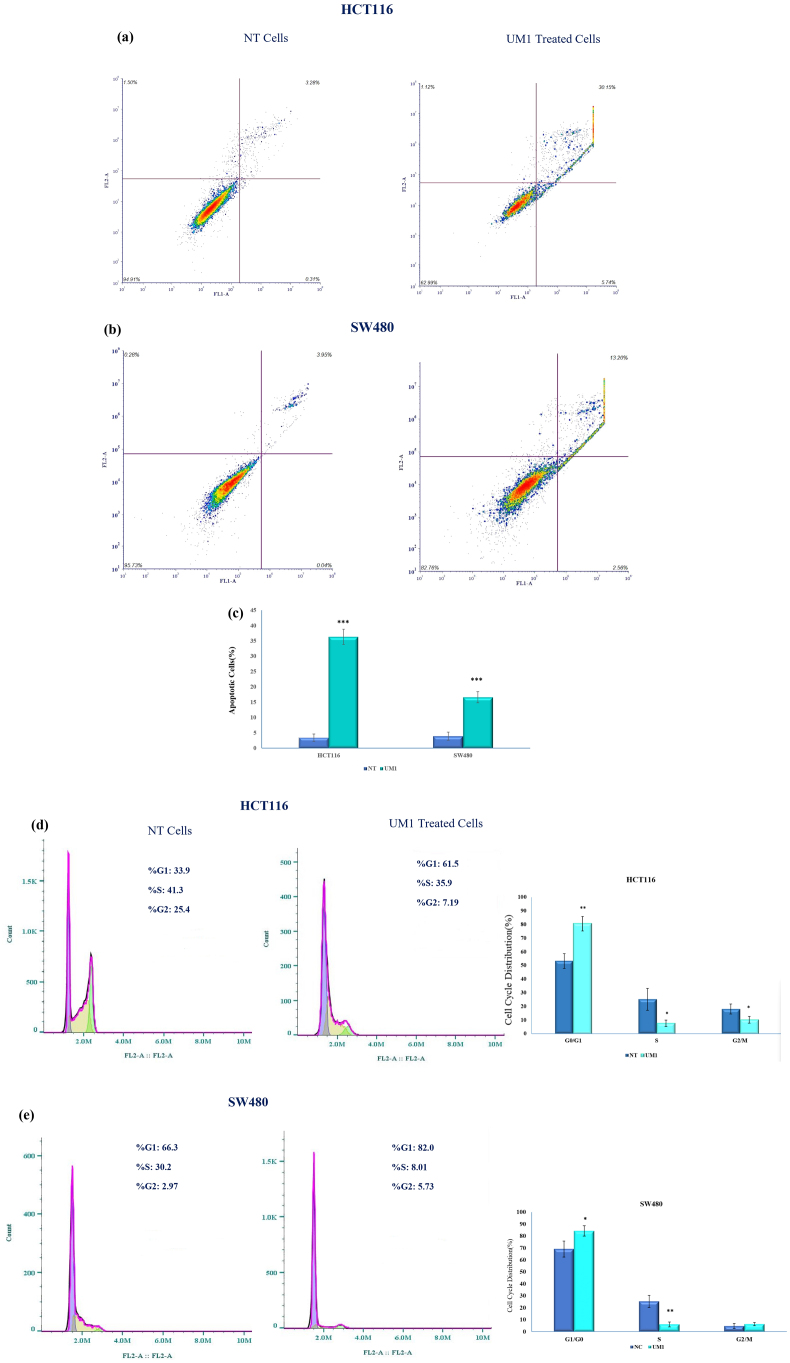
Dysregulation of long noncoding RNAs (lncRNAs), such as maternally expressed gene 3 (MEG3) and long intergenic noncoding RNA regulator of reprogramming (linc-ROR), plays a crucial role in colorectal cancer progression. We aimed to assess linc-ROR silencing and MEG3 activation on the colorectal cancer cell proliferation simultaneously; and explore the underlying mechanisms in the TP53-associated Pathway. The MEG3 and linc-ROR shRNA were cloned under the bidirectional CEA promoter (UM1). Subsequently, additional vectors were constructed to express linc-ROR shRNA (UM2) and MEG3 (UM3). After transfecting colorectal cancer cell lines with these recombinant vectors, experiments on cell viability, apoptosis, and cell cycle analysis were conducted. Furthermore, TP53's transcriptional activity and associated genes were assessed using quantitative real-time polymerase chain reaction (qRT-PCR). Interestingly, UM1 significantly inhibited the proliferation of both cell lines than UM2 and UM3. In response to UM1, TP53 transcript remarkably increased in HCT116 cells (10.46) than SW480 cells (6.16); which resulted in up-regulation of TP53INP1, TP53I3, GDF15, CCKN1A and BAX, and down-regulation of G1 cyclins (D1, E1). The rate of apoptosis increased in HCT116 (36.35 %) and SW480 (16.64 %) cells than control. Moreover, UM1-transfected HCT116 cells exhibited a notable arrest in the G0/G1 phase, accompanied by a reduction in the G2/M cell population. Compared to unidirectional vectors, the concurrent targeting approach enhanced TP53 activation at the transcription level. The cell response to UM1 resulted in rapid upregulation of TP53, leading to inhibition of cell proliferation, increased apoptosis, and cell cycle arrest. These findings suggest that the synergistic effect of targeting both MEG3 and linc-ROR could serve as a promising therapeutic strategy for TP53-associated colon cancer.
长链非编码RNA(lncRNA)的失调,如母系表达基因3(MEG3)和重编程长链基因间非编码RNA调节因子(linc-ROR),在结直肠癌进展中起关键作用。我们旨在同时评估linc-ROR沉默和MEG3激活对结直肠癌细胞增殖的影响;并探索TP53相关通路中的潜在机制。将MEG3和linc-ROR的短发夹RNA(shRNA)克隆到双向癌胚抗原(CEA)启动子(UM1)下。随后,构建额外的载体来表达linc-ROR shRNA(UM2)和MEG3(UM3)。用这些重组载体转染结直肠癌细胞系后,进行细胞活力、凋亡及细胞周期分析实验。此外,使用定量实时聚合酶链反应(qRT-PCR)评估TP53的转录活性及相关基因。有趣的是,与UM2和UM3相比,UM1显著抑制了两种细胞系的增殖。对于UM1的反应,HCT116细胞中TP53转录本(10.46)比SW480细胞(6.16)显著增加;这导致TP53INP1、TP53I3、生长分化因子15(GDF15)、细胞周期蛋白依赖性激酶抑制因子1A(CCKN1A)和凋亡蛋白(BAX)上调,以及G1期细胞周期蛋白(D1、E1)下调。与对照相比,HCT116(36.35%)和SW480(16.64%)细胞的凋亡率增加。此外,UM1转染的HCT116细胞在G0/G1期出现明显停滞,同时G2/M期细胞群体减少。与单向载体相比,同时靶向的方法在转录水平增强了TP53的激活。细胞对UM1的反应导致TP53迅速上调,从而抑制细胞增殖、增加凋亡并使细胞周期停滞。这些发现表明,同时靶向MEG3和linc-ROR的协同效应可能是TP53相关结肠癌的一种有前景的治疗策略。