
益生菌对2,4,6-三硝基苯磺酸诱导的溃疡性结肠炎大鼠 Toll 样受体表达的影响。
Effects of probiotics on Toll‑like receptor expression in ulcerative colitis rats induced by 2,4,6‑trinitro‑benzene sulfonic acid.
作者信息
Yao Ping, Tan Fang, Gao Hongliang, Wang Lei, Yang Tao, Cheng Yongbo
机构信息
Department of Gastroenterology, The First Affiliated Hospital of Xinjiang Medical University, Urumqi, Xinjiang 830054, P.R. China.
出版信息
Mol Med Rep. 2017 Apr;15(4):1973-1980. doi: 10.3892/mmr.2017.6226. Epub 2017 Feb 21.
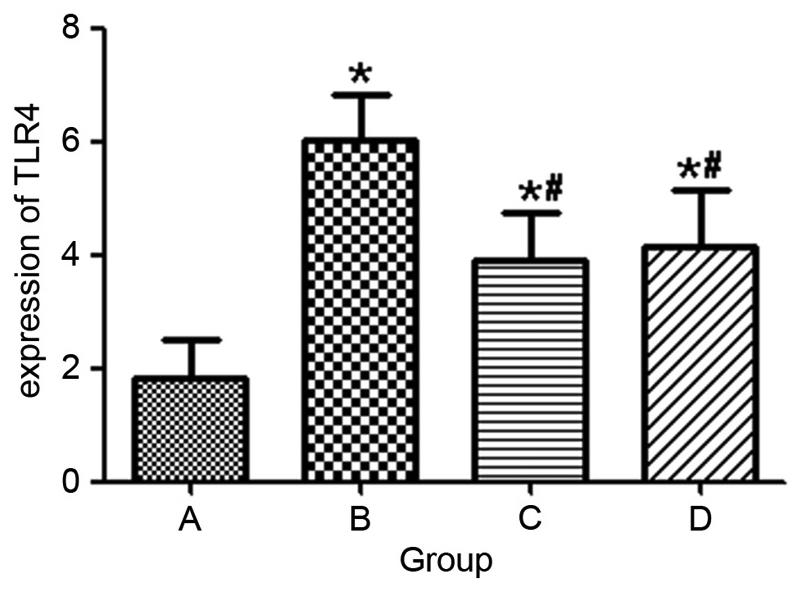
The present study aimed to investigate the regulatory effect of probiotics on the expression of Toll‑like receptors (TLRs) in an ulcerative colitis (UC) rat model, and to determine the role of probiotics in the underlying mechanisms through which UC develops and progresses in rat models. Rats were randomly allocated to one of the four following groups: i) The healthy control, ii) the model, iii) the Golden bifid treatment group, and iv) the TLR4 monoclonal antibody (TLR4mAb) intervention group. The UC rat model was established using 2,4,6‑trinitro‑benzene sulfonic acid. The general status and histological changes of rats were scored using the disease activity index and the histopathological scoring method, respectively. In these rats, the expression of TLR4 and TLR2 was measured using reverse transcription‑quantitative polymerase chain reaction. The expression of TLR4 and TLR2 in the model group was significantly higher than that in the healthy control group. However, when compared with the model rats, those that received either Golden bifid treatment or TLR4mAb intervention exhibited significantly decreased mRNA expression levels of TLR4 and TLR2 (P<0.05). The development of UC is characterized by an abnormal immune response in the intestines. Probiotics alleviated inflammatory reactions in rats with UC. The underlying mechanism of UC may be associated with the expression of TLRs and the subsequent release of inflammatory cytokines.
本研究旨在探讨益生菌对溃疡性结肠炎(UC)大鼠模型中Toll样受体(TLRs)表达的调节作用,并确定益生菌在UC大鼠模型发生和发展的潜在机制中的作用。将大鼠随机分为以下四组之一:i)健康对照组,ii)模型组,iii)金双歧治疗组,iv)TLR4单克隆抗体(TLR4mAb)干预组。使用2,4,6-三硝基苯磺酸建立UC大鼠模型。分别采用疾病活动指数和组织病理学评分方法对大鼠的一般状态和组织学变化进行评分。在这些大鼠中,使用逆转录-定量聚合酶链反应测量TLR4和TLR2的表达。模型组中TLR4和TLR2的表达明显高于健康对照组。然而,与模型大鼠相比,接受金双歧治疗或TLR4mAb干预的大鼠TLR4和TLR2的mRNA表达水平明显降低(P<0.05)。UC的发展以肠道异常免疫反应为特征。益生菌减轻了UC大鼠的炎症反应。UC的潜在机制可能与TLRs的表达及随后炎性细胞因子的释放有关。


 Zotero 插件