Nikitin Evgeny S, Bal Natalia V, Malyshev Aleksey, Ierusalimsky Victor N, Spivak Yulia, Balaban Pavel M, Volgushev Maxim
Institute of Higher Nervous Activity and Neurophysiology, Russian Academy of Sciences Moscow, Russia.
Institute of Higher Nervous Activity and Neurophysiology, Russian Academy of SciencesMoscow, Russia; Department of Psychological Sciences, University of ConnecticutStorrs, CT, USA.
Front Cell Neurosci. 2017 Feb 14;11:28. doi: 10.3389/fncel.2017.00028. eCollection 2017.
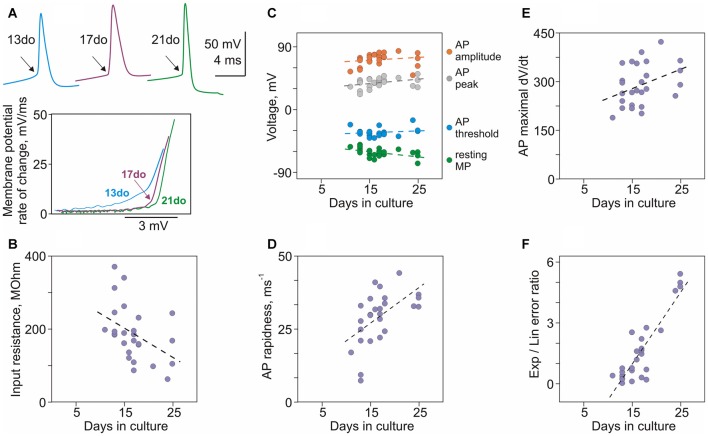
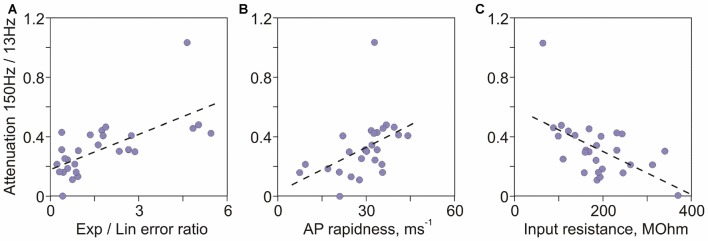
The ability of neocortical neurons to detect and encode rapid changes at their inputs is crucial for basic neuronal computations, such as coincidence detection, precise synchronization of activity and spike-timing dependent plasticity. Indeed, populations of cortical neurons can respond to subtle changes of the input very fast, on a millisecond time scale. Theoretical studies and model simulations linked the encoding abilities of neuronal populations to the fast onset dynamics of action potentials (APs). Experimental results support this idea, however mechanisms of fast onset of APs in cortical neurons remain elusive. Studies in neuronal cultures, that are allowing for accurate control over conditions of growth and microenvironment during the development of neurons and provide better access to the spike initiation zone, may help to shed light on mechanisms of AP generation and encoding. Here we characterize properties of AP encoding in neocortical neurons grown for 11-25 days in culture. We show that encoding of high frequencies improves upon culture maturation, which is accompanied by the development of passive electrophysiological properties and AP generation. The onset of APs becomes faster with culture maturation. Statistical analysis using correlations and linear model approaches identified the onset dynamics of APs as a major predictor of age-dependent changes of encoding. Encoding of high frequencies strongly correlated also with the input resistance of neurons. Finally, we show that maturation of encoding properties of neurons in cultures is similar to the maturation of encoding in neurons studied in slices. These results show that maturation of AP generators and encoding is, to a large extent, determined genetically and takes place even without normal micro-environment and activity of the whole brain . This establishes neuronal cultures as a valid experimental model for studying mechanisms of AP generation and encoding, and their maturation.
新皮质神经元检测并编码其输入处快速变化的能力对于基本的神经元计算至关重要,比如巧合检测、活动的精确同步以及动作电位时间依赖的可塑性。实际上,皮质神经元群体能够在毫秒时间尺度上非常快速地对输入的细微变化做出反应。理论研究和模型模拟将神经元群体的编码能力与动作电位(AP)的快速起始动力学联系起来。实验结果支持了这一观点,然而皮质神经元中AP快速起始的机制仍然难以捉摸。在神经元培养物中的研究,能够在神经元发育过程中对生长条件和微环境进行精确控制,并能更好地接触到动作电位起始区,这可能有助于阐明AP产生和编码的机制。在这里,我们描述了在培养11 - 25天的新皮质神经元中AP编码的特性。我们表明,随着培养成熟,高频编码得到改善,这伴随着被动电生理特性和AP产生的发展。随着培养成熟,AP的起始变得更快。使用相关性和线性模型方法的统计分析确定AP的起始动力学是编码随年龄变化的主要预测指标。高频编码也与神经元的输入电阻密切相关。最后,我们表明培养物中神经元编码特性的成熟与切片中研究的神经元编码成熟相似。这些结果表明,AP发生器和编码的成熟在很大程度上是由基因决定的,即使在没有正常微环境和全脑活动的情况下也会发生。这确立了神经元培养物作为研究AP产生、编码及其成熟机制的有效实验模型。