Makino Misato, Takami Akiyoshi, Oda Atsushi
Hirosaki University Graduate School of Health Sciences: 66-1 Honcho, Hirosaki-shi, Aomori 036-8564, Japan.
J Phys Ther Sci. 2017 Feb;29(2):187-190. doi: 10.1589/jpts.29.187. Epub 2017 Feb 24.
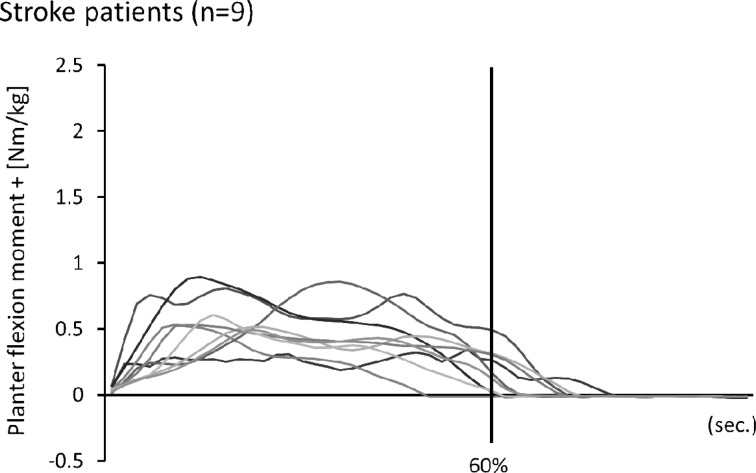
[Purpose] To investigate the features of backward walking in stroke patients with hemiplegia by focusing on the joint movements and moments of the paretic side, walking speed, stride length, and cadence. [Subjects and Methods] Nine stroke patients performed forward walking and backward walking along a 5-m walkway. Walking speed and stride length were self-selected. Movements were measured using a three-dimensional motion analysis system and a force plate. One walking cycle of the paretic side was analyzed. [Results] Walking speed, stride length, and cadence were significantly lower in backward walking than in forward walking. Peak hip extension was significantly lower in backward walking and peak hip flexion moment, knee extension moment, and ankle dorsiflexion and plantar flexion moments were lower in backward walking. [Conclusion] Unlike forward walking, backward walking requires conscious hip joint extension. Conscious extension of the hip joint is hard for stroke patients with hemiplegia. Therefore, the range of hip joint movement declined in backward walking, and walking speed and stride length also declined. The peak ankle plantar flexion moment was significantly lower in backward walking than in forward walking, and it was hard to generate propulsion power in backward walking. These difficulties also affected the walking speed.
[目的] 通过关注偏瘫中风患者患侧的关节运动和力矩、步行速度、步长及步频,研究其向后行走的特征。[对象与方法] 9名中风患者沿着一条5米长的通道进行向前和向后行走。步行速度和步长为自行选择。使用三维运动分析系统和测力板测量运动。对患侧的一个步行周期进行分析。[结果] 向后行走时的步行速度、步长和步频显著低于向前行走。向后行走时髋关节伸展峰值显著降低,髋关节屈曲力矩峰值、膝关节伸展力矩以及踝关节背屈和跖屈力矩在向后行走时较低。[结论] 与向前行走不同,向后行走需要有意识地伸展髋关节。对于偏瘫中风患者来说,有意识地伸展髋关节很困难。因此,向后行走时髋关节运动范围减小,步行速度和步长也降低。向后行走时踝关节跖屈力矩峰值显著低于向前行走,向后行走时难以产生推进力。这些困难也影响了步行速度。