Giambartolomei Guillermo H, Arriola Benitez Paula C, Delpino M Victoria
Instituto de Inmunología, Genética y Metabolismo - Consejo Nacional de Investigaciones Cientificas y Tecnicas - Universidad de Buenos Aires Buenos Aires, Argentina.
Front Microbiol. 2017 Feb 20;8:256. doi: 10.3389/fmicb.2017.00256. eCollection 2017.
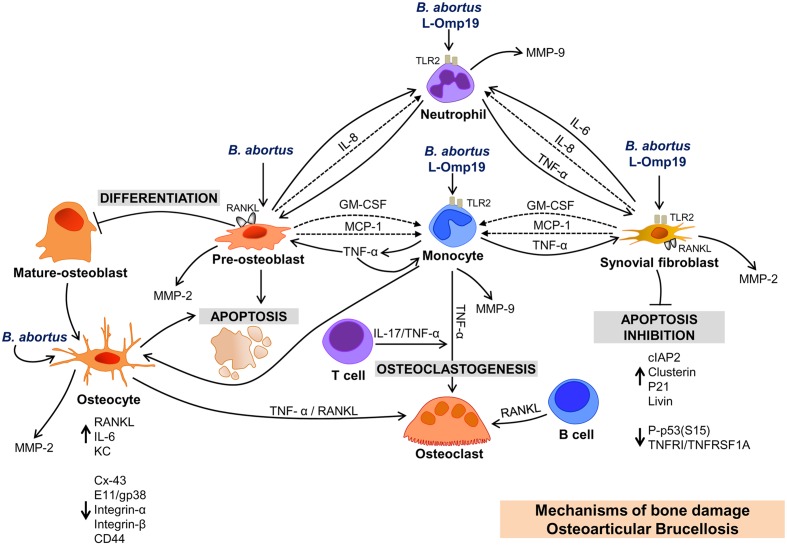
Osteoarticular brucellosis is the most common presentation of human active disease although its prevalence varies widely. The three most common forms of osteoarticular involvement are sacroiliitis, spondylitis, and peripheral arthritis. The molecular mechanisms implicated in bone damage have been recently elucidated. induces bone damage through diverse mechanisms in which TNF-α and the receptor activator of nuclear factor kappa-B ligand (RANKL)-the natural modulator of bone homeostasis are involved. These processes are driven by inflammatory cells, like monocytes/macrophages, neutrophils, Th17 CD4 T, and B cells. In addition, has a direct effect on osteoarticular cells and tilts homeostatic bone remodeling. These bacteria inhibit bone matrix deposition by osteoblasts (the only bone cells involved in bone deposition), and modify the phenotype of these cells to produce matrix metalloproteinases (MMPs) and cytokine secretion, contributing to bone matrix degradation. also affects osteoclasts (cells naturally involved in bone resorption) by inducing an increase in osteoclastogenesis and osteoclast activation; thus, increasing mineral and organic bone matrix resorption, contributing to bone damage. Given that the pathology induced by species involved joint tissue, experiments conducted on synoviocytes revealed that besides inducing the activation of these cells to secrete chemokines, proinflammatory cytokines and MMPS, the infection also inhibits synoviocyte apoptosis. is an intracellular bacterium that replicates preferentially in the endoplasmic reticulum of macrophages. The analysis of -infected synoviocytes indicated that bacteria also replicate in their reticulum suggesting that they could use this cell type for intracellular replication during the osteoarticular localization of the disease. Finally, the molecular mechanisms of osteoarticular brucellosis discovered recently shed light on how the interaction between and immune and osteoarticular cells may play an important role in producing damage in joint and bone.
骨关节布鲁氏菌病是人类活动性疾病最常见的表现形式,尽管其患病率差异很大。骨关节受累的三种最常见形式是骶髂关节炎、脊柱炎和外周关节炎。最近已经阐明了与骨损伤相关的分子机制。布鲁氏菌通过多种机制导致骨损伤,其中涉及肿瘤坏死因子-α(TNF-α)和核因子κB受体激活剂配体(RANKL,骨稳态的天然调节剂)。这些过程由炎症细胞驱动,如单核细胞/巨噬细胞、中性粒细胞、Th17 CD4 T细胞和B细胞。此外,布鲁氏菌对骨关节细胞有直接影响,并破坏骨稳态重塑。这些细菌抑制成骨细胞(唯一参与骨沉积的骨细胞)的骨基质沉积,并改变这些细胞的表型以产生基质金属蛋白酶(MMPs)和细胞因子分泌,从而导致骨基质降解。布鲁氏菌还通过诱导破骨细胞生成增加和破骨细胞激活来影响破骨细胞(天然参与骨吸收的细胞);因此,增加矿物质和有机骨基质的吸收,导致骨损伤。鉴于布鲁氏菌属物种引起的病理涉及关节组织,对滑膜细胞进行的实验表明,除了诱导这些细胞激活以分泌趋化因子、促炎细胞因子和MMPs外,感染还抑制滑膜细胞凋亡。布鲁氏菌是一种细胞内细菌,优先在巨噬细胞的内质网中复制。对感染布鲁氏菌的滑膜细胞的分析表明,细菌也在其内质网中复制,这表明在疾病的骨关节定位过程中,它们可能利用这种细胞类型进行细胞内复制。最后,最近发现的骨关节布鲁氏菌病的分子机制揭示了布鲁氏菌与免疫细胞和骨关节细胞之间的相互作用如何在关节和骨骼损伤中发挥重要作用。