National Center for Global Health and Medicine, Bureau of International Health Cooperation, Department of Epidemiology and Prevention, Shinjuku-ku, 162-8655, Japan.
Teikyo University Graduate School of Public Health, Itabashi-ku, 173-8605, Japan.
Sci Rep. 2017 Mar 7;7:43521. doi: 10.1038/srep43521.
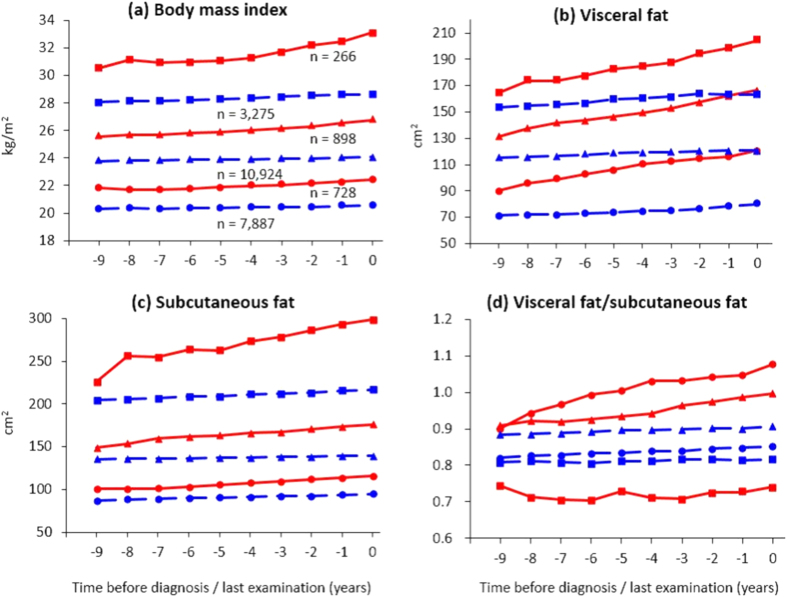
We investigated BMI trajectory patterns before diabetes diagnosis and examined associated changes in visceral adiposity and glucose metabolism. 23,978 non-diabetic Japanese participants (2,789 women) aged 30-64 years were assessed with a mean follow-up of 7.6 years. Diabetes was diagnosed via fasting glucose, HbA, and self-report. Latent-class trajectory analyses were performed to identify BMI trajectories. Longitudinal changes in BMI, visceral adiposity, and glucose metabolism were estimated using mixed models. 1,892 individuals developed diabetes. Three distinct BMI trajectories were identified in adults developing and not developing diabetes, respectively. Among adults developing diabetes, 47.3% were classified as "medium BMI" (n = 895), and had increased mean BMI within the obesity category before diagnosis. The "low BMI" group (38.4%, n = 726) had an initial mean BMI of 21.9 kg/m, and demonstrated small weight gain. The "high BMI" group (n = 271) were severely obese and showed greater increase in BMI until diagnosis. All groups which developed diabetes showed absolute and/or relative increase in visceral fat and impaired β-cell compensation for insulin resistance. All groups not developing diabetes showed measured variables were relatively stable during observation. These data suggest that visceral fat gain may induce β-cell failure in compensation for insulin resistance, resulting in diabetes regardless of obesity level.
我们研究了糖尿病诊断前的 BMI 轨迹模式,并检查了内脏脂肪和葡萄糖代谢的相关变化。23978 名非糖尿病的日本参与者(2789 名女性)年龄在 30-64 岁之间,平均随访 7.6 年。糖尿病通过空腹血糖、HbA 和自我报告进行诊断。使用潜在类别轨迹分析来识别 BMI 轨迹。使用混合模型估计 BMI、内脏脂肪和葡萄糖代谢的纵向变化。1892 人患有糖尿病。在患有和不患有糖尿病的成年人中分别确定了三种不同的 BMI 轨迹。在患有糖尿病的成年人中,47.3%被归类为“中等 BMI”(n=895),在诊断前肥胖类别内 BMI 均值增加。“低 BMI”组(38.4%,n=726)的初始平均 BMI 为 21.9kg/m,体重略有增加。“高 BMI”组(n=271)为严重肥胖,在诊断前 BMI 增加更大。所有患有糖尿病的组均表现出内脏脂肪的绝对和/或相对增加以及β细胞对胰岛素抵抗的补偿受损。所有未患糖尿病的组在观察期间表现出测量变量相对稳定。这些数据表明,内脏脂肪增加可能导致β细胞衰竭以补偿胰岛素抵抗,从而导致糖尿病,无论肥胖程度如何。