Nagy Reka, Boutin Thibaud S, Marten Jonathan, Huffman Jennifer E, Kerr Shona M, Campbell Archie, Evenden Louise, Gibson Jude, Amador Carmen, Howard David M, Navarro Pau, Morris Andrew, Deary Ian J, Hocking Lynne J, Padmanabhan Sandosh, Smith Blair H, Joshi Peter, Wilson James F, Hastie Nicholas D, Wright Alan F, McIntosh Andrew M, Porteous David J, Haley Chris S, Vitart Veronique, Hayward Caroline
MRC Human Genetics Unit, University of Edinburgh, Institute of Genetics and Molecular Medicine, Western General Hospital, Crewe Road, Edinburgh, EH4 2XU, UK.
Centre for Genomic and Experimental Medicine, University of Edinburgh, Institute of Genetics and Molecular Medicine, Western General Hospital, Edinburgh, UK.
Genome Med. 2017 Mar 7;9(1):23. doi: 10.1186/s13073-017-0414-4.
The Generation Scotland: Scottish Family Health Study (GS:SFHS) is a family-based population cohort with DNA, biological samples, socio-demographic, psychological and clinical data from approximately 24,000 adult volunteers across Scotland. Although data collection was cross-sectional, GS:SFHS became a prospective cohort due to of the ability to link to routine Electronic Health Record (EHR) data. Over 20,000 participants were selected for genotyping using a large genome-wide array.
GS:SFHS was analysed using genome-wide association studies (GWAS) to test the effects of a large spectrum of variants, imputed using the Haplotype Research Consortium (HRC) dataset, on medically relevant traits measured directly or obtained from EHRs. The HRC dataset is the largest available haplotype reference panel for imputation of variants in populations of European ancestry and allows investigation of variants with low minor allele frequencies within the entire GS:SFHS genotyped cohort.
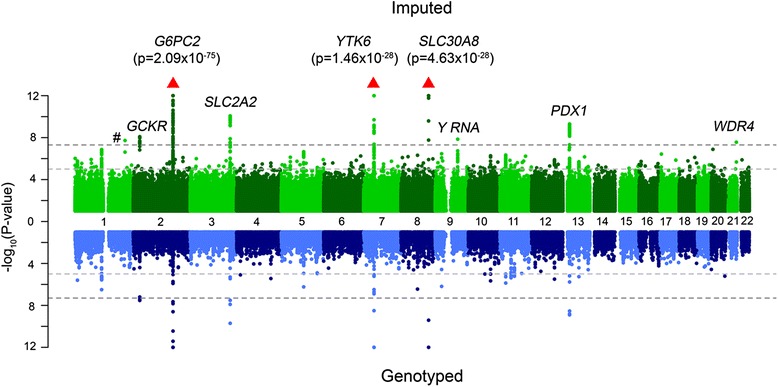
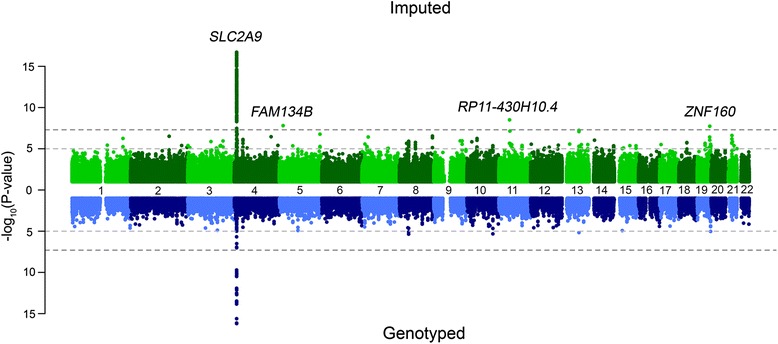
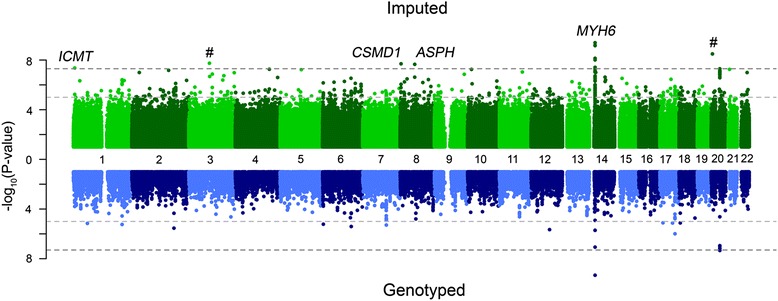
Genome-wide associations were run on 20,032 individuals using both genotyped and HRC imputed data. We present results for a range of well-studied quantitative traits obtained from clinic visits and for serum urate measures obtained from data linkage to EHRs collected by the Scottish National Health Service. Results replicated known associations and additionally reveal novel findings, mainly with rare variants, validating the use of the HRC imputation panel. For example, we identified two new associations with fasting glucose at variants near to Y_RNA and WDR4 and four new associations with heart rate at SNPs within CSMD1 and ASPH, upstream of HTR1F and between PROKR2 and GPCPD1. All were driven by rare variants (minor allele frequencies in the range of 0.08-1%). Proof of principle for use of EHRs was verification of the highly significant association of urate levels with the well-established urate transporter SLC2A9.
GS:SFHS provides genetic data on over 20,000 participants alongside a range of phenotypes as well as linkage to National Health Service laboratory and clinical records. We have shown that the combination of deeper genotype imputation and extended phenotype availability make GS:SFHS an attractive resource to carry out association studies to gain insight into the genetic architecture of complex traits.
“苏格兰世代研究:苏格兰家庭健康研究”(GS:SFHS)是一个基于家庭的人群队列,拥有来自苏格兰各地约24000名成年志愿者的DNA、生物样本、社会人口统计学、心理学和临床数据。尽管数据收集是横断面的,但由于能够与常规电子健康记录(EHR)数据相链接,GS:SFHS成为了一个前瞻性队列。超过20000名参与者被选用于使用大型全基因组阵列进行基因分型。
使用全基因组关联研究(GWAS)对GS:SFHS进行分析,以测试大量变异的影响,这些变异使用单倍型研究联盟(HRC)数据集进行填充,对直接测量或从EHR中获得的医学相关性状产生影响。HRC数据集是用于推断欧洲血统人群中变异的最大可用单倍型参考面板,并且允许在整个GS:SFHS基因分型队列中研究低次要等位基因频率的变异。
使用基因分型数据和HRC填充数据对20032名个体进行了全基因组关联分析。我们展示了一系列从临床就诊中获得的经过充分研究的定量性状以及从与苏格兰国民健康服务局收集的EHR数据链接中获得的血清尿酸测量结果。结果重复了已知的关联,并且还揭示了新的发现,主要是与罕见变异相关,验证了HRC填充面板的使用。例如,我们在靠近Y_RNA和WDR4的变异处发现了两个与空腹血糖的新关联,以及在CSMD1和ASPH内、HTR1F上游以及PROKR2和GPCPD1之间的单核苷酸多态性(SNP)处发现了四个与心率的新关联。所有这些都是由罕见变异驱动的(次要等位基因频率在0.08 - 1%范围内)。使用EHR的原理验证是尿酸水平与成熟的尿酸转运蛋白SLC2A9高度显著关联的验证。
GS:SFHS提供了超过20000名参与者的遗传数据以及一系列表型,以及与国民健康服务局实验室和临床记录的链接。我们已经表明,更深层次的基因型填充和扩展的表型可用性相结合,使得GS:SFHS成为开展关联研究以深入了解复杂性状遗传结构的有吸引力的资源。