Department of Clinical Pharmacy, School of Pharmacy, Taipei Medical University, Taipei, Taiwan.
Institute of Biomedical Sciences, Academia Sinica, Taipei, Taiwan.
PLoS Genet. 2022 Jan 20;18(1):e1009952. doi: 10.1371/journal.pgen.1009952. eCollection 2022 Jan.
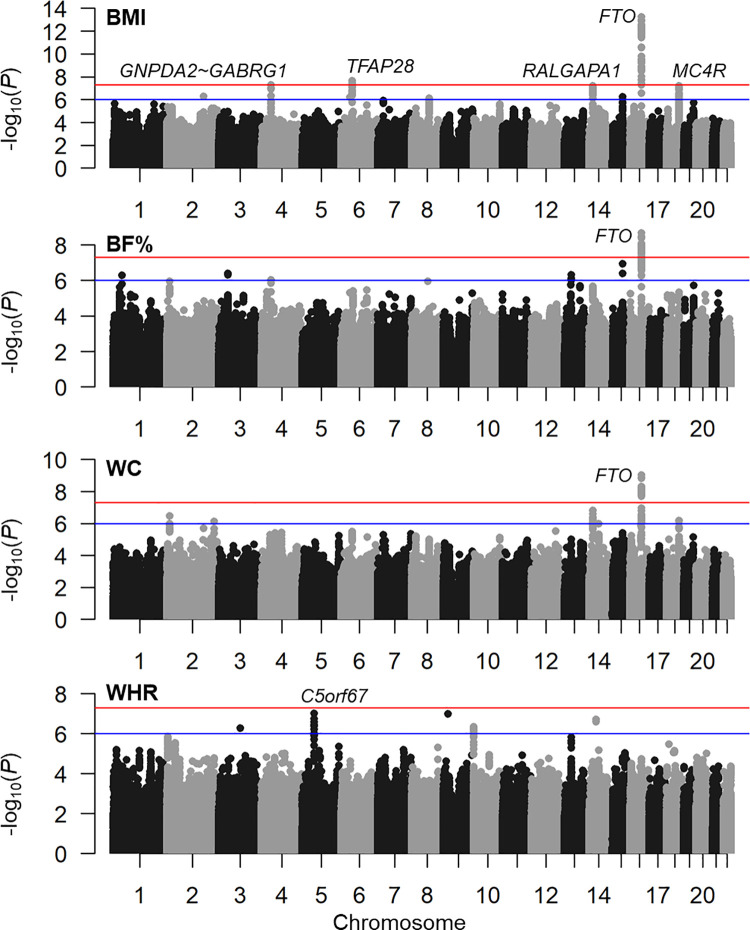
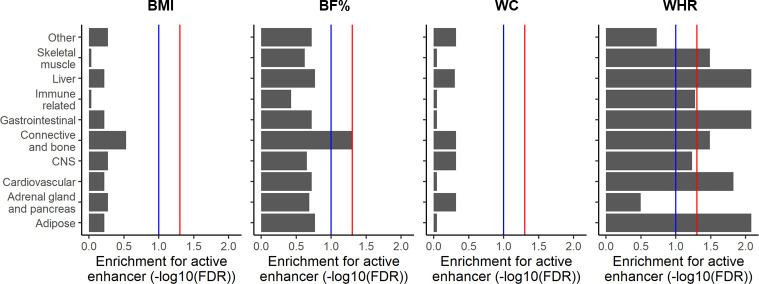
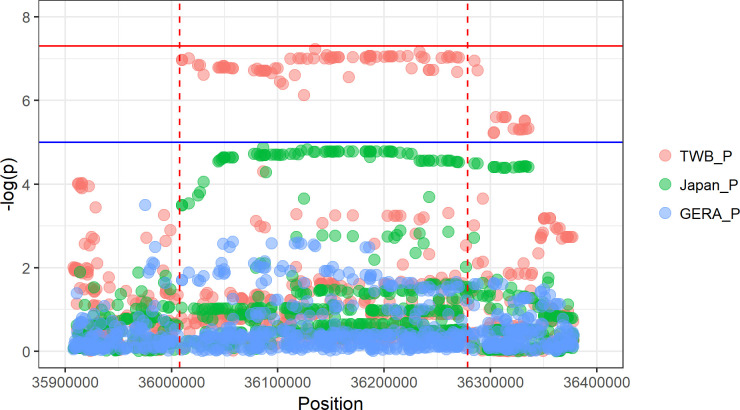
Overweight and obese are risk factors for various diseases. In Taiwan, the combined prevalence of overweight and obesity has increased dramatically. Here, we conducted a genome-wide association study (GWAS) on four adiposity traits, including body-mass index (BMI), body fat percentage (BF%), waist circumference (WC), and waist-hip ratio (WHR), using the data for more than 21,000 subjects in Taiwan Biobank. Associations were evaluated between 6,546,460 single-nucleotide polymorphisms (SNPs) and adiposity traits, yielding 13 genome-wide significant (GWS) adiposity-associated trait-loci pairs. A known gene, FTO, as well as two BF%-associated loci (GNPDA2-GABRG1 [4p12] and RNU6-2-PIAS1 [15q23]) were identified as pleiotropic effects. Moreover, RALGAPA1 was found as a specific genetic predisposing factor to high BMI in a Taiwanese population. Compared to other populations, a slightly lower heritability of the four adiposity traits was found in our cohort. Surprisingly, we uncovered the importance of neural pathways that might influence BF%, WC and WHR in the Taiwanese (East Asian) population. Additionally, a moderate genetic correlation between the WHR and BMI (γg = 0.52; p = 2.37×10⁻⁹) was detected, suggesting different genetic determinants exist for abdominal adiposity and overall adiposity. In conclusion, the obesity-related genetic loci identified here provide new insights into the genetic underpinnings of adiposity in the Taiwanese population.
超重和肥胖是多种疾病的危险因素。在台湾,超重和肥胖的综合患病率显著增加。在这里,我们使用来自台湾生物银行的超过 21000 名受试者的数据,对四个肥胖特征(体重指数(BMI)、体脂肪百分比(BF%)、腰围(WC)和腰臀比(WHR))进行了全基因组关联研究(GWAS)。评估了 6546460 个单核苷酸多态性(SNP)与肥胖特征之间的关联,得出了 13 个与肥胖特征相关的全基因组显著(GWS)关联特征对。一个已知的基因 FTO 以及两个与 BF%相关的基因座(GNPDA2-GABRG1[4p12]和 RNU6-2-PIAS1[15q23])被鉴定为具有多效性效应。此外,RALGAPA1 被发现是台湾人群中 BMI 升高的特定遗传易感因素。与其他人群相比,我们的队列中四个肥胖特征的遗传力略低。令人惊讶的是,我们发现了神经通路在台湾(东亚)人群中可能影响 BF%、WC 和 WHR 的重要性。此外,还检测到 WHR 和 BMI 之间存在中度遗传相关性(γg=0.52;p=2.37×10⁻⁹),这表明腹部肥胖和整体肥胖存在不同的遗传决定因素。总之,这里确定的肥胖相关遗传基因座为台湾人群的肥胖遗传基础提供了新的见解。