Bahall Mandreker, Legall George
School of Medicine and Arthur Lok Jack Graduate School of Business, University of the West Indies, St. Augustine, Trinidad and Tobago.
, House #57 LP 62, Calcutta Road Number 3, McBean, Couva, Trinidad, Trinidad and Tobago.
BMC Complement Altern Med. 2017 Mar 8;17(1):144. doi: 10.1186/s12906-017-1654-y.
Health care providers are often ill prepared to interact about or make acceptable conclusions on complementary and alternative medicine (CAM) despite its widespread use. We explored the knowledge, attitudes, and practices of health care providers regarding CAM.
This cross-sectional study was conducted between March 1 and July 31, 2015 among health care providers working mainly in the public sector in Trinidad and Tobago. A 34-item questionnaire was distributed and used for data collection. Questionnaire data were analysed using inferential and binary logistic regression models.
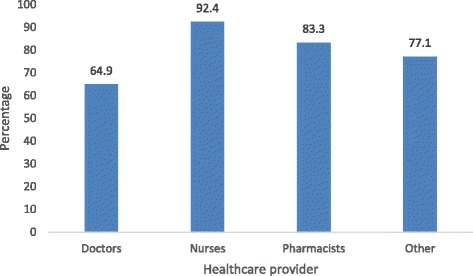
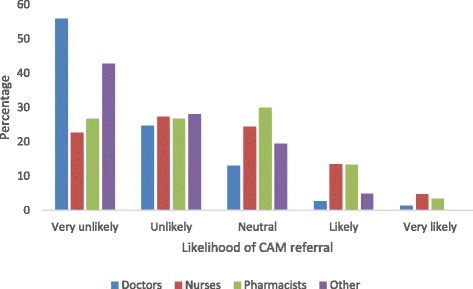
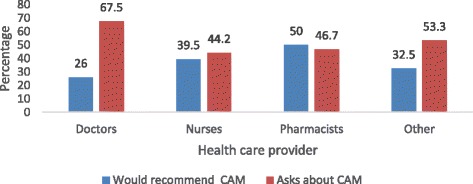
Response rate was 60.3% (362/600). Responders were 172 nurses, 77 doctors, 30 pharmacists, and 83 other health care providers of unnamed categories (mainly nursing assistants). Responders were predominantly female (69.1%), Indo-Trinidadian (55.8%), Christian (47.5%), self-claimed "very religious" (48.3%), and had <5 years of working experience (40.6%). The prevalence of CAM use was 92.4% for nurses, 64.9% for doctors, 83.3% for pharmacists, and 77.1% for other health care providers. The majority (50-75%) reported fair knowledge of herbal, spiritual, alternative, and physical types of CAM, but had no knowledge of energy therapy and therapeutic methods. Sex, ethnicity, and type of health care provider were associated with both personal use and recommendation for the use of CAM. Predictors of CAM use were sex, religion, and type of health care provider; predictors of recommendation for the use of CAM were sex and type of health care provider. About half of health care providers (51.4%) and doctors (52%) were likely to ask their patients about CAM and <15% were likely to refer patients to a CAM practitioner. However, health care providers expressed interest in being educated on the subject. Doctors (51.9%) and pharmacists (63.3%) said that combination therapy is superior to conventional medicine alone. Less than 10% said conventional medicine should be used alone.
Knowledge about CAM is low among health care providers. The majority engages in using CAM but is reluctant to recommend it. Predictors of CAM use were sex, religion, and profession; predictors of recommendation for the use of CAM were sex and profession. Health care providers feel the future lies in integrative medicine.
尽管补充和替代医学(CAM)被广泛使用,但医疗保健提供者往往没有做好充分准备来就其进行交流或得出可接受的结论。我们探讨了医疗保健提供者对补充和替代医学的知识、态度及实践。
这项横断面研究于2015年3月1日至7月31日在特立尼达和多巴哥主要在公共部门工作的医疗保健提供者中进行。发放了一份包含34个条目的问卷用于数据收集。问卷数据使用推断性和二元逻辑回归模型进行分析。
回复率为60.3%(362/600)。回复者包括172名护士、77名医生、30名药剂师以及83名未明确分类的其他医疗保健提供者(主要是护理助理)。回复者以女性为主(69.1%),印度裔特立尼达人(55.8%),基督教徒(47.5%),自称“非常虔诚”(48.3%),且工作经验少于5年(40.6%)。护士使用补充和替代医学的比例为92.4%,医生为64.9%,药剂师为83.3%,其他医疗保健提供者为77.1%。大多数人(50 - 75%)表示对草药、精神、替代和物理类型的补充和替代医学有一定了解,但对能量疗法和治疗方法不了解。性别、种族和医疗保健提供者类型与个人使用补充和替代医学以及推荐使用补充和替代医学均有关联。使用补充和替代医学的预测因素是性别、宗教和医疗保健提供者类型;推荐使用补充和替代医学的预测因素是性别和医疗保健提供者类型。约一半的医疗保健提供者(51.4%)和医生(52%)可能会询问患者关于补充和替代医学的情况,不到15%的人可能会将患者转介给补充和替代医学从业者。然而,医疗保健提供者表示有兴趣接受关于该主题的教育。医生(51.9%)和药剂师(63.3%)表示联合疗法优于单纯的传统医学。不到10%的人表示应单独使用传统医学。
医疗保健提供者对补充和替代医学的知识水平较低。大多数人使用补充和替代医学,但不愿推荐。使用补充和替代医学的预测因素是性别、宗教和职业;推荐使用补充和替代医学的预测因素是性别和职业。医疗保健提供者认为未来在于整合医学。