Bahall Mandreker
School of Medicine and Arthur Lok Jack Graduate School of Business, University of the West Indies, St. Augustine, Trinidad and Tobago.
Department of Medicine, San Fernando General Hospital, Chancery Lane, San Fernando, Trinidad and Tobago.
BMC Complement Altern Med. 2017 Jun 30;17(1):345. doi: 10.1186/s12906-017-1853-6.
Sophisticated conventional medicine (CM) has brought significant advances to cancer prevention, detection, and treatment. However, many cancer patients still turn to complementary and alternative medicine (CAM) treatment. This study explored the prevalence, patterns, and perceived value of CAM among cancer patients.
This quantitative descriptive study was conducted between March 1, 2015, and July 31, 2015, among a cross-sectional, convenience sample of patients from the Oncology Department of San Fernando General Hospital in Trinidad and Tobago. Face-to-face interviews were conducted at the oncology clinic and treatment suite after obtaining informed consent. Data analysis included descriptive analysis, chi-square tests, and binary logistic regression analysis.
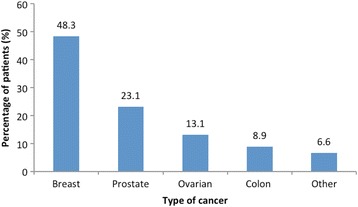
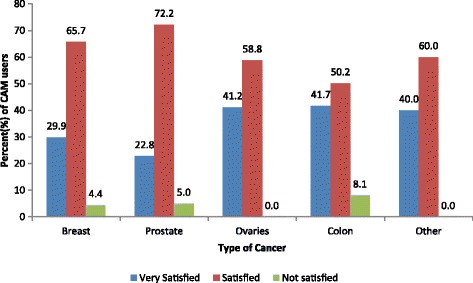
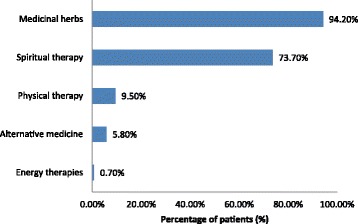
The prevalence of CAM use among a sample of 350 cancer patients was 39.1% (39.6% for breast cancer, 44.4% for prostate cancer, 37% for ovarian cancer, and 38.7% for colon cancer patients). Herbs were the most common type of CAM used (93.4%), followed by spiritual therapy (73.7%). CAM use was more prevalent among females (68.6%), Indo-Trinidadians (63.5%), and patients aged 41-50 years (37.2%). The majority (70%-80%) rated CAM efficacy on perceived value. CAM was used mainly because of a desire to try anything that might help (67.6%), followed by it being congruent with the patients' beliefs (59.1%). Patients knew about CAM mainly through friends (69.3%) and family (69.3%). Most patients were generally satisfied (93.6%) and considered CAM helpful (89.8%), but the majority never informed their health care provider of CAM use (78.8%). Patients reported the simultaneous use of more than one type of CAM, without considering or knowing of possible side-effects. The perceived value of CAM included empowerment, control, cure, and improved quality of life. CAM use was associated with age, but no predictors of CAM use could be identified.
Medicinal herbs and spiritual therapy are commonly used among cancer patients because of perceived benefits and satisfaction. CAM use is more prevalent among females, Indo-Trinidadians, and patients aged 41-50 years old. There are no useful predictors of CAM use. More than one type of CAM is commonly used simultaneously without disclosure to health care providers.
先进的传统医学(CM)在癌症预防、检测和治疗方面取得了重大进展。然而,许多癌症患者仍求助于补充和替代医学(CAM)治疗。本研究探讨了癌症患者中CAM的使用 prevalence、模式及感知价值。
本定量描述性研究于2015年3月1日至2015年7月31日在特立尼达和多巴哥圣费尔南多总医院肿瘤科的横断面便利样本患者中进行。在获得知情同意后,于肿瘤诊所和治疗室进行面对面访谈。数据分析包括描述性分析、卡方检验和二元逻辑回归分析。
350名癌症患者样本中CAM的使用率为39.1%(乳腺癌患者为39.6%,前列腺癌患者为44.4%,卵巢癌患者为37%,结肠癌患者为38.7%)。草药是最常用的CAM类型(93.4%),其次是精神疗法(73.7%)。CAM在女性(68.6%)、印度裔特立尼达人和多巴哥人(63.5%)以及41 - 50岁患者(37.2%)中更为普遍。大多数(70% - 80%)根据感知价值对CAM疗效进行评分。使用CAM主要是因为渴望尝试任何可能有帮助的事物(67.6%),其次是因为它与患者的信仰相符(59.1%)。患者主要通过朋友(69.3%)和家人(69.3%)了解CAM。大多数患者总体上感到满意(93.6%),并认为CAM有帮助(89.8%),但大多数患者从未告知其医疗保健提供者他们使用了CAM(78.8%)。患者报告同时使用多种类型的CAM,而没有考虑或知晓可能的副作用。CAM的感知价值包括增强权能、控制、治愈和改善生活质量。CAM的使用与年龄有关,但无法确定CAM使用的预测因素。
由于感知到的益处和满意度,草药和精神疗法在癌症患者中普遍使用。CAM在女性、印度裔特立尼达人和多巴哥人以及41 - 50岁患者中更为普遍。没有CAM使用的有用预测因素。通常同时使用多种类型的CAM,且未告知医疗保健提供者。