Obuku E A, Lavis J N, Kinengyere A, Mafigiri D K, Sengooba F, Karamagi C, Sewankambo N K
Clinical Epidemiology Unit, Department of Medicine, School of Medicine, College of Health Sciences, Makerere University, P.O. Box 7072, Kampala, Uganda.
Faculty of Epidemiology and Population Health, London School of Hygiene and Tropical Medicine, London, United Kingdom.
Health Res Policy Syst. 2017 Mar 9;15(1):18. doi: 10.1186/s12961-017-0169-9.
Investing in research that is not accessible or used is a waste of resources and an injustice to human subject participants. Post-graduate students' research in institutions of higher learning involves considerable time, effort and money, warranting evaluation of the return on investment. Although individual studies addressing research productivity of post-graduate students are available, a synthesis of these results in low-income settings has not been undertaken. Our first aim is to identify the types of approaches that increase productivity and those that increase the application of medical post-graduate students' research and to assess their effectiveness. Our second aim is to assess the determinants of post-graduate students' research productivity.
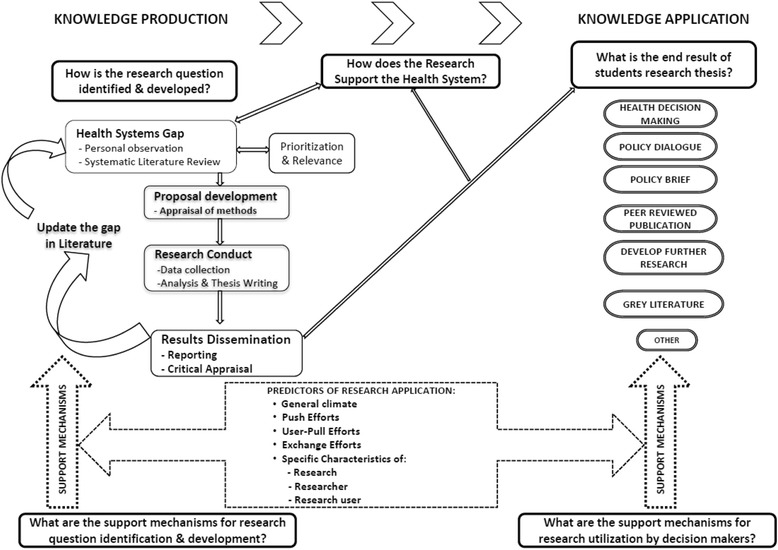
We propose a two-stage systematic review. We will electronically search for published and grey literature in PubMed/MEDLINE and the ERIC databases, as well as contact authors, research administration units of universities, and other key informants as appropriate. In stage one, we will map the nature of the evidence available using a knowledge translation framework adapted from existing literature. We will perform duplicate screening and selection of articles, data abstraction, and risk of bias assessments for included primary studies as described in the Cochrane handbook for systematic reviews. Our primary outcome is publication output as a measure of research productivity, whilst we defined research use as citations in peer-reviewed journals or policy-related documents as our secondary outcome. In stage two, we will perform a structured narrative synthesis of the findings and advance to quantitative meta-analysis if the number of studies are adequate and their heterogeneity is low. Adapting the Grading, Recommendations, Assessment, Development and Evaluation (GRADE) approach, we will assess the overall quality of evidence for effects, and report our results in line with the Preferred Reporting Items for Systematic Reviews and Meta-Analyses (PRISMA) statement.
We will share our findings with universities, other training institutions, civil society, funders as well as government departments in charge of education and health particularly in low- and middle-income countries.
对无法获取或未被使用的研究进行投资是资源浪费,也是对人类受试者的不公。高等院校研究生的研究需要投入大量的时间、精力和资金,因此有必要评估投资回报率。虽然有针对研究生研究生产力的个别研究,但尚未对低收入环境下的这些结果进行综合分析。我们的首要目标是确定提高生产力的方法类型以及增加医学研究生研究应用的方法类型,并评估其有效性。我们的第二个目标是评估研究生研究生产力的决定因素。
我们提议进行两阶段的系统评价。我们将在PubMed/MEDLINE和教育资源信息中心(ERIC)数据库中电子搜索已发表和灰色文献,并酌情联系作者、大学研究管理部门及其他关键信息提供者。在第一阶段,我们将使用从现有文献改编的知识转化框架来梳理可用证据的性质。我们将按照Cochrane系统评价手册中所述,对纳入的原始研究进行重复筛选和文章选择、数据提取以及偏倚风险评估。我们的主要结局是发表成果,作为研究生产力的衡量指标,而我们将研究应用定义为同行评审期刊或政策相关文件中的引用,作为次要结局。在第二阶段,如果研究数量足够且异质性较低,我们将对研究结果进行结构化叙述性综合分析,并推进到定量Meta分析。我们将采用分级、推荐、评估、制定和评价(GRADE)方法,评估效应证据的总体质量,并按照系统评价和Meta分析的首选报告项目(PRISMA)声明报告我们的结果。
我们将与大学、其他培训机构、民间社会、资助者以及负责教育和卫生的政府部门分享我们的研究结果,特别是在低收入和中等收入国家。