Anejo-Okopi Joseph, Abah Isaac Okoh, Barshep Yakhat, Ebonyi Augustine Odo, Daniyam Comfort, Isa Samson Ejiji, Simji Gomerep, Oguche Stephen, Agaba Patricia, Lar Patricia, Agbaji Oche, Idoko John A
Department of Microbiology, University of Jos, Nigeria; AIDS Prevention Initiative in Nigeria, Jos University Teaching Hospital, Nigeria.
AIDS Prevention Initiative in Nigeria, Jos University Teaching Hospital, Nigeria; Department of Pharmacy, Jos University Teaching Hospital, Nigeria.
J Virus Erad. 2017 Jan 1;3(1):51-55. doi: 10.1016/S2055-6640(20)30296-X.
Plasma HIV-RNA viral load (VL) of HIV-infected persons is an important prognostic factor in HIV management. We determined the VL among antiretroviral therapy (ART)-naive patients to identify the association between patients' demographic, clinical and laboratory characteristics with VL.
A cross-sectional study of 224 ART-naive HIV-1-infected patients (≥15 years of age) accessing care at the Jos University Teaching Hospital AIDS Prevention Initiative in Nigeria ART treatment centre, from October 2010 to April 2011. A log-linear model was used to determine if VL was related to demographic and clinical variables.
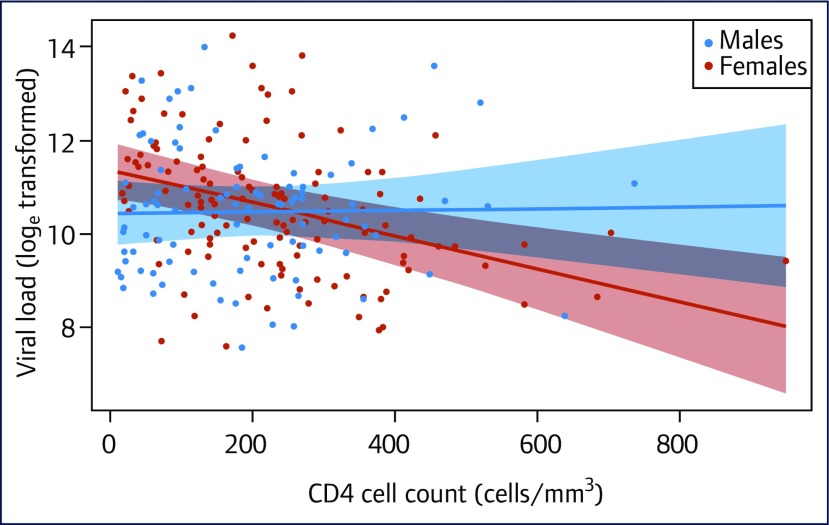
The patients had a median (interquartile range) age of 34 (28-41) years with females in the majority (59%). Females compared to males and pulmonary tuberculosis (PTB) co-infected compared to not co-infected patients had a significantly higher VL (14.9 log versus 11.5 log, =0.003 and 11.31 log versus 11.89 log, =0.047, respectively). VL tended to decrease with increasing CD4+ cell count levels in females, but remained relatively unchanged in males across all values of CD4+ cell counts. The difference (β) in the mean change in VL between males and females was log 0.64 copies/mL, =0.005.
In ART-naive HIV-1-infected patients in our setting, females had significantly higher VL and lower CD4+ cell count, at the same VL threshold, compared to males, and hence were more likely to be at a higher risk of rapid progression to AIDS. Therefore, gender-based strategies for early identification and engaging females into care are required in this setting to mitigate against rapid progression to AIDS.
HIV感染者的血浆HIV-RNA病毒载量(VL)是HIV管理中的一个重要预后因素。我们测定了未接受抗逆转录病毒治疗(ART)患者的病毒载量,以确定患者的人口统计学、临床和实验室特征与病毒载量之间的关联。
对2010年10月至2011年4月期间在尼日利亚乔斯大学教学医院艾滋病预防倡议ART治疗中心接受治疗的224例未接受ART的HIV-1感染患者(≥15岁)进行横断面研究。使用对数线性模型来确定病毒载量是否与人口统计学和临床变量相关。
患者的年龄中位数(四分位间距)为34(28-41)岁,女性占多数(59%)。与男性相比,女性以及与未合并感染的患者相比,合并肺结核(PTB)的患者病毒载量显著更高(分别为14.9 log对11.5 log,P=0.003;11.31 log对11.89 log,P=0.047)。女性的病毒载量倾向于随着CD4+细胞计数水平的增加而降低,但在男性中,在所有CD4+细胞计数水平上相对保持不变。男性和女性之间病毒载量平均变化的差异(β)为0.64 log拷贝/mL,P=0.005。
在我们所研究的未接受ART的HIV-1感染患者中,在相同的病毒载量阈值下,女性的病毒载量显著更高,CD4+细胞计数更低,因此与男性相比,更有可能面临快速进展至艾滋病的更高风险。因此,在这种情况下,需要基于性别的策略来早期识别并促使女性接受治疗,以减轻快速进展至艾滋病的风险。