• 文献检索
  • 文档翻译
  • 深度研究
  • 学术资讯
  • Suppr Zotero 插件Zotero 插件
  • 邀请有礼
  • 套餐&价格
  • 历史记录
应用&插件
Suppr Zotero 插件Zotero 插件浏览器插件Mac 客户端Windows 客户端微信小程序
定价
高级版会员购买积分包购买API积分包
服务
文献检索文档翻译深度研究API 文档MCP 服务
关于我们
关于 Suppr公司介绍联系我们用户协议隐私条款
关注我们

Suppr 超能文献

核心技术专利:CN118964589B侵权必究
粤ICP备2023148730 号-1Suppr @ 2026

文献检索

告别复杂PubMed语法,用中文像聊天一样搜索,搜遍4000万医学文献。AI智能推荐,让科研检索更轻松。

立即免费搜索

文件翻译

保留排版,准确专业,支持PDF/Word/PPT等文件格式,支持 12+语言互译。

免费翻译文档

深度研究

AI帮你快速写综述,25分钟生成高质量综述,智能提取关键信息,辅助科研写作。

立即免费体验

ICARES:荷兰传染病聚集性病例实时自动检测工具。

ICARES: a real-time automated detection tool for clusters of infectious diseases in the Netherlands.

作者信息

Groeneveld Geert H, Dalhuijsen Anton, Kara-Zaïtri Chakib, Hamilton Bob, de Waal Margot W, van Dissel Jaap T, van Steenbergen Jim E

机构信息

Department of Internal Medicine and Infectious Diseases, Leiden University Medical Center, P.O. box 9600, 2300 RC, Leiden, The Netherlands.

Unit for Infectious Disease Control, Public Health Service Hollands Midden, Leiden, The Netherlands.

出版信息

BMC Infect Dis. 2017 Mar 9;17(1):201. doi: 10.1186/s12879-017-2300-5.

DOI:10.1186/s12879-017-2300-5
PMID:28279150
原文链接:https://pmc.ncbi.nlm.nih.gov/articles/PMC5345172/
Abstract

BACKGROUND

Clusters of infectious diseases are frequently detected late. Real-time, detailed information about an evolving cluster and possible associated conditions is essential for local policy makers, travelers planning to visit the area, and the local population. This is currently illustrated in the Zika virus outbreak.

METHODS

In the Netherlands, ICARES (Integrated Crisis Alert and Response System) has been developed and tested on three syndromes as an automated, real-time tool for early detection of clusters of infectious diseases. From local general practices, General Practice Out-of-Hours services and a hospital, the numbers of routinely used syndrome codes for three piloted tracts i.e., respiratory tract infection, hepatitis and encephalitis/meningitis, are sent on a daily basis to a central unit of infectious disease control. Historic data combined with information about patients' syndromes, age cohort, gender and postal code area have been used to detect clusters of cases.

RESULTS

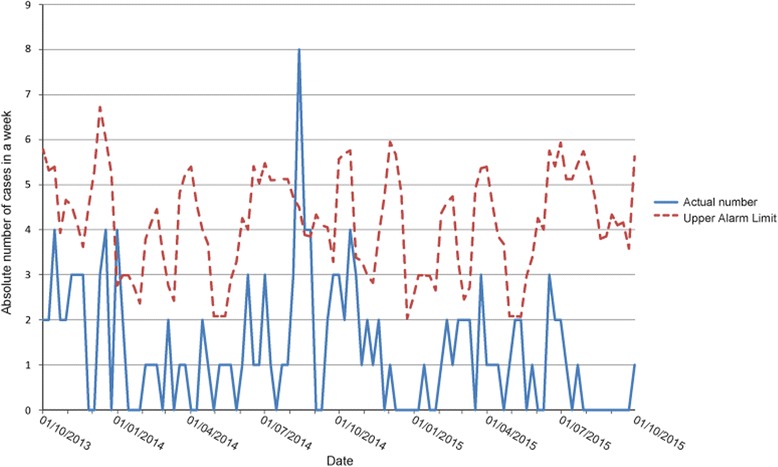
During the first 2 years, two out of eight alerts appeared to be a real cluster. The first was part of the seasonal increase in Enterovirus encephalitis and the second was a remarkably long lasting influenza season with high peak incidence.

CONCLUSIONS

This tool is believed to be the first flexible automated, real-time cluster detection system for infectious diseases, based on physician information from both general practitioners and hospitals. ICARES is able to detect and follow small regional clusters in real time and can handle any diseases entity that is regularly registered by first line physicians. Its value will be improved when more health care institutions agree to link up with ICARES thus improving further the signal-to-noise ratio.

摘要

背景

传染病聚集性病例往往发现得较晚。对于地方政策制定者、计划前往该地区的旅行者以及当地居民而言,获取有关正在演变的聚集性病例及可能相关情况的实时详细信息至关重要。寨卡病毒疫情便是当前的一个例证。

方法

在荷兰,已开发出ICARES(综合危机警报与应对系统)并针对三种综合征进行了测试,作为一种用于早期发现传染病聚集性病例的自动化实时工具。来自当地全科诊所、全科诊所非工作时间服务机构以及一家医院的三种试点疾病(即呼吸道感染、肝炎和脑炎/脑膜炎)的常规使用综合征代码数量每天被发送至传染病控制中心。利用历史数据以及有关患者综合征、年龄组、性别和邮政编码区域的信息来检测病例聚集情况。

结果

在最初的两年中,八个警报中有两个似乎是真正的聚集性病例。第一个是肠道病毒脑炎季节性增加的一部分,第二个是流感季节持续时间极长且发病率峰值很高。

结论

该工具被认为是首个基于来自全科医生和医院的医生信息的灵活的传染病自动化实时聚集性病例检测系统。ICARES能够实时检测并跟踪小范围的区域聚集性病例,并且能够处理一线医生常规登记的任何疾病实体。当更多的医疗机构同意与ICARES建立联系从而进一步提高信噪比时,其价值将得到提升。
https://cdn.ncbi.nlm.nih.gov/pmc/blobs/9385/5345172/d3f2aedab58e/12879_2017_2300_Fig4_HTML.jpg
https://cdn.ncbi.nlm.nih.gov/pmc/blobs/9385/5345172/f96465227787/12879_2017_2300_Fig1_HTML.jpg
https://cdn.ncbi.nlm.nih.gov/pmc/blobs/9385/5345172/234bf1a556a8/12879_2017_2300_Fig2_HTML.jpg
https://cdn.ncbi.nlm.nih.gov/pmc/blobs/9385/5345172/a7604def7c02/12879_2017_2300_Fig3_HTML.jpg
https://cdn.ncbi.nlm.nih.gov/pmc/blobs/9385/5345172/d3f2aedab58e/12879_2017_2300_Fig4_HTML.jpg
https://cdn.ncbi.nlm.nih.gov/pmc/blobs/9385/5345172/f96465227787/12879_2017_2300_Fig1_HTML.jpg
https://cdn.ncbi.nlm.nih.gov/pmc/blobs/9385/5345172/234bf1a556a8/12879_2017_2300_Fig2_HTML.jpg
https://cdn.ncbi.nlm.nih.gov/pmc/blobs/9385/5345172/a7604def7c02/12879_2017_2300_Fig3_HTML.jpg
https://cdn.ncbi.nlm.nih.gov/pmc/blobs/9385/5345172/d3f2aedab58e/12879_2017_2300_Fig4_HTML.jpg

相似文献

1
ICARES: a real-time automated detection tool for clusters of infectious diseases in the Netherlands.ICARES:荷兰传染病聚集性病例实时自动检测工具。
BMC Infect Dis. 2017 Mar 9;17(1):201. doi: 10.1186/s12879-017-2300-5.
2
Outbreak of Zika virus infection in Singapore: an epidemiological, entomological, virological, and clinical analysis.新加坡寨卡病毒感染疫情的流行病学、昆虫学、病毒学和临床分析。
Lancet Infect Dis. 2017 Aug;17(8):813-821. doi: 10.1016/S1473-3099(17)30249-9. Epub 2017 May 17.
3
ID-Viewer: a visual analytics architecture for infectious diseases surveillance and response management in Pakistan.ID-Viewer:巴基斯坦传染病监测与应对管理的可视化分析架构
Public Health. 2016 May;134:72-85. doi: 10.1016/j.puhe.2016.01.006. Epub 2016 Feb 13.
4
Real-Time Surveillance of Infectious Diseases: Taiwan's Experience.传染病实时监测:台湾地区的经验
Health Secur. 2017 Mar/Apr;15(2):144-153. doi: 10.1089/hs.2016.0107.
5
[The application of China Infectious Diseases Automated-alert and Response System in Zhejiang province, 2012].[中国传染病自动预警与响应系统在浙江省的应用,2012年]
Zhonghua Liu Xing Bing Xue Za Zhi. 2013 Jun;34(6):594-7.
6
Automated detection of infectious disease outbreaks: hierarchical time series models.传染病爆发的自动检测:分层时间序列模型
Stat Med. 2006 Dec 30;25(24):4179-96. doi: 10.1002/sim.2674.
7
An update on Zika virus infection.寨卡病毒感染的最新进展。
Lancet. 2017 Nov 4;390(10107):2099-2109. doi: 10.1016/S0140-6736(17)31450-2. Epub 2017 Jun 21.
8
Local Mosquito-Borne Transmission of Zika Virus - Miami-Dade and Broward Counties, Florida, June-August 2016.2016 年 6 月至 8 月,佛罗里达州迈阿密戴德县和布劳沃德县发生寨卡病毒本地蚊媒传播。
MMWR Morb Mortal Wkly Rep. 2016 Sep 30;65(38):1032-8. doi: 10.15585/mmwr.mm6538e1.
9
How to select a proper early warning threshold to detect infectious disease outbreaks based on the China infectious disease automated alert and response system (CIDARS).如何基于中国传染病自动预警与响应系统(CIDARS)选择合适的早期预警阈值以检测传染病暴发。
BMC Public Health. 2017 Jun 12;17(1):570. doi: 10.1186/s12889-017-4488-0.
10
[Imported Zika virus infection in the Netherlands].[荷兰的输入性寨卡病毒感染]
Ned Tijdschr Geneeskd. 2015;160:D153.

引用本文的文献

1
Outbreak detector: a web application to boost disease surveillance systems and timely detection of infectious disease epidemics.爆发探测器:一个网络应用程序,用于增强疾病监测系统和及时发现传染病疫情。
BMC Res Notes. 2024 Aug 20;17(1):229. doi: 10.1186/s13104-024-06892-8.
2
Developing a Research Network of Early Warning Systems for Infectious Diseases Transmission Between China and Australia.建立中国与澳大利亚之间传染病传播早期预警系统研究网络。
China CDC Wkly. 2024 Jul 26;6(30):740-753. doi: 10.46234/ccdcw2024.166.
3
Effectiveness of early warning systems in the detection of infectious diseases outbreaks: a systematic review.

本文引用的文献

1
Microcephaly in Brazil: how to interpret reported numbers?巴西的小头症:如何解读报告数据?
Lancet. 2016 Feb 13;387(10019):621-624. doi: 10.1016/S0140-6736(16)00273-7. Epub 2016 Feb 7.
2
Global rise in human infectious disease outbreaks.全球人类传染病暴发事件增多。
J R Soc Interface. 2014 Dec 6;11(101):20140950. doi: 10.1098/rsif.2014.0950.
3
Surveillance for emerging respiratory viruses.新型呼吸道病毒监测
早期预警系统在传染病爆发检测中的效果:系统评价。
BMC Public Health. 2022 Nov 29;22(1):2216. doi: 10.1186/s12889-022-14625-4.
4
The effectiveness of syndromic surveillance for the early detection of waterborne outbreaks: a systematic review.症候群监测在早期发现水源性传染病暴发中的效果:系统评价。
BMC Infect Dis. 2021 Jul 20;21(1):696. doi: 10.1186/s12879-021-06387-y.
5
Experience of establishing severe acute respiratory surveillance in the Netherlands: Evaluation and challenges.荷兰建立严重急性呼吸道监测的经验:评估与挑战。
Public Health Pract (Oxf). 2020 Nov;1:100014. doi: 10.1016/j.puhip.2020.100014. Epub 2020 Dec 22.
6
Web-Based Apps for Responding to Acute Infectious Disease Outbreaks in the Community: Systematic Review.基于网络的应用程序在社区急性传染病应对中的应用:系统评价。
JMIR Public Health Surveill. 2021 Apr 21;7(4):e24330. doi: 10.2196/24330.
7
Contribution of Enteroviruses to Acute Central Nervous System or Systemic Infections in Northern Italy (2015-2017): Is It Time to Establish a National Laboratory-Based Surveillance System?意大利北部肠病毒引起的急性中枢神经系统或全身性感染(2015-2017 年):是否有必要建立全国性基于实验室的监测系统?
Biomed Res Int. 2020 Jul 1;2020:9393264. doi: 10.1155/2020/9393264. eCollection 2020.
8
Cluster Detection Mechanisms for Syndromic Surveillance Systems: Systematic Review and Framework Development.症候群监测系统的集群检测机制:系统评价与框架开发。
JMIR Public Health Surveill. 2020 May 26;6(2):e11512. doi: 10.2196/11512.
9
Utility of emergency call centre, dispatch and ambulance data for syndromic surveillance of infectious diseases: a scoping review.紧急呼叫中心、派遣和救护车数据在传染病症状监测中的应用:范围综述。
Eur J Public Health. 2020 Aug 1;30(4):639-647. doi: 10.1093/eurpub/ckz177.
Lancet Infect Dis. 2014 Oct;14(10):992-1000. doi: 10.1016/S1473-3099(14)70840-0. Epub 2014 Sep 1.
4
Big data. The parable of Google Flu: traps in big data analysis.大数据。谷歌流感预测的教训:大数据分析中的陷阱。
Science. 2014 Mar 14;343(6176):1203-5. doi: 10.1126/science.1248506.
5
A confidence-based aberration interpretation framework for outbreak conciliation.一种基于置信度的异常解释框架,用于疫情调解。
Online J Public Health Inform. 2010;2(1). doi: 10.5210/ojphi.v2i1.2837. Epub 2010 Apr 9.
6
A spatio-temporal absorbing state model for disease and syndromic surveillance.时空吸收态模型在疾病和症状监测中的应用
Stat Med. 2012 Aug 30;31(19):2123-36. doi: 10.1002/sim.5350. Epub 2012 Mar 2.
7
Assessment of syndromic surveillance in Europe.欧洲综合征监测评估。
Lancet. 2011 Nov 26;378(9806):1833-4. doi: 10.1016/S0140-6736(11)60834-9.
8
Timeliness of surveillance during outbreak of Shiga Toxin-producing Escherichia coli infection, Germany, 2011.2011 年德国产志贺毒素大肠杆菌感染爆发期间的监测及时性。
Emerg Infect Dis. 2011 Oct;17(10):1906-9. doi: 10.3201/eid1710.111027.
9
Epidemic profile of Shiga-toxin-producing Escherichia coli O104:H4 outbreak in Germany.德国产志贺毒素大肠杆菌 O104:H4 疫情概况。
N Engl J Med. 2011 Nov 10;365(19):1771-80. doi: 10.1056/NEJMoa1106483. Epub 2011 Jun 22.
10
Assessment of ESSENCE performance for influenza-like illness surveillance after an influenza outbreak--U.S. Air Force Academy, Colorado, 2009.评估流感爆发后流感样疾病监测的 ESSENCE 表现——2009 年,美国科罗拉多州空军学院。
MMWR Morb Mortal Wkly Rep. 2011 Apr 8;60(13):406-9.