Eliasson Lina, Bewley Anthony P, Mughal Farhan, Johnston Karissa M, Kuznik Andreas, Patel Chloe, Lloyd Andrew J
Clinical Outcomes Assessment, ICON Clinical Research UK Ltd.
Department of Dermatology, Whipps Cross University Hospital, Barts Health National Health Service Trust, London.
Patient Prefer Adherence. 2017 Feb 28;11:353-362. doi: 10.2147/PPA.S121838. eCollection 2017.
Treatment options for psoriasis offer trade-offs in terms of efficacy, convenience, and risk of adverse events. We evaluated patients' preferences with respect to benefit-risk in the treatment of psoriasis.
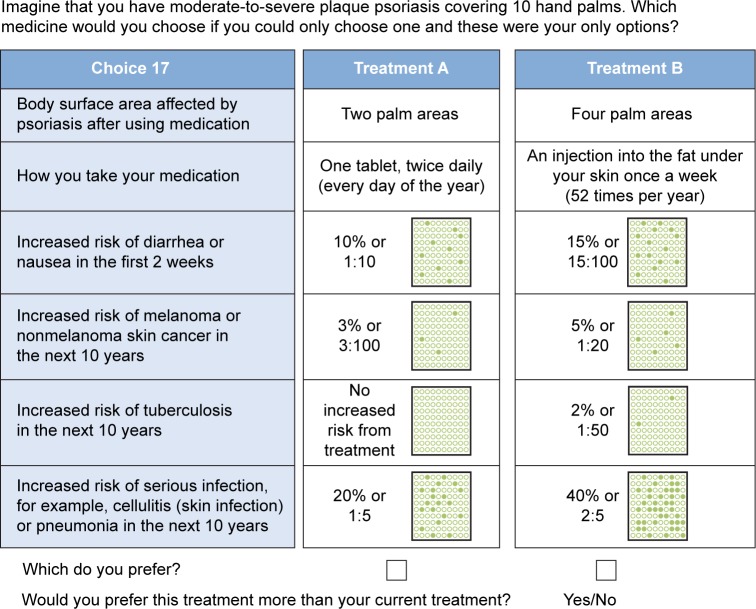
A discrete choice experiment was conducted in adults from the UK with moderate-to-severe psoriasis using an orthogonal design with 32 hypothetical choice sets. Participants were randomly assigned to one of two surveys with 16 choice sets. Patients' preferences were investigated with respect to the following attributes: reduction in body surface area affected by psoriasis, treatment administration (frequency and mode of delivery), short-term diarrhea or nausea risk, and 10-year risk of developing melanoma or nonmelanoma skin cancer, tuberculosis, or serious infections. A mixed effects logistic regression model generated relative preferences between treatment profiles.
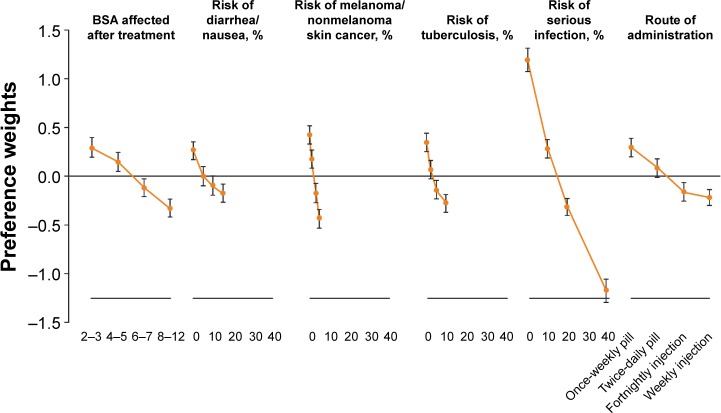
Participants (N=292) had a strong preference to avoid increased risk of melanoma or nonmelanoma skin cancer (odds ratio [OR]: 0.44 per 5% increased 10-year risk) and increased risks of tuberculosis and serious infections (both ORs: 0.73 per 5% increased 10-year risk) and preferred once-weekly to twice-daily tablets (OR: 0.76) and weekly (OR: 0.56) or fortnightly (OR: 0.65) injections. Participants preferred avoiding treatments that may cause diarrhea or nausea in the first 2 weeks (OR: 0.87 per 5% increase) and preferred treatments that effectively resolved plaque lesions (OR: 0.93 for each palm area still affected).
All attributes were significant predictors of choice. Patients' preference research complements clinical trial data by providing insight regarding the relative weight of efficacy, tolerability, and other factors for patients when making treatment choices.
银屑病的治疗方案在疗效、便利性和不良事件风险方面存在权衡。我们评估了患者在银屑病治疗中对获益-风险的偏好。
在英国患有中度至重度银屑病的成年人中进行了一项离散选择实验,采用具有32个假设选择集的正交设计。参与者被随机分配到两个包含16个选择集的调查之一。针对以下属性调查了患者的偏好:银屑病受累体表面积的减少、治疗给药(频率和给药方式)、短期腹泻或恶心风险以及患黑色素瘤或非黑色素瘤皮肤癌、结核病或严重感染的10年风险。混合效应逻辑回归模型生成了不同治疗方案之间的相对偏好。
参与者(N = 292)强烈倾向于避免黑色素瘤或非黑色素瘤皮肤癌风险增加(比值比[OR]:10年风险每增加5%为0.44)以及结核病和严重感染风险增加(两者的OR:10年风险每增加5%均为0.73),并且更喜欢每周一次的片剂而非每日两次的片剂(OR:0.76)以及每周(OR:0.56)或每两周(OR:0.65)一次的注射。参与者倾向于避免在前两周可能引起腹泻或恶心的治疗(OR:每增加5%为0.87),并且更喜欢能有效消除斑块病变的治疗(每仍有一个手掌面积受累的OR:0.93)。
所有属性都是选择的重要预测因素。患者偏好研究通过提供有关疗效、耐受性和其他因素在患者做出治疗选择时的相对权重的见解,对临床试验数据起到补充作用。