McManus Kimberly F, Taravella Angela M, Henn Brenna M, Bustamante Carlos D, Sikora Martin, Cornejo Omar E
Department of Biology, Stanford University, Stanford, California, United States of America.
Department of Ecology and Evolution, Stony Brook University, Stony Brook, New York, United States of America.
PLoS Genet. 2017 Mar 10;13(3):e1006560. doi: 10.1371/journal.pgen.1006560. eCollection 2017 Mar.
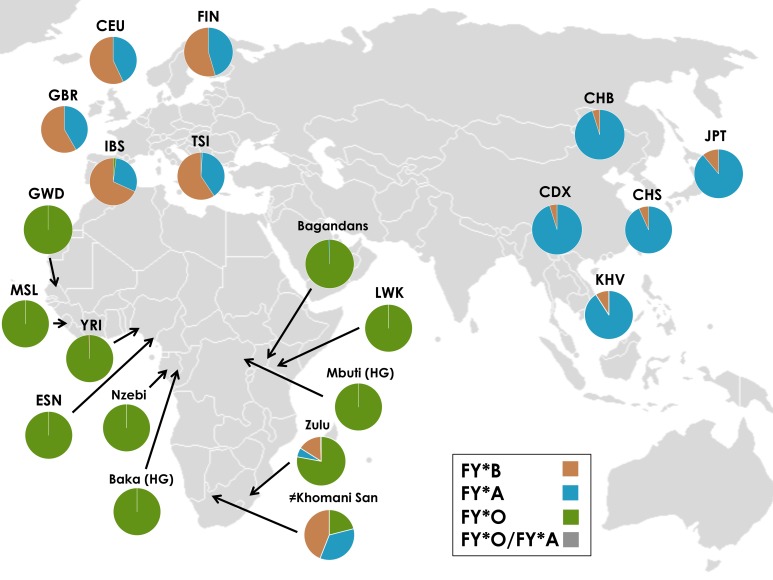
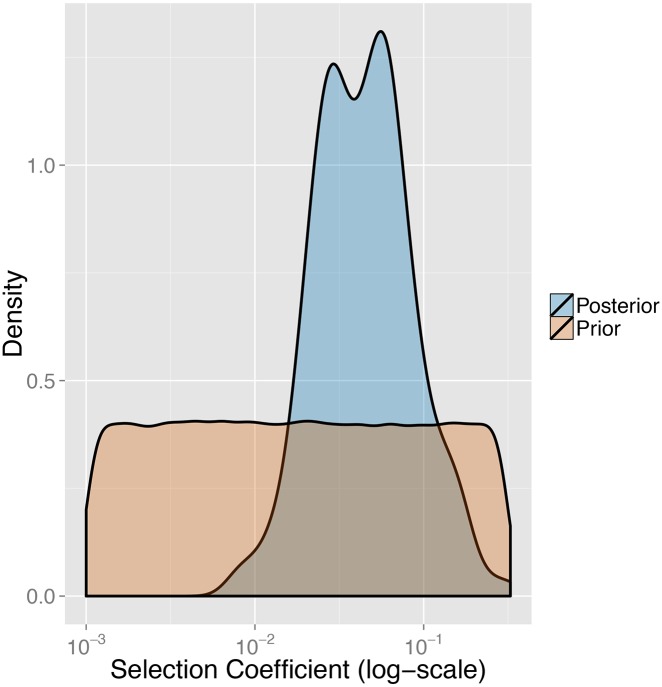
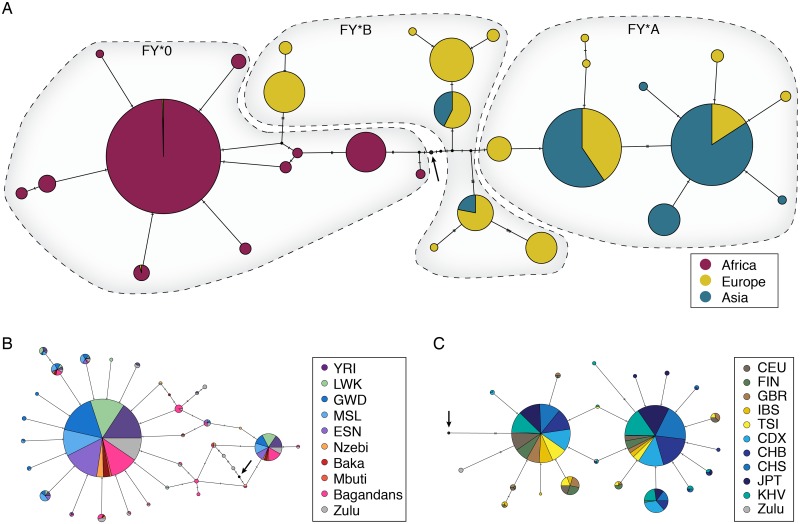
The human DARC (Duffy antigen receptor for chemokines) gene encodes a membrane-bound chemokine receptor crucial for the infection of red blood cells by Plasmodium vivax, a major causative agent of malaria. Of the three major allelic classes segregating in human populations, the FYO allele has been shown to protect against P. vivax infection and is at near fixation in sub-Saharan Africa, while FYB and FYA are common in Europe and Asia, respectively. Due to the combination of strong geographic differentiation and association with malaria resistance, DARC is considered a canonical example of positive selection in humans. Despite this, details of the timing and mode of selection at DARC remain poorly understood. Here, we use sequencing data from over 1,000 individuals in twenty-one human populations, as well as ancient human genomes, to perform a fine-scale investigation of the evolutionary history of DARC. We estimate the time to most recent common ancestor (TMRCA) of the most common FYO haplotype to be 42 kya (95% CI: 34-49 kya). We infer the FYO null mutation swept to fixation in Africa from standing variation with very low initial frequency (0.1%) and a selection coefficient of 0.043 (95% CI:0.011-0.18), which is among the strongest estimated in the human genome. We estimate the TMRCA of the FYA mutation in non-Africans to be 57 kya (95% CI: 48-65 kya) and infer that, prior to the sweep of FYO, all three alleles were segregating in Africa, as highly diverged populations from Asia and ≠Khomani San hunter-gatherers share the same FYA haplotypes. We test multiple models of admixture that may account for this observation and reject recent Asian or European admixture as the cause.
人类DARC(趋化因子的达菲抗原受体)基因编码一种膜结合趋化因子受体,对间日疟原虫(疟疾的主要病原体)感染红细胞至关重要。在人类群体中分离出的三个主要等位基因类别中,FYO等位基因已被证明可预防间日疟原虫感染,并且在撒哈拉以南非洲地区几乎固定存在,而FYB和FYA分别在欧洲和亚洲很常见。由于强烈的地理分化以及与疟疾抗性的关联,DARC被认为是人类正选择的典型例子。尽管如此,DARC选择的时间和模式细节仍知之甚少。在这里,我们使用来自21个人类群体中1000多个个体的测序数据以及古代人类基因组,对DARC的进化历史进行精细研究。我们估计最常见的FYO单倍型的最近共同祖先时间(TMRCA)为42千年前(95%置信区间:34 - 49千年前)。我们推断FYO无效突变从初始频率非常低(0.1%)的现有变异中在非洲迅速固定,选择系数为0.043(95%置信区间:0.011 - 0.18),这是人类基因组中估计的最强选择系数之一。我们估计非非洲人中FYA突变的TMRCA为57千年前(95%置信区间:48 - 65千年前),并推断在FYO迅速固定之前,所有三个等位基因在非洲都存在分离,因为来自亚洲的高度分化群体和≠科曼尼桑族狩猎采集者共享相同的FYA单倍型。我们测试了多种可能解释这一观察结果的混合模型,并排除了近期亚洲或欧洲混合作为原因。