Chalker Victoria, Jironkin Aleksey, Coelho Juliana, Al-Shahib Ali, Platt Steve, Kapatai Georgia, Daniel Roger, Dhami Chenchal, Laranjeira Marisa, Chambers Timothy, Guy Rebecca, Lamagni Theresa, Harrison Timothy, Chand Meera, Johnson Alan P, Underwood Anthony
National Infection Service, Public Health England, 61 Colindale Avenue, London, NW9 5HT, UK.
Guy's and St Thomas' NHS Foundation Trust, London, UK.
BMC Genomics. 2017 Mar 10;18(1):224. doi: 10.1186/s12864-017-3603-z.
During a substantial elevation in scarlet fever (SF) notifications in 2014 a national genomic study was undertaken of Streptococcus pyogenes (Group A Streptococci, GAS) isolates from patients with SF with comparison to isolates from patients with invasive disease (iGAS) to test the hypotheses that the increase in SF was due to either the introduction of one or more new/emerging strains in the population in England or the transmission of a known genetic element through the population of GAS by horizontal gene transfer (HGT) resulting in infections with an increased likelihood of causing SF. Isolates were collected to provide geographical representation, for approximately 5% SF isolates from each region from 1 April 2014 to 18 June 2014. Contemporaneous iGAS isolates for which genomic data were available were included for comparison. Data were analysed in order to determine emm gene sequence type, phylogenetic lineage and genomic clade representation, the presence of known prophage elements and the presence of genes known to confer pathogenicity and resistance to antibiotics.
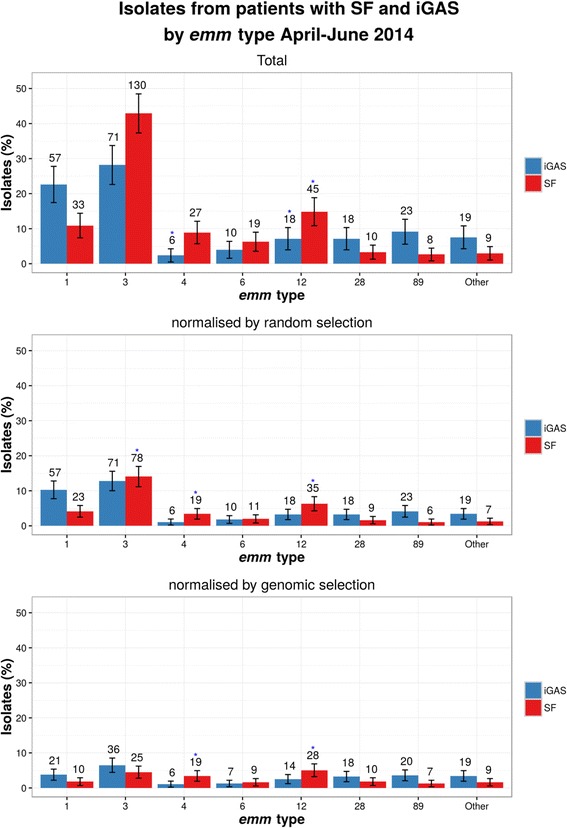
555 isolates were analysed, 303 from patients with SF and 252 from patients with iGAS. Isolates from patients with SF were of multiple distinct emm sequence types and phylogenetic lineages. Prior to data normalisation, emm3 was the predominant type (accounting for 42.9% of SF isolates, 130/303 95%CI 37.5-48.5; 14.7% higher than the percentage of emm3 isolates found in the iGAS isolates). Post-normalisation emm types, 4 and 12, were found to be over-represented in patients with SF versus iGAS (p < 0.001). A single gene, ssa, was over-represented in isolates from patients with SF. No single phage was found to be over represented in SF vs iGAS. However, a "meta-ssa" phage defined by the presence of :315.2, SPsP6, MGAS10750.3 or HK360ssa, was found to be over represented. The HKU360.vir phage was not detected yet the HKU360.ssa phage was present in 43/63 emm12 isolates but not found to be over-represented in isolates from patients with SF.
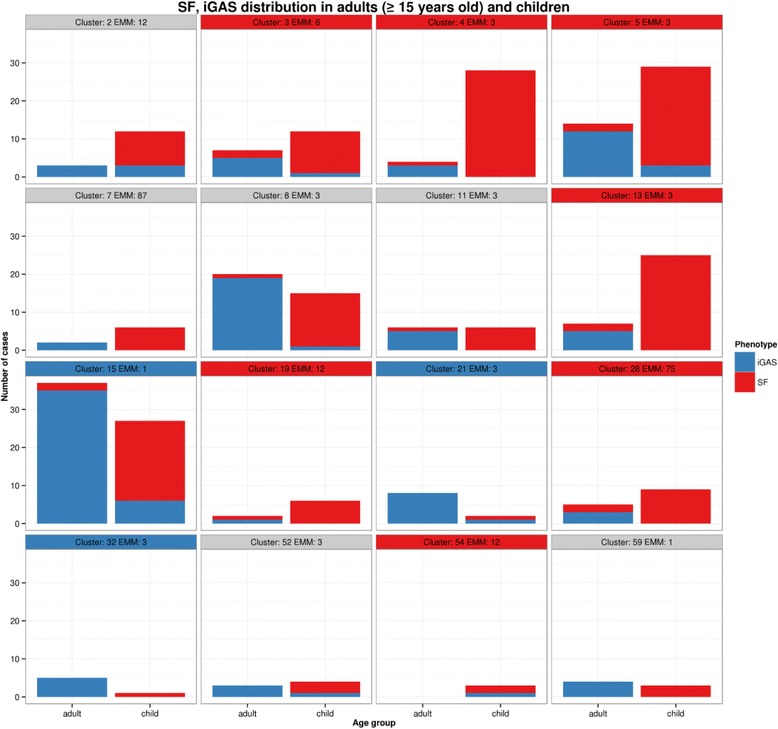
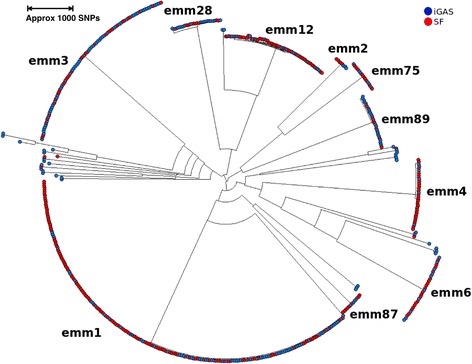
There is no evidence that the increased number of SF cases was a strain-specific or known mobile element specific phenomenon, as the increase in SF cases was associated with multiple lineages of GAS.
2014年猩红热(SF)报告病例大幅增加期间,开展了一项全国性基因组研究,对来自SF患者的化脓性链球菌(A组链球菌,GAS)分离株与侵袭性疾病患者(iGAS)的分离株进行比较,以检验以下假设:SF病例增加是由于英格兰人群中引入了一种或多种新出现的菌株,或者是通过水平基因转移(HGT)在GAS菌群中传播了一种已知的遗传元件,导致感染后引起SF的可能性增加。收集分离株以提供地理代表性,于2014年4月1日至2014年6月18日从每个地区收集约5%的SF分离株。纳入了可获得基因组数据的同期iGAS分离株进行比较。对数据进行分析,以确定emm基因序列类型、系统发育谱系和基因组分支代表性、已知前噬菌体元件的存在情况以及已知赋予致病性和抗生素耐药性的基因的存在情况。
共分析了555株分离株,其中303株来自SF患者,252株来自iGAS患者。SF患者的分离株具有多种不同的emm序列类型和系统发育谱系。在数据标准化之前,emm3是主要类型(占SF分离株的42.9%,130/303,95%CI 37.5 - 48.5;比iGAS分离株中emm3分离株的百分比高14.7%)。标准化后,发现emm4和emm12类型在SF患者中相对于iGAS患者过度富集(p < 0.001)。单个基因ssa在SF患者的分离株中过度富集。在SF与iGAS的比较中,未发现单个噬菌体过度富集。然而,由:315.2、SPsP6、MGAS10750.3或HK360ssa的存在所定义的“meta - ssa”噬菌体被发现过度富集。未检测到HKU360.vir噬菌体,但HKU360.ssa噬菌体存在于43/63株emm12分离株中,且在SF患者的分离株中未发现过度富集。
没有证据表明SF病例数增加是菌株特异性或已知可移动元件特异性现象,因为SF病例增加与GAS的多个谱系相关。