Taketani Yukako, Mayama Chihiro, Suzuki Noriyuki, Wada Akiko, Oka Tatsuhiro, Inamochi Kazuya, Nomoto Yohei
Department of Ophthalmology, The University of Tokyo Graduate School of Medicine, Tokyo, Japan; Department of Ophthalmology, Asahi General Hospital, Chiba, Japan.
Department of Ophthalmology, The University of Tokyo Graduate School of Medicine, Tokyo, Japan.
PLoS One. 2015 Apr 23;10(4):e0123361. doi: 10.1371/journal.pone.0123361. eCollection 2015.
Robot-assisted laparoscopic radical prostatectomy (RALP) is a minimally invasive surgical procedure for prostate cancer. During RALP, the patient must be in a steep Trendelenburg (head-down) position, which leads to a significant increase in intraocular pressure (IOP). The association of RALP with visual field sensitivity, however, has not been prospectively studied. The purpose of this study was to evaluate prospectively the visual field, retinal nerve fiber layer (RNFL) thickness, and optic disc morphology in 50 normal eyes of 25 male patients that underwent RALP.
The subjects were 25 males among 33 consecutive patients who underwent uneventful RALP under general anesthesia in our hospital. Visual field tests using the Humphrey visual field analyzer 30-2 SITA-standard program were performed before, 7 days after, and 1-3 months after RALP. IOP was measured before, during, and after RALP; and ophthalmologic examinations, including slit-lamp, fundus examination, and optical coherence tomography (OCT), were scheduled before and 7 days after surgery.
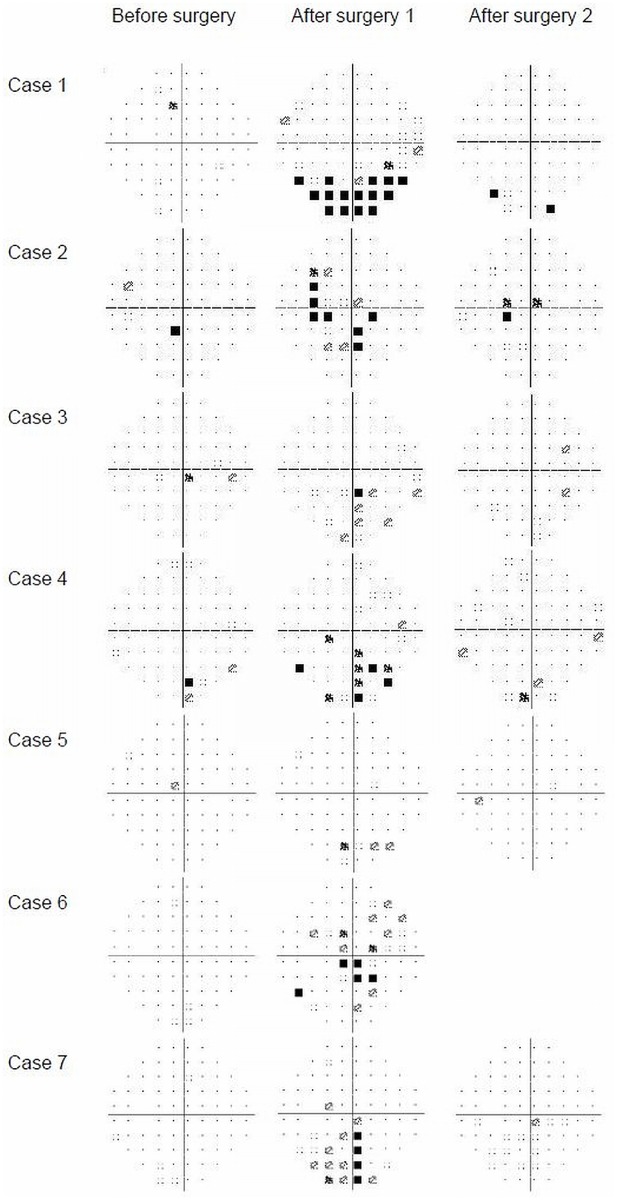
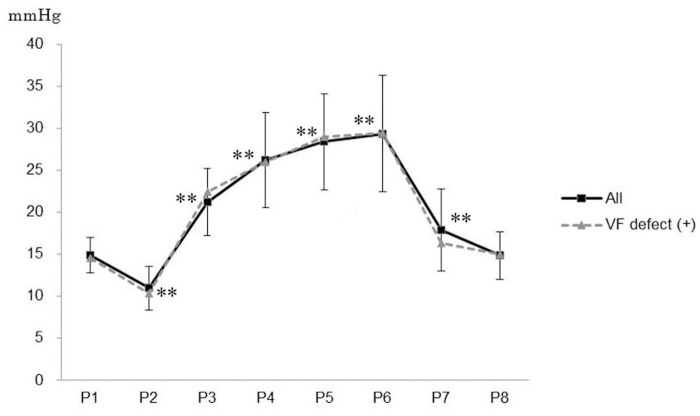
IOP was significantly increased during RALP up to 29.4 mmHg (P<0.01). Postoperative local visual field defects were detected in 7 eyes of 7 subjects dominantly in the lower hemifield without abnormal findings in the optic nerve head or retina, and the visual field recovered to normal within 3 months after surgery. General factors associated with RALP, IOP, RNFL thickness, or optic disc parameters did not differ significantly between eyes with and without postoperative visual field defects, and parameters of OCT measurements were not altered after surgery.
Transient but significant unilateral visual field defects were found in 28% of the subjects examined. The probable cause are the increased IOP and altered perfusion during surgery and ophthalmologic examinations are therefore suggested before and after RALP.
机器人辅助腹腔镜根治性前列腺切除术(RALP)是一种用于前列腺癌的微创手术。在RALP手术过程中,患者必须处于陡峭的头低脚高位(Trendelenburg位),这会导致眼内压(IOP)显著升高。然而,RALP与视野敏感度之间的关系尚未进行前瞻性研究。本研究的目的是前瞻性评估25例接受RALP手术的男性患者50只正常眼睛的视野、视网膜神经纤维层(RNFL)厚度和视盘形态。
研究对象为我院33例连续接受全身麻醉下顺利完成RALP手术患者中的25例男性。在RALP手术前、术后7天以及术后1 - 3个月,使用Humphrey视野分析仪30 - 2 SITA标准程序进行视野测试。在RALP手术前、手术期间和手术后测量眼压;并在手术前和术后7天安排眼科检查,包括裂隙灯检查、眼底检查和光学相干断层扫描(OCT)。
RALP手术期间眼压显著升高至29.4 mmHg(P<0.01)。7名受试者的7只眼睛检测到术后局部视野缺损,主要位于下半视野,视神经乳头或视网膜无异常发现,术后3个月内视野恢复正常。有和没有术后视野缺损的眼睛之间,与RALP、眼压、RNFL厚度或视盘参数相关的一般因素无显著差异,且OCT测量参数术后未改变。
在所检查的受试者中,28%发现了短暂但显著的单侧视野缺损。可能的原因是手术期间眼压升高和灌注改变,因此建议在RALP手术前后进行眼科检查。