Yu Jihion, Hong Jun Hyuk, Park Jun-Young, Hwang Jai-Hyun, Cho Seong-Sik, Kim Young-Kug
Department of Anesthesiology and Pain Medicine, Asan Medical Center, University of Ulsan College of Medicine, 88, Olympic-ro 43-gil, Songpa-gu, Seoul, 05505, Republic of Korea.
Department of Urology, Asan Medical Center, University of Ulsan College of Medicine, Seoul, 05505, Republic of Korea.
BMC Anesthesiol. 2018 Jun 20;18(1):72. doi: 10.1186/s12871-018-0523-7.
Robot-assisted laparoscopic prostatectomy (RALP) requires pneumoperitoneum and the Trendelenburg position to optimize surgical exposure, which can increase intracranial pressure (ICP). Anesthetic agents also influence ICP. We compared the effects of propofol and sevoflurane on sonographic optic nerve sheath diameter (ONSD) as a surrogate for ICP in prostate cancer patients who underwent RALP.
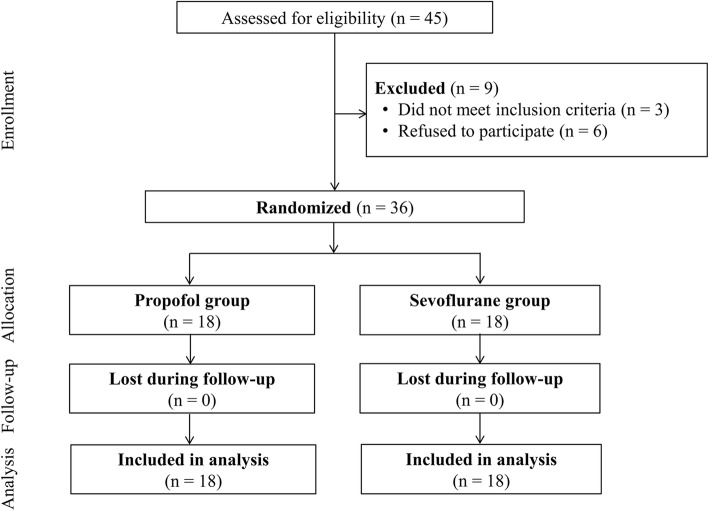
Thirty-six patients were randomly allocated to groups receiving propofol (propofol group, n = 18) or sevoflurane (sevoflurane group, n = 18) anesthesia. The ONSD was measured 10 min after induction of anesthesia in the supine position (T1); 5 min (T2), 30 min (T3), and 60 min (T4) after establishing pneumoperitoneum and the Trendelenburg position; and at the end of surgery after desufflation in the supine position (T5). Respiratory and hemodynamic variables were also evaluated.
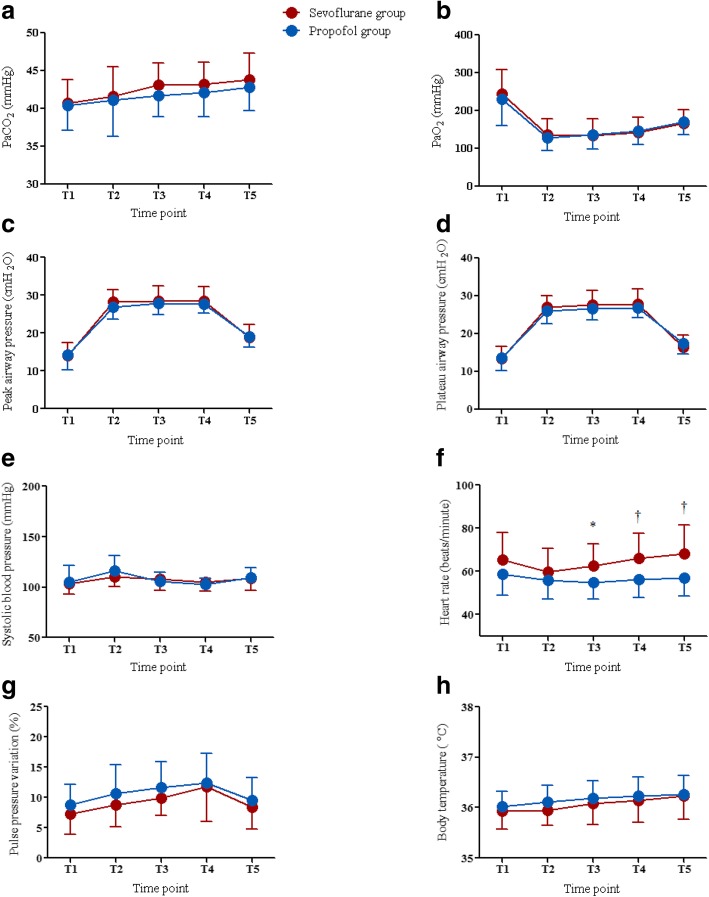
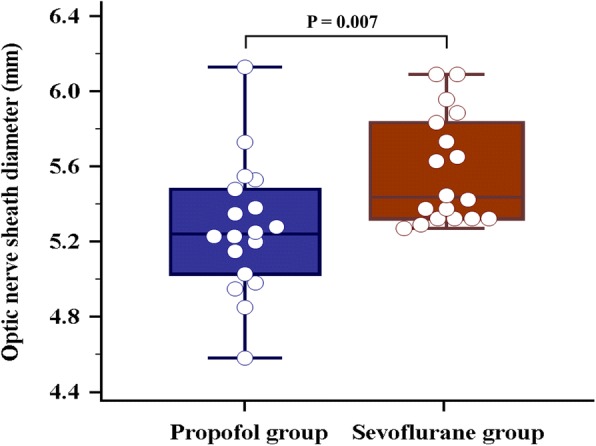
The ONSD was significantly different between the propofol group and the sevoflurane group at T4 (5.27 ± 0.35 mm vs. 5.57 ± 0.28 mm, P = 0.007), but not at other time points. The ONSDs at T2, T3, T4, and T5 were significantly greater than at T1 in both groups (all P < 0.001). Arterial carbon dioxide partial pressure, arterial oxygen partial pressure, peak airway pressure, plateau airway pressure, systolic blood pressure, pulse pressure variation, body temperature and regional cerebral oxygen saturation, except heart rate, were not significantly different between the two groups.
The ONSD was significantly lower during propofol anesthesia than during sevoflurane anesthesia 60 min after pneumoperitoneum and the Trendelenburg position, suggesting that propofol anesthesia may help minimize ICP changes in robotic prostatectomy patients.
Clinicaltrials.gov identifier: NCT03271502 . Registered August 31, 2017.
机器人辅助腹腔镜前列腺切除术(RALP)需要气腹和头低脚高位以优化手术视野,这会增加颅内压(ICP)。麻醉药物也会影响颅内压。我们比较了丙泊酚和七氟醚对接受RALP的前列腺癌患者超声视神经鞘直径(ONSD)的影响,以此作为颅内压的替代指标。
36例患者被随机分为接受丙泊酚麻醉的组(丙泊酚组,n = 18)和接受七氟醚麻醉的组(七氟醚组,n = 18)。在仰卧位麻醉诱导后10分钟(T1)、建立气腹和头低脚高位后5分钟(T2)、30分钟(T3)和60分钟(T4)以及仰卧位放气后手术结束时(T5)测量ONSD。还评估了呼吸和血流动力学变量。
丙泊酚组和七氟醚组在T4时的ONSD有显著差异(5.27±0.35mm对5.57±0.28mm,P = 0.007),但在其他时间点无差异。两组在T2、T3、T4和T5时的ONSD均显著大于T1时(所有P < 0.001)。除心率外,两组的动脉二氧化碳分压、动脉氧分压、气道峰压、平台气道压、收缩压、脉压变异、体温和局部脑氧饱和度无显著差异。
气腹和头低脚高位60分钟后,丙泊酚麻醉期间的ONSD显著低于七氟醚麻醉期间,提示丙泊酚麻醉可能有助于使机器人前列腺切除术患者的颅内压变化最小化。
Clinicaltrials.gov标识符:NCT03271502。2017年8月31日注册。