Green Manfred S, Hayek Samah, Tarabeia Jalal, Yehia Mohammad, HaGani Neta
School of Public Health, University of Haifa, Abba Hushi 199, Haifa, Israel.
Faculty of Nursing, The Yezreel Valley College, Afula, Israel.
Isr J Health Policy Res. 2017 Mar 7;6:12. doi: 10.1186/s13584-017-0137-4. eCollection 2017.
Knowledge and understanding of what health insurance covers is an important public health issue. In Israel, whereas national health insurance covers all residents, optional supplemental health insurance (SHI) can be purchased from the healthcare providers, for additional, special services. The purpose of this study was to identify disparities between Jews and Arabs in their knowledge and understanding of SHI.
National, cross-sectional, telephone survey using a structured questionnaire, among random samples of 814 Jews and 800 Arabs. Knowledge and understanding of health insurance was assessed by a score based on correct answers to 8 questions. Log-linear regression was used to estimate association between health insurance knowledge and population group, after controlling for potential confounding independent variables.
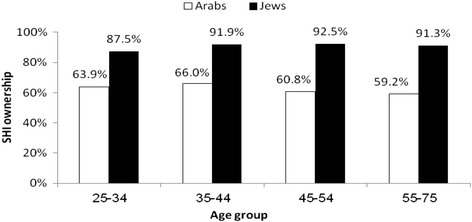
Ninety one percent of Jews and 62% of Arabs reported owning SHI. Among both groups, knowledge levels were low on a 0-8 scale. However, the average score for Jews was statistically higher (Mean = 3.50, S.D = 1.69) as compared with Arabs (Mean = 2.78, S.D = 1.70) ( < 0.001). The adjusted health insurance knowledge score was significantly higher among Jews than Arabs (Prevalence ratio = 1.10; 95% CI = 1.06-1.13), indicating that differences remain even after controlling for socio-demographic characteristics and SHI ownership.
There is a large gap between the public's understanding of what is covered by SHI and the services that it covers in practice. Low SHI knowledge and understanding may lead to frustration, and limit access to additional health care among populations that suffer from socio-economic inequalities. These findings emphasize the need to provide clearer and more culturally sensitive information on health insurance coverage.
了解健康保险涵盖的内容是一个重要的公共卫生问题。在以色列,国民健康保险覆盖所有居民,而可选择的补充健康保险(SHI)可以从医疗服务提供者处购买,用于额外的特殊服务。本研究的目的是确定犹太人和阿拉伯人在对补充健康保险的了解方面的差异。
采用结构化问卷进行全国性横断面电话调查,随机抽取814名犹太人和800名阿拉伯人作为样本。通过对8个问题的正确回答得分来评估对健康保险的了解。在控制潜在的混杂自变量后,使用对数线性回归来估计健康保险知识与人群组之间的关联。
91%的犹太人及62%的阿拉伯人报告拥有补充健康保险。在两组中,在0-8分的量表上知识水平都较低。然而,犹太人的平均得分在统计学上高于阿拉伯人(均值 = 3.50,标准差 = 1.69)(均值 = 2.78,标准差 = 1.70)(< 0.001)。调整后的健康保险知识得分犹太人显著高于阿拉伯人(患病率比 = 1.10;95%置信区间 = 1.06-1.13),这表明即使在控制了社会人口学特征和补充健康保险拥有情况后差异仍然存在。
公众对补充健康保险涵盖内容的理解与实际涵盖的服务之间存在很大差距。补充健康保险知识和理解水平低可能导致沮丧情绪,并限制社会经济不平等人群获得额外医疗保健的机会。这些发现强调了需要提供更清晰、更具文化敏感性的健康保险覆盖信息。