Mind and Brain Theme, South Australian Health and Medical Research Institute, North Terrace, Adelaide, SA 5000, Australia.
School of Medicine, Flinders University, Bedford Park, SA 5042, Australia.
Sci Rep. 2017 Mar 13;7:44389. doi: 10.1038/srep44389.
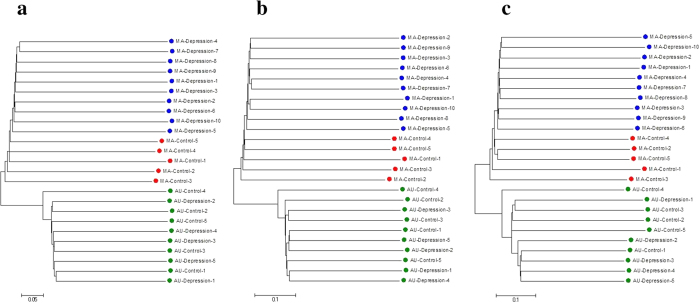
Major depressive disorder (MDD) is highly prevalent, resulting in an exceedingly high disease burden. The identification of generic risk factors could lead to advance prevention and therapeutics. Current approaches examine genotyping data to identify specific variations between cases and controls. Compared to genotyping, whole-genome sequencing (WGS) allows for the detection of private mutations. In this proof-of-concept study, we establish a conceptually novel computational approach that clusters subjects based on the entirety of their WGS. Those clusters predicted MDD diagnosis. This strategy yielded encouraging results, showing that depressed Mexican-American participants were grouped closer; in contrast ethnically-matched controls grouped away from MDD patients. This implies that within the same ancestry, the WGS data of an individual can be used to check whether this individual is within or closer to MDD subjects or to controls. We propose a novel strategy to apply WGS data to clinical medicine by facilitating diagnosis through genetic clustering. Further studies utilising our method should examine larger WGS datasets on other ethnical groups.
重度抑郁症(MDD)的患病率很高,导致疾病负担极其沉重。识别通用风险因素可能有助于提前预防和治疗。目前的方法检查基因分型数据以确定病例和对照组之间的特定变异。与基因分型相比,全基因组测序(WGS)允许检测私人突变。在这项概念验证研究中,我们建立了一种概念新颖的计算方法,该方法基于 WGS 的全部内容对受试者进行聚类。这些聚类预测了 MDD 的诊断。该策略产生了令人鼓舞的结果,表明抑郁的墨西哥裔美国参与者被分组得更接近;相比之下,种族匹配的对照组与 MDD 患者分组更远。这意味着在同一祖先中,可以使用个体的 WGS 数据来检查该个体是否在 MDD 受试者或对照者内部或更接近 MDD 受试者。我们提出了一种通过遗传聚类促进诊断将 WGS 数据应用于临床医学的新策略。利用我们的方法进行的进一步研究应该在其他种族群体上检查更大的 WGS 数据集。