Shen-Gunther Jane, Wang Yufeng, Lai Zhao, Poage Graham M, Perez Luis, Huang Tim H M
Department of Clinical Investigation, Brooke Army Medical Center, Gynecologic Oncology & Clinical Investigation, 3698 Chambers Pass, Fort Sam Houston, TX, 78234, USA.
Department of Biology, University of Texas at San Antonio, San Antonio, TX, 78249, USA.
BMC Genomics. 2017 Mar 14;18(1):231. doi: 10.1186/s12864-017-3612-y.
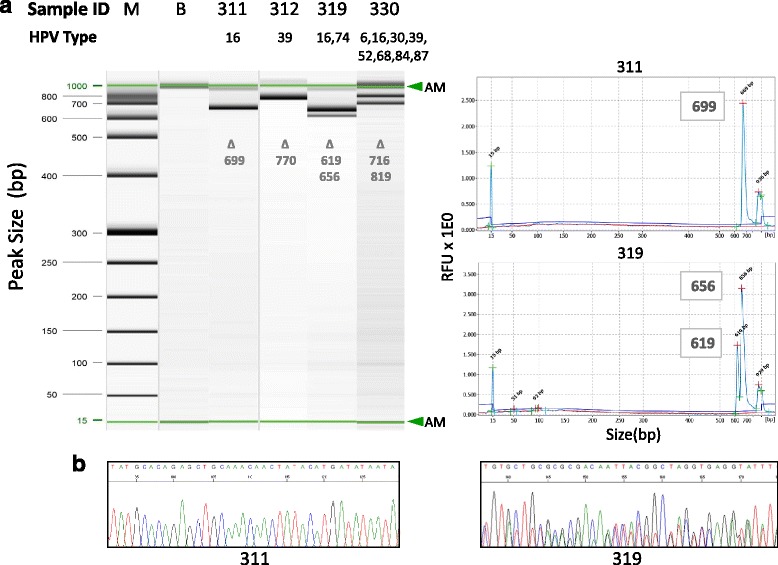
Human papillomavirus (HPV) is the carcinogen of almost all invasive cervical cancer and a major cause of oral and other anogenital malignancies. HPV genotyping by dideoxy (Sanger) sequencing is currently the reference method of choice for clinical diagnostics. However, for samples with multiple HPV infections, genotype identification is singular and occasionally imprecise or indeterminable due to overlapping chromatograms. Our aim was to explore and compare HPV metagenomes in abnormal cervical cytology by deep sequencing for correlation with disease states.
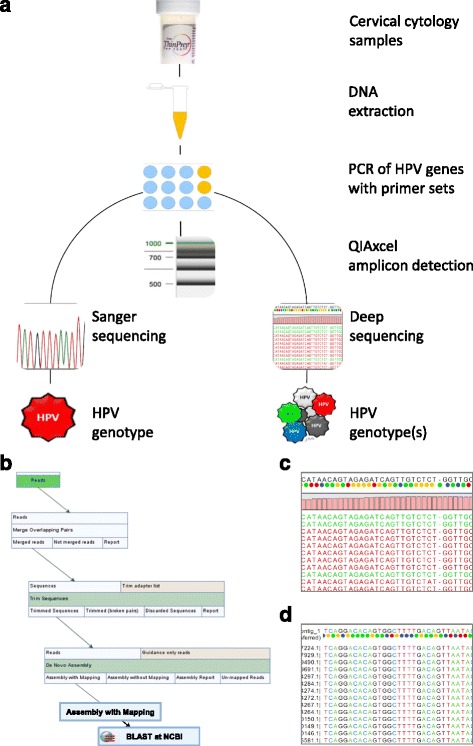
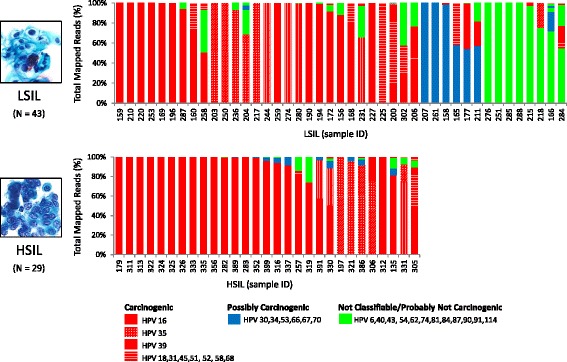
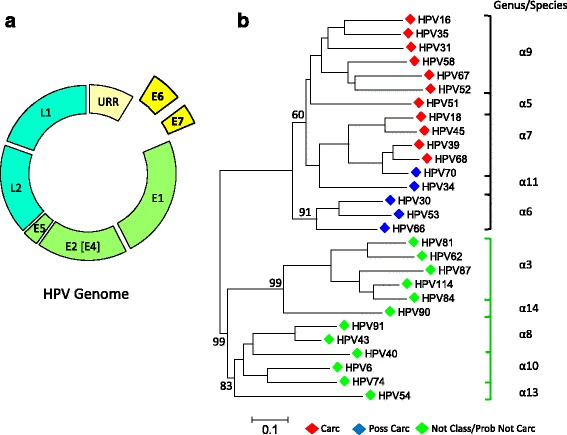
Low- and high-grade intraepithelial lesion (LSIL and HSIL) cytology samples were DNA extracted for PCR-amplification of the HPV E6/E7 genes. HPV+ samples were sequenced by dideoxy and deep methods. Deep sequencing revealed ~60% of all samples (n = 72) were multi-HPV infected. Among LSIL samples (n = 43), 27 different genotypes were found. The 3 dominant (most abundant) genotypes were: HPV-39, 11/43 (26%); -16, 9/43 (21%); and -35, 4/43 (9%). Among HSIL (n = 29), 17 HPV genotypes were identified; the 3 dominant genotypes were: HPV-16, 21/29 (72%); -35, 4/29 (14%); and -39, 3/29 (10%). Phylogenetically, type-specific E6/E7 genetic distances correlated with carcinogenic potential. Species diversity analysis between LSIL and HSIL revealed loss of HPV diversity and domination by HPV-16 in HSIL samples.
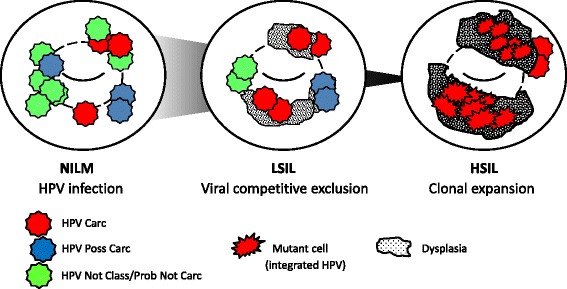
Deep sequencing resolves HPV genotype composition within multi-infected cervical cytology. Biodiversity analysis reveals loss of diversity and gain of dominance by carcinogenic genotypes in high-grade cytology. Metagenomic profiles may therefore serve as a biomarker of disease severity and a population surveillance tool for emerging genotypes.
人乳头瘤病毒(HPV)是几乎所有浸润性宫颈癌的致癌原,也是口腔及其他肛门生殖器恶性肿瘤的主要病因。通过双脱氧(桑格)测序进行HPV基因分型是目前临床诊断的首选参考方法。然而,对于多重HPV感染的样本,由于色谱图重叠,基因型鉴定单一,偶尔不准确或无法确定。我们的目的是通过深度测序探索和比较异常宫颈细胞学中的HPV宏基因组,以与疾病状态相关联。
对低级别和高级别上皮内瘤变(LSIL和HSIL)细胞学样本进行DNA提取,用于HPV E6/E7基因的PCR扩增。对HPV阳性样本采用双脱氧测序法和深度测序法进行测序。深度测序显示,所有样本(n = 72)中约60%为多重HPV感染。在LSIL样本(n = 43)中,发现了27种不同基因型。三种主要(最丰富)基因型为:HPV-39,11/43(26%);-16,9/43(21%);-35,4/43(9%)。在HSIL样本(n = 29)中,鉴定出17种HPV基因型;三种主要基因型为:HPV-16,21/29(72%);-35,4/29(14%);-39,3/29(10%)。在系统发育上,特定类型的E6/E7基因距离与致癌潜力相关。LSIL和HSIL之间的物种多样性分析显示,HSIL样本中HPV多样性丧失,HPV-16占主导地位。
深度测序可解析多重感染宫颈细胞学中的HPV基因型组成。生物多样性分析显示,高级别细胞学中致癌基因型的多样性丧失和优势增加。因此,宏基因组图谱可作为疾病严重程度的生物标志物和新出现基因型的人群监测工具。