Kubo Terufumi, Sugita Shintaro, Wada Ryuichi, Kikuchi Noriaki, Iwasaki Masahiro, Ito Yumika, Sugawara Taro, Fujita Hiromi, Emori Makoto, Tanaka Ryoichi, Hirano Hiroshi, Saito Tsuyoshi, Hasegawa Tadashi
Department of Surgical Pathology, School of Medicine, Sapporo Medical University, South 1, West 16, Chuo-ku, Sapporo, Hokkaido, 060-8543, Japan.
Department of Integrated Diagnostic Pathology, Nippon Medical School, Tokyo, Japan.
Diagn Pathol. 2017 Mar 14;12(1):26. doi: 10.1186/s13000-017-0615-6.
Uterine sarcoma is a rare tumor that is often difficult to classify based on morphological and immunohistochemical analysis alone. Limited access to molecular biological analysis in routine practice would hinder making a definitive diagnosis.
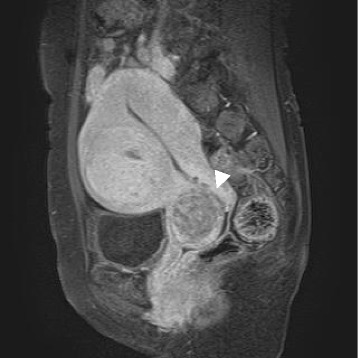
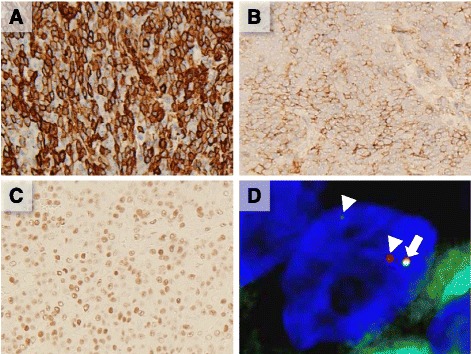
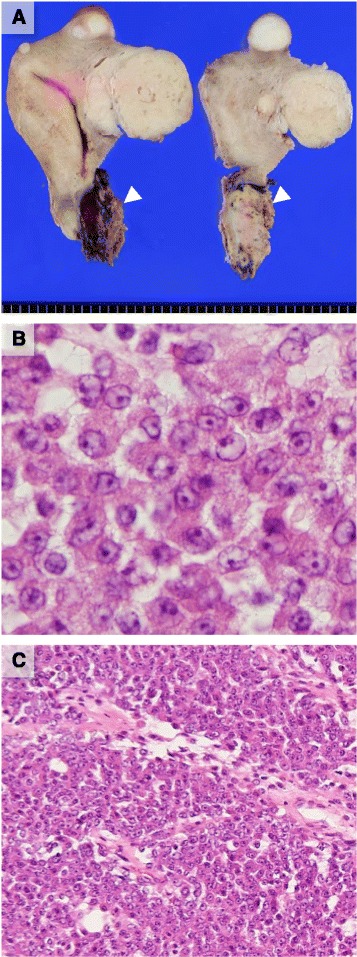
In this report, we describe a case of a mesenchymal tumor arising from the uterine cervix in a 52-year-old woman. From microscopic morphology of the resected specimen, epithelioid leiomyosarcoma, high-grade endometrial stromal sarcoma, or uterine gastrointestinal stromal tumor (GIST) were considered as differential diagnoses. The immunophenotype of the tumor featured smooth muscle differentiation and hormone receptor expression. The cell membrane and cytoplasm were positive for c-kit, although no mutation was found in the c-kit or PDGFRA gene. Fluorescence in situ hybridization (FISH) analysis revealed a relatively low frequency of YWHAE rearrangement, whereas there were few NUTM2A and NUTM2B split signals.
In this case, the tumor was not typical of any three of the differential diagnoses mentioned above. However, insufficient frequency of YWHAE, NUTM2A, and NUTM2B gene rearrangement and absence of mutation in both the c-kit and PDGFRA genes suggested that this tumor should be categorized as epithelioid leiomyosarcoma. This is an instructive case showing a potential diagnostic pitfall of uterine sarcoma. Comprehensive approaches including molecular biological techniques are required for definitive diagnosis.
子宫肉瘤是一种罕见肿瘤,仅依靠形态学和免疫组化分析往往难以分类。在常规实践中,分子生物学分析手段有限会妨碍做出明确诊断。
在本报告中,我们描述了一例52岁女性子宫颈间叶组织肿瘤病例。根据切除标本的微观形态,鉴别诊断考虑为上皮样平滑肌肉瘤、高级别子宫内膜间质肉瘤或子宫胃肠道间质瘤(GIST)。肿瘤的免疫表型具有平滑肌分化和激素受体表达特征。肿瘤细胞膜和细胞质c-kit呈阳性,尽管c-kit或血小板衍生生长因子受体A(PDGFRA)基因未发现突变。荧光原位杂交(FISH)分析显示YWHAE重排频率相对较低,而NUTM2A和NUTM2B分裂信号较少。
在该病例中,肿瘤不属于上述三种鉴别诊断中的任何一种典型类型。然而,YWHAE、NUTM2A和NUTM2B基因重排频率不足以及c-kit和PDGFRA基因均无突变提示该肿瘤应归类为上皮样平滑肌肉瘤。这是一个具有指导意义的病例,显示了子宫肉瘤潜在的诊断陷阱。明确诊断需要包括分子生物学技术在内的综合方法。