Ashok A H, Marques T R, Jauhar S, Nour M M, Goodwin G M, Young A H, Howes O D
Psychiatric Imaging Group, MRC London Institute of Medical Sciences, Hammersmith Hospital, Imperial College London, London, UK.
Psychiatric Imaging Group, Institute of Clinical Sciences (ICS), Faculty of Medicine, Imperial College London, London, UK.
Mol Psychiatry. 2017 May;22(5):666-679. doi: 10.1038/mp.2017.16. Epub 2017 Mar 14.
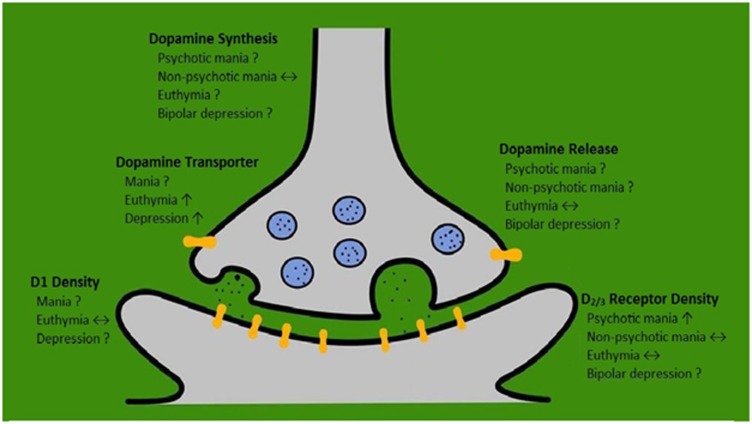
Bipolar affective disorder is a common neuropsychiatric disorder. Although its neurobiological underpinnings are incompletely understood, the dopamine hypothesis has been a key theory of the pathophysiology of both manic and depressive phases of the illness for over four decades. The increased use of antidopaminergics in the treatment of this disorder and new in vivo neuroimaging and post-mortem studies makes it timely to review this theory. To do this, we conducted a systematic search for post-mortem, pharmacological, functional magnetic resonance and molecular imaging studies of dopamine function in bipolar disorder. Converging findings from pharmacological and imaging studies support the hypothesis that a state of hyperdopaminergia, specifically elevations in D2/3 receptor availability and a hyperactive reward processing network, underlies mania. In bipolar depression imaging studies show increased dopamine transporter levels, but changes in other aspects of dopaminergic function are inconsistent. Puzzlingly, pharmacological evidence shows that both dopamine agonists and antidopaminergics can improve bipolar depressive symptoms and perhaps actions at other receptors may reconcile these findings. Tentatively, this evidence suggests a model where an elevation in striatal D2/3 receptor availability would lead to increased dopaminergic neurotransmission and mania, whilst increased striatal dopamine transporter (DAT) levels would lead to reduced dopaminergic function and depression. Thus, it can be speculated that a failure of dopamine receptor and transporter homoeostasis might underlie the pathophysiology of this disorder. The limitations of this model include its reliance on pharmacological evidence, as these studies could potentially affect other monoamines, and the scarcity of imaging evidence on dopaminergic function. This model, if confirmed, has implications for developing new treatment strategies such as reducing the dopamine synthesis and/or release in mania and DAT blockade in bipolar depression.
双相情感障碍是一种常见的神经精神疾病。尽管其神经生物学基础尚未完全明确,但在过去四十多年里,多巴胺假说一直是该疾病躁狂和抑郁发作期病理生理学的关键理论。在这种疾病的治疗中,抗多巴胺能药物的使用日益增加,同时新的体内神经影像学和尸检研究也使得对这一理论进行回顾变得恰逢其时。为此,我们对双相情感障碍中多巴胺功能的尸检、药理学、功能磁共振和分子成像研究进行了系统检索。药理学和成像研究的一致结果支持了这样一种假说,即多巴胺能亢进状态,特别是D2/3受体可用性增加和奖赏处理网络过度活跃,是躁狂症的基础。在双相抑郁症中,成像研究显示多巴胺转运体水平升高,但多巴胺能功能其他方面的变化并不一致。令人困惑的是,药理学证据表明多巴胺激动剂和抗多巴胺能药物都能改善双相抑郁症状,或许作用于其他受体的效应可以解释这些发现。初步来看,这一证据提示了一个模型:纹状体D2/3受体可用性升高会导致多巴胺能神经传递增加和躁狂,而纹状体多巴胺转运体(DAT)水平升高会导致多巴胺能功能降低和抑郁。因此,可以推测多巴胺受体和转运体稳态失衡可能是该疾病病理生理学的基础。该模型的局限性包括其对药理学证据的依赖,因为这些研究可能会潜在地影响其他单胺类物质,以及关于多巴胺能功能的成像证据较少。如果这一模型得到证实,将对开发新的治疗策略具有启示意义,例如在躁狂症中减少多巴胺合成和/或释放,以及在双相抑郁症中阻断DAT。