The Huck Institutes of Life Sciences, The Pennsylvania State University, University Park, PA, 16802, USA.
Department of Biomedical Engineering, The Pennsylvania State University, W-341 Millennium Science Complex, University Park, PA, 16802, USA.
Brain Struct Funct. 2017 Sep;222(7):3205-3216. doi: 10.1007/s00429-017-1396-0. Epub 2017 Mar 13.
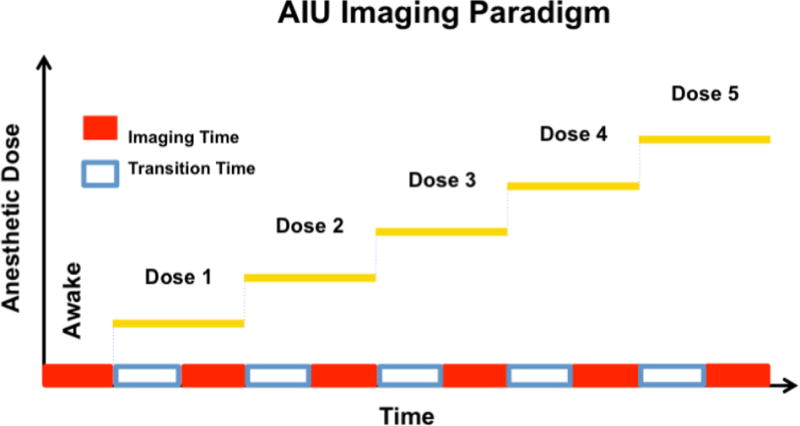
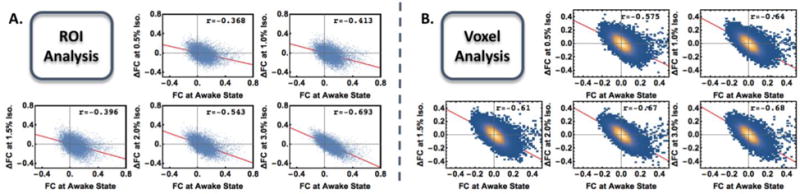
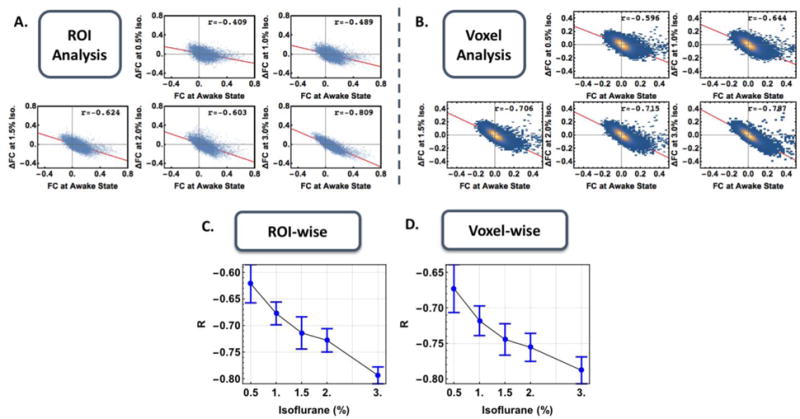
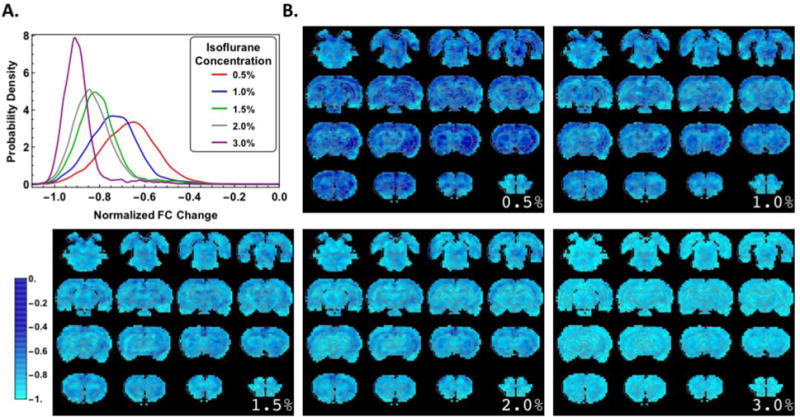
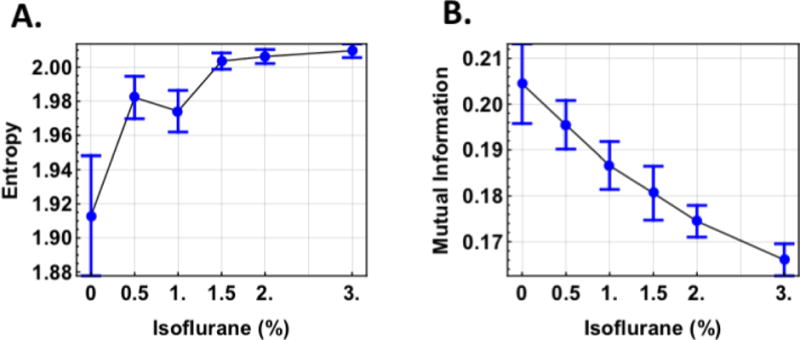
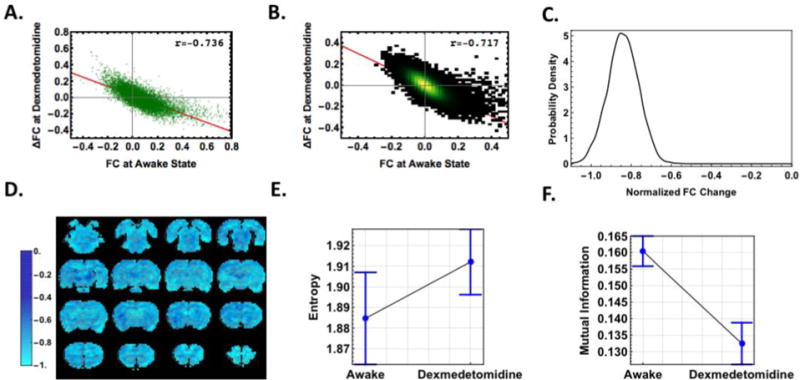
During anesthetic-induced unconsciousness (AIU), the brain undergoes a dramatic change in its capacity to exchange information between regions. However, the spatial distribution of information exchange loss/gain across the entire brain remains elusive. In the present study, we acquired and analyzed resting-state functional magnetic resonance imaging (rsfMRI) data in rats during wakefulness and graded levels of consciousness induced by incrementally increasing the concentration of isoflurane. We found that, regardless of spatial scale, the functional connectivity (FC) change (i.e., ∆FC) was proportionally dependent on the FC strength at the awake state across all connections. This dependency became stronger at higher doses of isoflurane. In addition, the relative FC change at each anesthetized condition (i.e., ∆FC normalized to the corresponding FC strength at the awake state) was exclusively negative across the whole brain, indicating a global loss of meaningful information exchange between brain regions during AIU. To further support this notion, we showed that during unconsciousness, the entropy of rsfMRI signal increased to a value comparable to random noise while the mutual information decreased appreciably. Importantly, consistent results were obtained when unconsciousness was induced by dexmedetomidine, an anesthetic agent with a distinct molecular action than isoflurane. This result indicates that the observed global reduction in information exchange may be agent invariant. Taken together, these findings provide compelling neuroimaging evidence suggesting that the brain undergoes a widespread disruption in the exchange of meaningful information during AIU and that this phenomenon may represent a common system-level neural mechanism of AIU.
在麻醉诱导的无意识(AIU)期间,大脑在区域之间交换信息的能力发生了巨大变化。然而,整个大脑中信息交换损失/增益的空间分布仍然难以捉摸。在本研究中,我们在清醒状态和递增异氟醚浓度诱导的不同意识水平下获取并分析了大鼠的静息态功能磁共振成像(rsfMRI)数据。我们发现,无论空间尺度如何,功能连接(FC)变化(即 ∆FC)与所有连接在清醒状态下的 FC 强度成正比。这种依赖性在异氟醚剂量更高时更强。此外,在每个麻醉状态下的相对 FC 变化(即 ∆FC 相对于清醒状态下的相应 FC 强度归一化)在整个大脑中均为负,表明在 AIU 期间大脑区域之间的有意义信息交换普遍丧失。为了进一步支持这一观点,我们表明在无意识状态下,rsfMRI 信号的熵增加到与随机噪声相当的值,而互信息则显著降低。重要的是,当使用具有与异氟醚不同分子作用的麻醉剂右美托咪定时,也获得了一致的结果。这一结果表明,观察到的信息交换总体减少可能是药物不变的。总之,这些发现提供了令人信服的神经影像学证据,表明大脑在 AIU 期间经历了有意义信息交换的广泛破坏,并且这种现象可能代表 AIU 的共同系统级神经机制。