Gupta Arjun, Pandey Ambarish, Ayers Colby, Beg Muhammad S, Lakoski Susan G, Vega Gloria L, Grundy Scott M, Johnson David H, Neeland Ian J
Department of Internal Medicine, University of Texas Southwestern Medical Center, Dallas, TX.
Division of Cardiology, University of Texas Southwestern Medical Center, Dallas, TX.
Mayo Clin Proc. 2017 Apr;92(4):536-543. doi: 10.1016/j.mayocp.2016.12.023. Epub 2017 Mar 11.
To examine the association between specific adipose tissue depots and the risk of incident cancer in the Dallas Heart Study.
Individuals without prevalent cancer in the Dallas Heart Study underwent quantification of adipose depots: visceral adipose tissue (VAT), abdominal subcutaneous adipose tissue, and liver fat by magnetic resonance imaging, and subcutaneous lower-body fat (LBF) by dual-energy X-ray absorptiometry from January 1, 2000, through December 31, 2002, and were observed for the development of cancer for up to 12 years. Multivariable Cox proportional hazards modeling was performed to examine the association between fat depots and cancer.
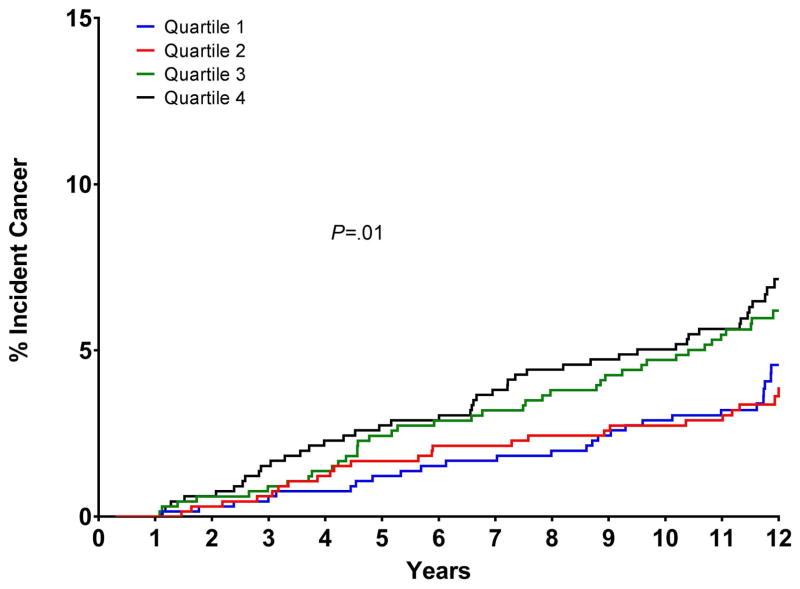
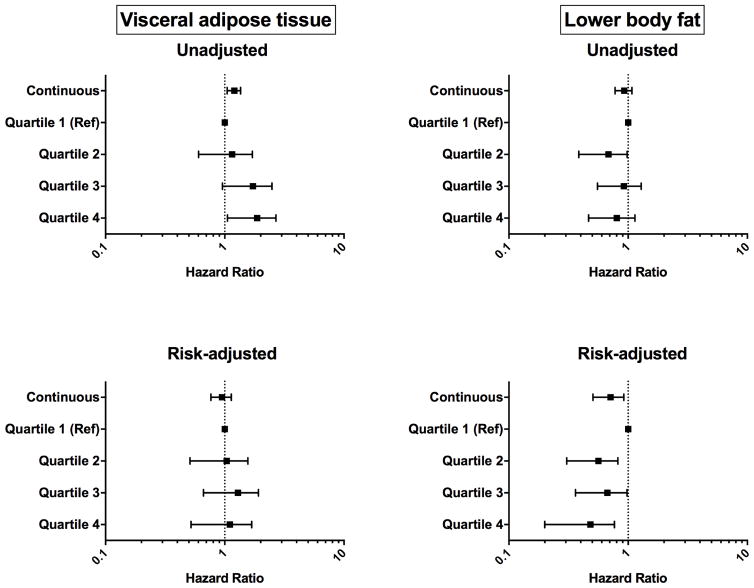
Of 2627 participants (median age, 43 years; 69% nonwhite race), 167 (6.4%) developed cancer. The most common primary sites of cancer were the breast (in women) and the prostate (in men). In multivariable models adjusted for age, sex, race, smoking, alcohol use, family history of malignancy, and body mass index, a 1-SD increase in VAT was not associated with increased risk of cancer (hazard ratio [HR], 0.94; 95% CI, 0.77-1.14). In contrast, each 1-SD increase in LBF was associated with a reduced incidence of cancer (HR, 0.69; 95% CI, 0.52-0.92) in the fully adjusted model.
In this study, adiposity-associated cancer risk was heterogeneous and varied by fat depot: VAT was not independently associated with incident cancer, and LBF seemed to protect against cancer development. Further studies of the adiposity-cancer relationship, including serial assessments, are needed to better elucidate this relationship.
在达拉斯心脏研究中,探究特定脂肪组织储存库与新发癌症风险之间的关联。
达拉斯心脏研究中无癌症病史的个体,于2000年1月1日至2002年12月31日期间,通过磁共振成像对脂肪储存库进行定量分析,包括内脏脂肪组织(VAT)、腹部皮下脂肪组织和肝脏脂肪,并通过双能X线吸收法对皮下下身脂肪(LBF)进行定量分析,随后对这些个体进行长达12年的癌症发生情况观察。采用多变量Cox比例风险模型来研究脂肪储存库与癌症之间的关联。
在2627名参与者(中位年龄43岁;69%为非白人种族)中,167人(6.4%)患癌。最常见的癌症原发部位是女性的乳房和男性的前列腺。在调整了年龄、性别、种族、吸烟、饮酒、恶性肿瘤家族史和体重指数的多变量模型中,VAT增加1个标准差与癌症风险增加无关(风险比[HR],0.94;95%置信区间,0.77 - 1.14)。相比之下,在完全调整模型中,LBF每增加1个标准差与癌症发病率降低相关(HR,0.69;95%置信区间,0.52 - 0.92)。
在本研究中,肥胖相关的癌症风险具有异质性,且因脂肪储存库而异:VAT与新发癌症无独立关联,而LBF似乎可预防癌症发生。需要进一步开展肥胖与癌症关系的研究,包括系列评估,以更好地阐明这种关系。