Carroll Shannon H, Zhang Ellen, Wang Bing F, LeClair Katherine B, Rahman Arifeen, Cohen David E, Plutzky Jorge, Patwari Parth, Lee Richard T
Harvard Stem Cell Institute and Department of Stem Cell and Regenerative Biology, Harvard University, Cambridge, Massachusetts, United States of America.
Division of Gastroenterology, Hepatology and Endoscopy, Brigham and Women's Hospital and Harvard Medical School, Boston, Massachusetts, United States of America.
PLoS One. 2017 Mar 14;12(3):e0173823. doi: 10.1371/journal.pone.0173823. eCollection 2017.
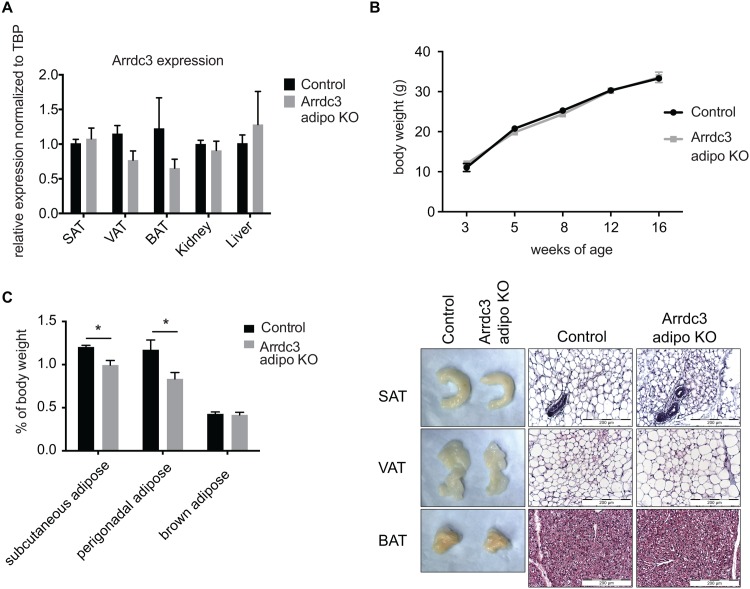
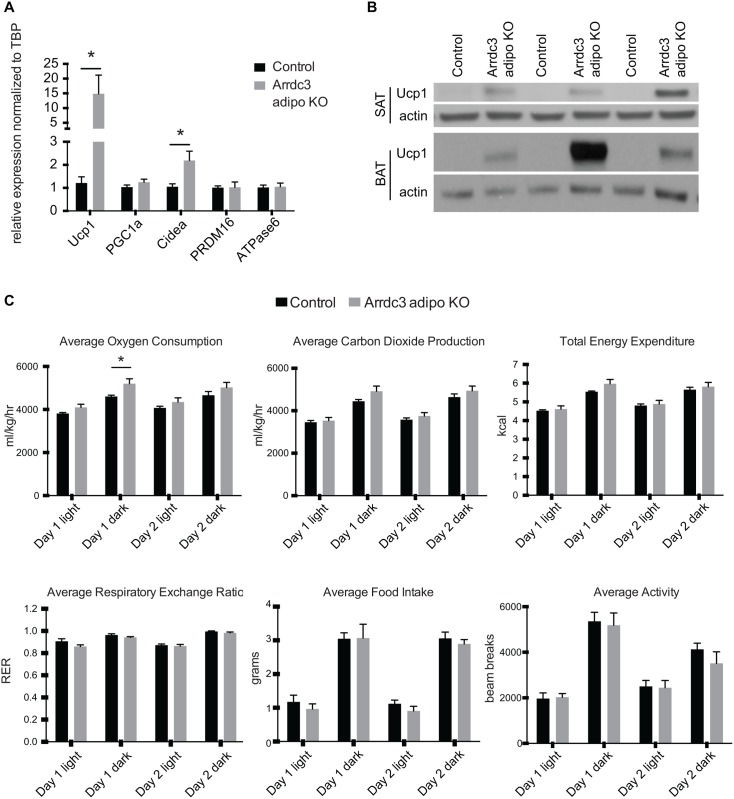
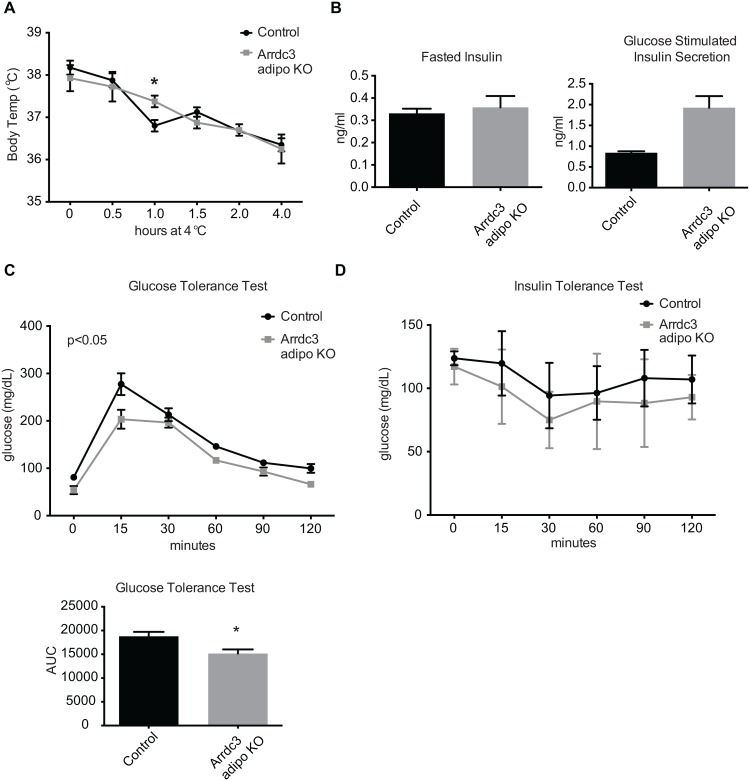
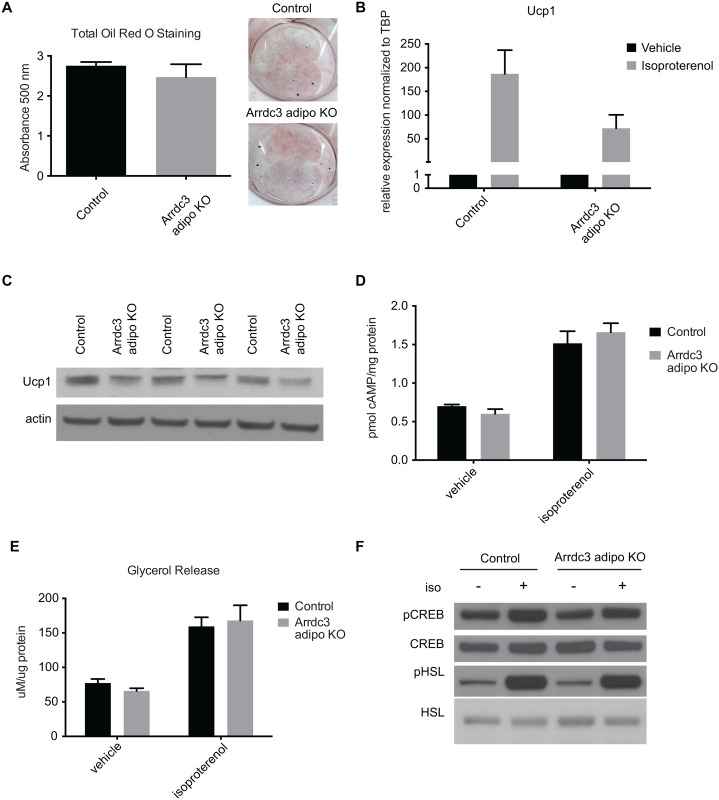
Adaptive thermogenesis and cold-induced activation of uncoupling protein 1 (Ucp1) in brown adipose tissue in rodents is well-described and attributed to sympathetic activation of β-adrenergic signaling. The arrestin domain containing protein Arrdc3 is a regulator of obesity in mice and also appears linked to obesity in humans. We generated a mouse with conditional deletion of Arrdc3, and here we present evidence that genetic ablation of Arrdc3 specifically in adipocytes results in increased Ucp1 expression in subcutaneous and parametrial adipose tissue. Although this increase in expression did not correspond with significant changes in body weight or energy expenditure, adipocyte-specific Arrdc3-null mice had improved glucose tolerance. It was previously hypothesized that Arrdc3 ablation leads to increased β-adrenergic receptor sensitivity; however, in vitro experiments show that Arrdc3-null adipocytes responded to β-adrenergic receptor agonist with decreased Ucp1 levels. Additionally, canonical β-adrenergic receptor signaling was not different in Arrdc3-null adipocytes. These data reveal a role for Arrdc3 in the regulation of Ucp1 expression in adipocytes. However, this adipocyte effect is insufficient to generate the obesity-resistant phenotype of mice with ubiquitous deletion of Arrdc3, indicating a likely role for Arrdc3 in cells other than adipocytes.
啮齿动物棕色脂肪组织中的适应性产热以及冷诱导的解偶联蛋白1(Ucp1)激活已得到充分描述,并且归因于β-肾上腺素能信号通路的交感神经激活。含抑制蛋白结构域蛋白Arrdc3是小鼠肥胖的调节因子,在人类肥胖中似乎也有联系。我们构建了条件性缺失Arrdc3的小鼠,在此我们提供证据表明,在脂肪细胞中特异性基因敲除Arrdc3会导致皮下和子宫旁脂肪组织中Ucp1表达增加。尽管这种表达增加与体重或能量消耗的显著变化不相关,但脂肪细胞特异性Arrdc3基因敲除小鼠的糖耐量得到改善。以前曾推测Arrdc3基因敲除会导致β-肾上腺素能受体敏感性增加;然而,体外实验表明,Arrdc3基因敲除的脂肪细胞对β-肾上腺素能受体激动剂的反应是Ucp1水平降低。此外,Arrdc3基因敲除的脂肪细胞中经典β-肾上腺素能受体信号通路并无差异。这些数据揭示了Arrdc3在脂肪细胞中Ucp1表达调节中的作用。然而,这种脂肪细胞效应不足以产生普遍缺失Arrdc3的小鼠的抗肥胖表型,这表明Arrdc3在脂肪细胞以外的细胞中可能也发挥作用。