Jambaldorj Enkthuya, Han Miyeun, Jeong Jong Cheol, Koo Tai Yeon, Min Sang Il, Song Eun Young, Ha Jongwon, Ahn Curie, Yang Jaeseok
Transplantation Research Institute, Seoul National University Hospital, 101 Daehak-ro, Jongno-gu, Seoul, 110-744, Republic of Korea.
Department of Internal Medicine, Seoul National University College of Medicine, Seoul, Korea.
BMC Nephrol. 2017 Mar 14;18(1):88. doi: 10.1186/s12882-017-0506-9.
Tuberculosis (TB) is a common opportunistic infection after kidney transplantation (KT). The QuantiFERON-TB-Gold In-Tube test (QFT) is widely used for assessing latent TB; however, it is currently unclear whether the pre-KT QFT of the recipient and donor can predict post-KT TB.
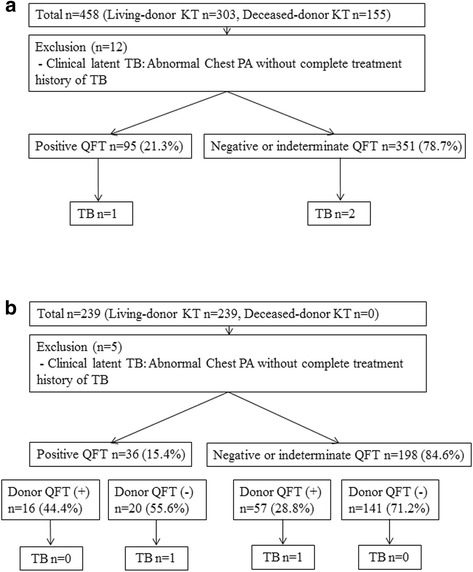
We retrospectively reviewed patients who received KT between January 2009 and December 2015 at Seoul National University Hospital. The QFT was performed in 458 KT recipients and 239 paired living donors, and 138 KT recipients underwent both the QFT and tuberculin skin test (TST). After excluding 12 patients diagnosed as having clinically latent TB, we evaluated whether the QFT of the recipient and donor was predictive for new-onset active TB after KT.
The QFT was positive in 101 (22.1%) recipients and associated with clinically latent TB before KT (P < 0.05). However, agreement between the TST and QFT was poor (κ = 0.327). Post-KT TB occurred in 1 of 95 recipients with a positive QFT, and 2 cases of TB occurred among 351 patients with a negative or indeterminate QFT. The incidence of TB was 242 cases/100,000 person-years among 446 KT recipients with a median follow-up of 30.2 months. The QFT of recipients could not predict post-KT TB in Poisson regression analysis (relative risk [RR], 1.847; 95% confidence interval [CI], 0.168-20.373; P = 0.616). Of 234 living donor-recipient pairs, the QFT of the recipient (RR, 5.012; 95% CI, 0.301-83.430; P = 0.261) and QFT of the donor (RR, 1.758; 95% CI, 0.106-29.274; P = 0.694) could not predict post-KT TB.
The QFT of recipients or living donors pre-KT cannot predict the short-term development of post-KT TB in an intermediate TB-burden country.
结核病(TB)是肾移植(KT)后常见的机会性感染。全血γ干扰素释放试验(QFT)被广泛用于评估潜伏性结核;然而,目前尚不清楚受者和供者术前的QFT能否预测肾移植后的结核病。
我们回顾性分析了2009年1月至2015年12月在首尔国立大学医院接受肾移植的患者。对458例肾移植受者和239例配对的活体供者进行了QFT检测,138例肾移植受者同时接受了QFT和结核菌素皮肤试验(TST)。排除12例诊断为临床潜伏性结核的患者后,我们评估了受者和供者的QFT是否能预测肾移植后新发活动性结核。
101例(22.1%)受者的QFT呈阳性,且与肾移植前的临床潜伏性结核相关(P<0.05)。然而,TST和QFT之间的一致性较差(κ=0.327)。95例QFT阳性的受者中有1例发生了肾移植后结核,351例QFT阴性或不确定的患者中有2例发生了结核。446例肾移植受者的结核病发病率为242例/100,000人年,中位随访时间为30.2个月。在泊松回归分析中,受者的QFT不能预测肾移植后结核(相对风险[RR],1.847;95%置信区间[CI],0.168-20.373;P=0.616)。在234对活体供者-受者中,受者的QFT(RR,5.012;95%CI,0.301-83.430;P=0.261)和供者的QFT(RR,1.758;95%CI,0.106-29.274;P=0.694)均不能预测肾移植后结核。
在结核病负担中等的国家,受者或活体供者术前的QFT不能预测肾移植后结核的短期发生情况。