Payros Delphine, Dobrindt Ulrich, Martin Patricia, Secher Thomas, Bracarense Ana Paula F L, Boury Michèle, Laffitte Joelle, Pinton Philippe, Oswald Eric, Oswald Isabelle P
Toxalim (Research Centre in Food Toxicology), Université de Toulouse, INRA, ENVT, INP-Purpan, UPS, Toulouse, France.
Institute of Hygiene, University of Münster, Münster, Germany.
mBio. 2017 Mar 14;8(2):e00007-17. doi: 10.1128/mBio.00007-17.
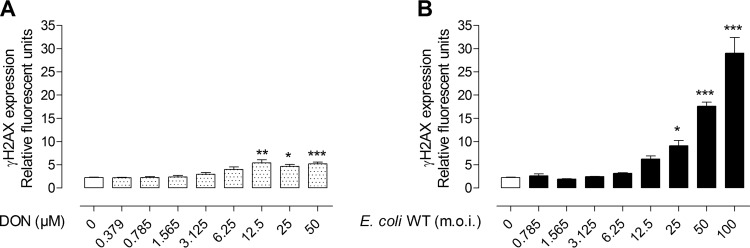
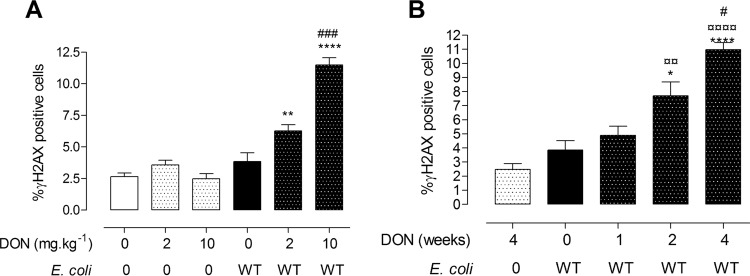
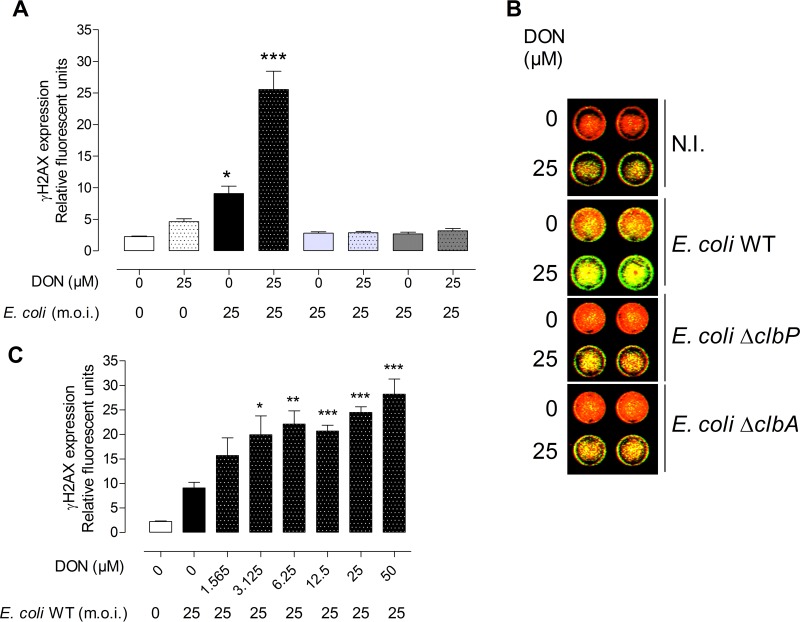
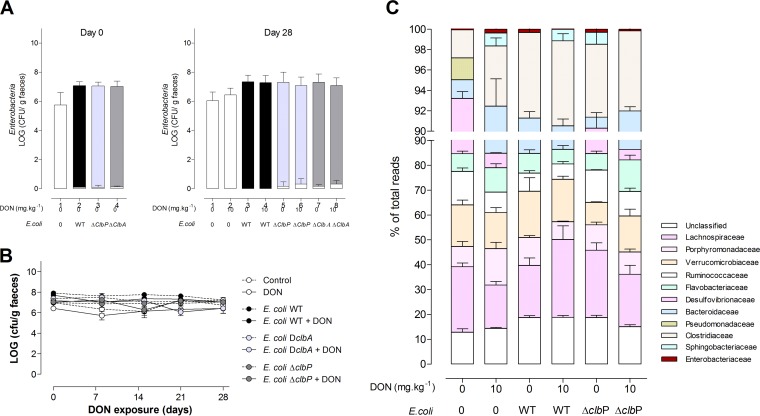
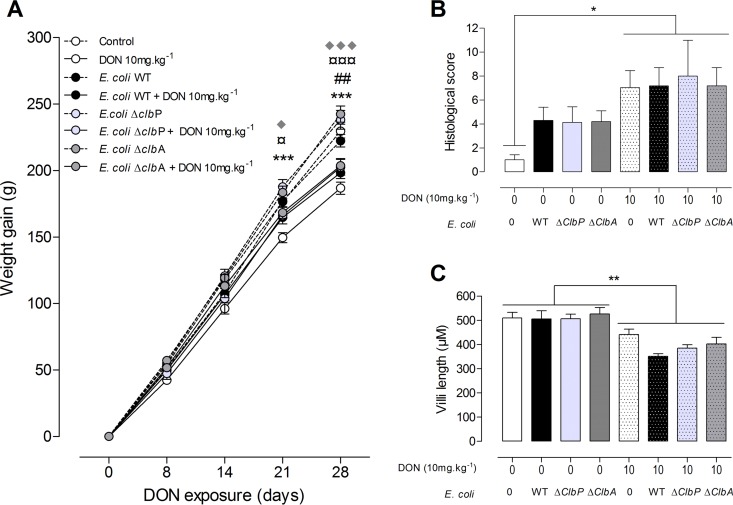
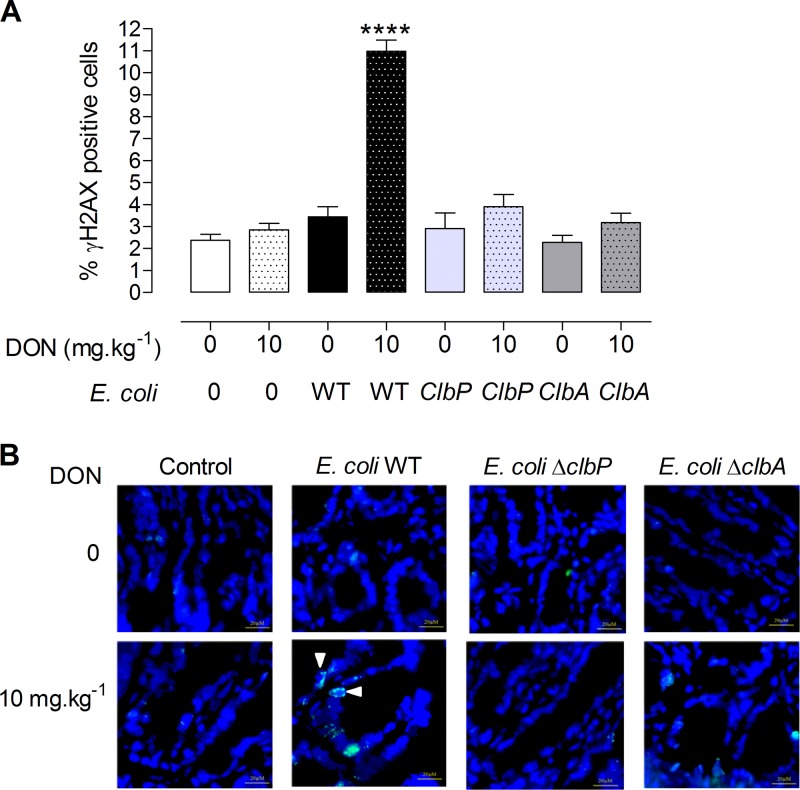
An increasing number of human beings from developed countries are colonized by strains producing colibactin, a genotoxin suspected to be associated with the development of colorectal cancers. Deoxynivalenol (DON) is the most prevalent mycotoxin that contaminates staple food-especially cereal products-in Europe and North America. This study investigates the effect of the food contaminant DON on the genotoxicity of the strains producing colibactin. , intestinal epithelial cells were coexposed to DON and producing colibactin. , newborn rats colonized at birth with producing colibactin were fed a DON-contaminated diet. Intestinal DNA damage was estimated by the phosphorylation of histone H2AX. DON exacerbates the genotoxicity of the producing colibactin in a time- and dose-dependent manner Although DON had no effect on the composition of the gut microbiota, and especially on the number of , a significant increase in DNA damage was observed in intestinal epithelial cells of animals colonized by strains producing colibactin and coexposed to DON compared to animals colonized with strains unable to produce colibactin or animals exposed only to DON. In conclusion, our data demonstrate that the genotoxicity of strains producing colibactin, increasingly present in the microbiota of asymptomatic human beings, is modulated by the presence of DON in the diet. This raises questions about the synergism between food contaminants and gut microbiota with regard to intestinal carcinogenesis. An increasing number of human beings from developed countries are colonized by strains producing colibactin, a genotoxin suspected to be associated with the development of colorectal cancers. Deoxynivalenol (DON) is the most prevalent mycotoxin that contaminates staple food-especially cereal products-in Europe and North America. Our and results demonstrate that the intestinal DNA damage induced by colibactin-producing strains was exacerbated by the presence of DON in the diet. This raises questions about the synergism between food contaminants and gut microbiota with regard to intestinal carcinogenesis.
越来越多来自发达国家的人被产大肠杆菌素的菌株定植,大肠杆菌素是一种疑似与结直肠癌发生有关的基因毒素。脱氧雪腐镰刀菌烯醇(DON)是在欧洲和北美污染主食(尤其是谷物产品)的最普遍的霉菌毒素。本研究调查了食品污染物DON对产大肠杆菌素菌株遗传毒性的影响。首先,将肠道上皮细胞同时暴露于DON和产大肠杆菌素的菌株。其次,给出生时就被产大肠杆菌素的菌株定植的新生大鼠喂食受DON污染的饮食。通过组蛋白H2AX的磷酸化来估计肠道DNA损伤。DON以时间和剂量依赖性方式加剧产大肠杆菌素菌株的遗传毒性。尽管DON对肠道微生物群的组成没有影响,尤其是对大肠杆菌的数量没有影响,但与被不能产大肠杆菌素的菌株定植的动物或仅暴露于DON的动物相比,在被产大肠杆菌素的菌株定植并同时暴露于DON的动物的肠道上皮细胞中观察到DNA损伤显著增加。总之,我们的数据表明,饮食中DON的存在会调节无症状人群微生物群中越来越常见的产大肠杆菌素菌株的遗传毒性。这就提出了关于食品污染物和肠道微生物群在肠道致癌方面协同作用的问题。越来越多来自发达国家的人被产大肠杆菌素的菌株定植,大肠杆菌素是一种疑似与结直肠癌发生有关的基因毒素。脱氧雪腐镰刀菌烯醇(DON)是在欧洲和北美污染主食(尤其是谷物产品)的最普遍的霉菌毒素。我们的……和……结果表明,饮食中DON的存在会加剧产大肠杆菌素菌株诱导的肠道DNA损伤。这就提出了关于食品污染物和肠道微生物群在肠道致癌方面协同作用的问题。