Bahmad Hisham, Hadadeh Ola, Chamaa Farah, Cheaito Katia, Darwish Batoul, Makkawi Ahmad-Kareem, Abou-Kheir Wassim
Department of Anatomy, Cell Biology and Physiological Sciences, Faculty of Medicine, American University of Beirut Beirut, Lebanon.
Front Mol Neurosci. 2017 Feb 28;10:50. doi: 10.3389/fnmol.2017.00050. eCollection 2017.
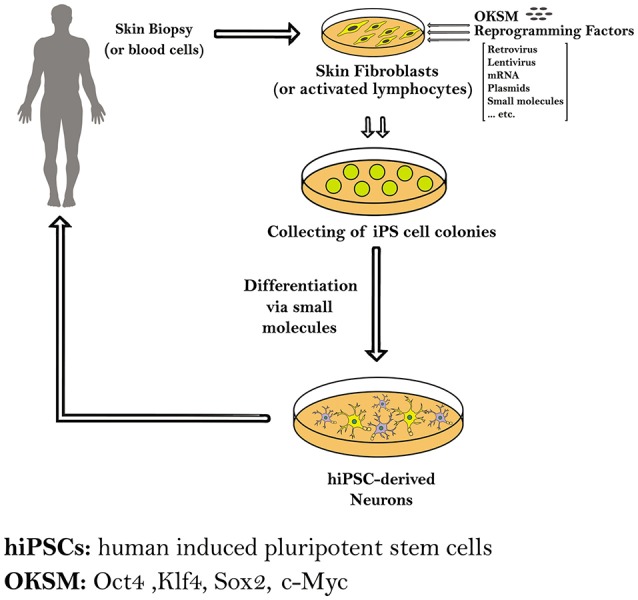
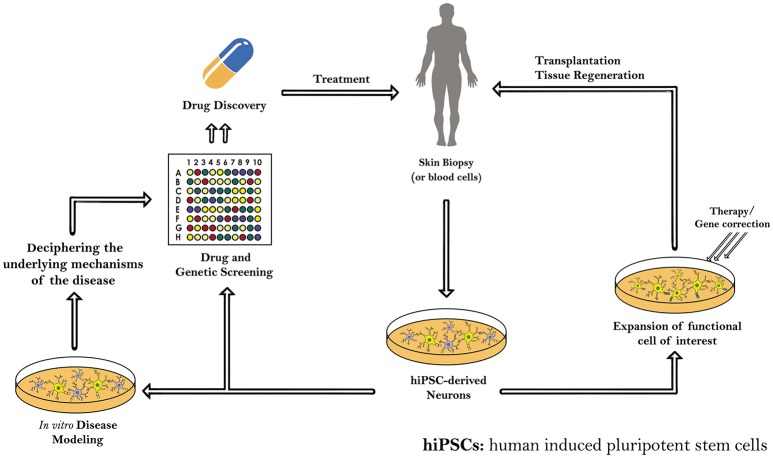
With the help of several inducing factors, somatic cells can be reprogrammed to become induced pluripotent stem cell (iPSCs) lines. The success is in obtaining iPSCs almost identical to embryonic stem cells (ESCs), therefore various approaches have been tested and ultimately several ones have succeeded. The importance of these cells is in how they serve as models to unveil the molecular pathways and mechanisms underlying several human diseases, and also in its potential roles in the development of regenerative medicine. They further aid in the development of regenerative medicine, autologous cell therapy and drug or toxicity screening. Here, we provide a comprehensive overview of the recent development in the field of iPSCs research, specifically for modeling human neurological and neurodegenerative diseases, and its applications in neurotrauma. These are mainly characterized by progressive functional or structural neuronal loss rendering them extremely challenging to manage. Many of these diseases, including Parkinson's disease (PD), Huntington's disease (HD), Amyotrophic lateral sclerosis (ALS) and Alzheimer's disease (AD) have been explored . The main purpose is to generate patient-specific iPS cell lines from the somatic cells that carry mutations or genetic instabilities for the aim of studying their differentiation potential and behavior. This new technology will pave the way for future development in the field of stem cell research anticipating its use in clinical settings and in regenerative medicine in order to treat various human diseases, including neurological and neurodegenerative diseases.
在多种诱导因子的帮助下,体细胞可以被重编程为诱导多能干细胞(iPSC)系。成功之处在于获得几乎与胚胎干细胞(ESC)相同的iPSC,因此人们测试了各种方法,最终有几种方法取得了成功。这些细胞的重要性在于它们如何作为模型来揭示多种人类疾病背后的分子途径和机制,以及它们在再生医学发展中的潜在作用。它们进一步有助于再生医学、自体细胞疗法以及药物或毒性筛选的发展。在此,我们全面概述了iPSC研究领域的最新进展,特别是在模拟人类神经和神经退行性疾病方面,以及其在神经创伤中的应用。这些疾病主要特征是神经元功能或结构逐渐丧失,使其治疗极具挑战性。已经对许多这类疾病进行了探索,包括帕金森病(PD)、亨廷顿病(HD)、肌萎缩侧索硬化症(ALS)和阿尔茨海默病(AD)。主要目的是从携带突变或基因不稳定的体细胞中生成患者特异性的iPS细胞系,以研究其分化潜能和行为。这项新技术将为干细胞研究领域的未来发展铺平道路,有望在临床环境和再生医学中用于治疗各种人类疾病,包括神经和神经退行性疾病。