Yang Yongxiang, Ye Yuqin, Su Xinhong, He Jun, Bai Wei, He Xiaosheng
Department of Neurosurgery, Xijing Hospital, Fourth Military Medical UniversityXi'an, China; Department of Neurosurgery, PLA 422nd HospitalZhanjiang, China.
Department of Neurosurgery, Xijing Hospital, Fourth Military Medical UniversityXi'an, China; Department of Neurosurgery, PLA 163rd Hospital (Second Affiliated Hospital of Hunan Normal University)Changsha, China.
Front Cell Neurosci. 2017 Feb 28;11:55. doi: 10.3389/fncel.2017.00055. eCollection 2017.
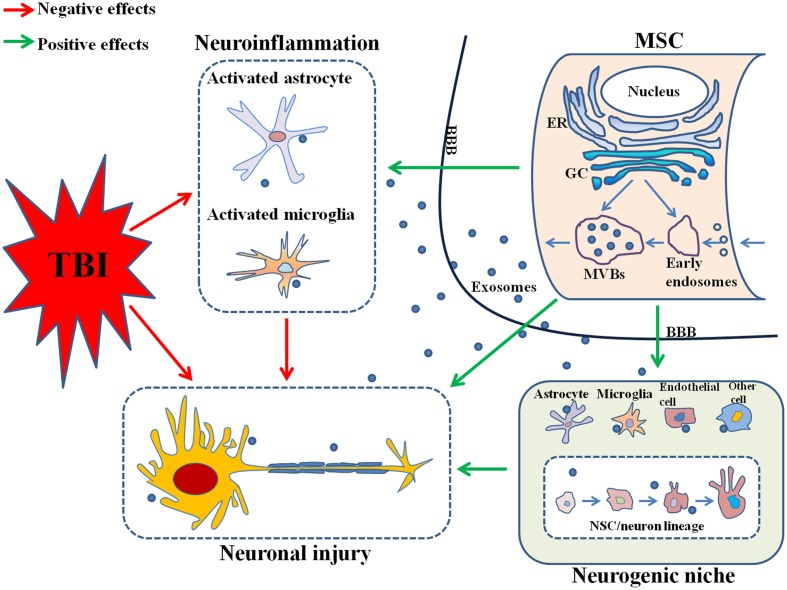
Exosomes are endosomal origin membrane-enclosed small vesicles (30-100 nm) that contain various molecular constituents including proteins, lipids, mRNAs and microRNAs. Accumulating studies demonstrated that exosomes initiated and regulated neuroinflammation, modified neurogenic niches and neurogenesis, and were even of potential significance in treating some neurological diseases. These tiny extracellular vesicles (EVs) can derive from some kinds of multipotent cells such as mesenchymal stem cells (MSCs) that have been confirmed to be a potentially promising therapy for traumatic brain injury (TBI) in experimental models and in preclinical studies. Nevertheless, subsequent studies demonstrated that the predominant mechanisms of MSCs's contributions to brain tissue repairment and functional recovery after TBI were not the cell replacement effects but likely the secretion-based paracrine effects produced by EVs such as MSCs-derived exosomes. These nanosized exosomes derived from MSCs cannot proliferate, are easier to preserve and transfer and have lower immunogenicity, compared with transplanted exogenous MSCs. These reports revealed that MSCs-derived exosomes might promise to be a new and valuable therapeutic strategy for TBI than MSCs themselves. However, the concrete mechanisms involved in the positive effects induced by MSCs-derived exosomes in TBI are still ambiguous. In this review, we intend to explore the potential effects of MSCs-derived exosomes on neuroinflammation and neurogenesis in TBI and, especially, on therapy.
外泌体是源自内体的膜包裹小囊泡(30 - 100纳米),其包含各种分子成分,包括蛋白质、脂质、信使核糖核酸(mRNA)和微小核糖核酸(miRNA)。越来越多的研究表明,外泌体启动并调节神经炎症,改变神经发生微环境和神经发生,甚至在治疗某些神经系统疾病方面具有潜在意义。这些微小的细胞外囊泡(EVs)可源自某些多能细胞,如间充质干细胞(MSCs),在实验模型和临床前研究中,间充质干细胞已被证实是治疗创伤性脑损伤(TBI)的一种潜在有前景的疗法。然而,随后的研究表明,间充质干细胞对创伤性脑损伤后脑组织修复和功能恢复的主要作用机制不是细胞替代效应,而是可能由间充质干细胞衍生的外泌体等细胞外囊泡产生的基于分泌的旁分泌效应。与移植的外源性间充质干细胞相比,这些源自间充质干细胞的纳米级外泌体不能增殖,更易于保存和转移,且免疫原性较低。这些报道表明,与间充质干细胞本身相比,间充质干细胞衍生的外泌体可能有望成为一种新的、有价值的创伤性脑损伤治疗策略。然而,间充质干细胞衍生的外泌体在创伤性脑损伤中诱导积极作用所涉及的具体机制仍不明确。在本综述中,我们旨在探讨间充质干细胞衍生的外泌体对创伤性脑损伤中神经炎症和神经发生的潜在影响,尤其是对治疗的影响。