
树突状细胞衍生的白细胞介素-10在感染过程中调节促炎细胞因子的产生并促进CD4IL-10调节性T细胞的诱导。
DC-Derived IL-10 Modulates Pro-inflammatory Cytokine Production and Promotes Induction of CD4IL-10 Regulatory T Cells during Infection.
作者信息
Loevenich Katharina, Ueffing Kristina, Abel Simone, Hose Matthias, Matuschewski Kai, Westendorf Astrid M, Buer Jan, Hansen Wiebke
机构信息
Institute of Medical Microbiology, University Hospital Essen, University Duisburg-Essen , Essen , Germany.
Institute of Biology, Humboldt University, Berlin, Germany; Parasitology Unit, Max Planck Institute for Infection Biology, Berlin, Germany.
出版信息
Front Immunol. 2017 Feb 28;8:152. doi: 10.3389/fimmu.2017.00152. eCollection 2017.
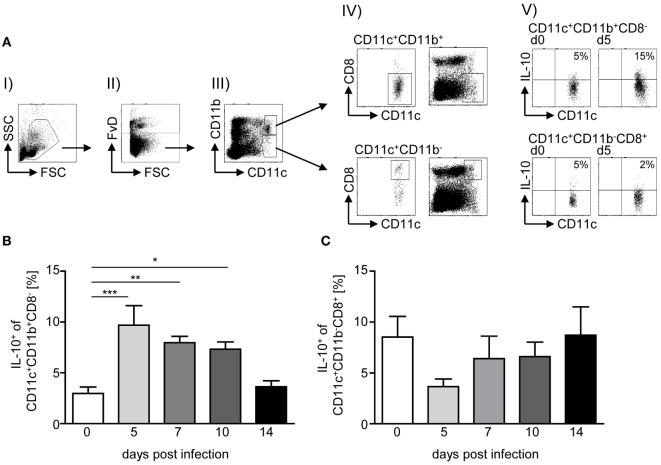
The cytokine IL-10 plays a crucial role during malaria infection by counteracting the pro-inflammatory immune response. We and others demonstrated that infection results in enhanced IL-10 production in CD4 T cells accompanied by the induction of an immunosuppressive phenotype. However, it is unclear whether this is a direct effect caused by the parasite or an indirect consequence due to T cell activation by IL-10-producing antigen-presenting cells. Here, we demonstrate that CD11cCD11bCD8 dendritic cells (DCs) produce elevated levels of IL-10 after infection of BALB/c mice. DC-specific ablation of IL-10 in -infected IL-10/CD11c-cre mice resulted in increased IFN-γ and TNF-α production with no effect on MHC-II, CD80, or CD86 expression in CD11c DCs. Accordingly, DC-specific ablation of IL-10 exacerbated systemic IFN-γ and IL-12 production without altering blood stage progression. Strikingly, DC-specific inactivation of IL-10 in -infected mice interfered with the induction of IL-10-producing CD4 T cells while raising the frequency of IFN-γ-secreting CD4 T cells. These results suggest that infection promotes IL-10 production in DCs, which in turn dampens secretion of pro-inflammatory cytokines and supports the induction of CD4IL-10 T cells.
细胞因子白细胞介素-10(IL-10)通过对抗促炎免疫反应在疟疾感染过程中发挥关键作用。我们和其他人证明,感染导致CD4 T细胞中IL-10产生增加,并伴有免疫抑制表型的诱导。然而,尚不清楚这是由寄生虫引起的直接效应还是由产生IL-10的抗原呈递细胞激活T细胞导致的间接后果。在这里,我们证明感染BALB/c小鼠后,CD11c⁺CD11b⁻CD8⁺树突状细胞(DCs)产生的IL-10水平升高。在感染疟原虫的IL-10/CD11c-cre小鼠中对DC特异性敲除IL-10导致IFN-γ和TNF-α产生增加,而对CD11c⁺ DCs中的MHC-II、CD80或CD86表达没有影响。因此,DC特异性敲除IL-10会加剧全身IFN-γ和IL-12的产生,而不会改变血液阶段的进展。引人注目的是,在感染疟原虫的小鼠中DC特异性失活IL-10会干扰产生IL-10的CD4 T细胞的诱导,同时提高分泌IFN-γ的CD4 T细胞的频率。这些结果表明,疟原虫感染促进DC中IL-10的产生,这反过来又抑制促炎细胞因子的分泌并支持CD4⁺IL-10⁺ T细胞的诱导。



 Zotero 插件