Förster Andreas H, Beblawy Sebastian, Golitsch Frederik, Gescher Johannes
Department of Applied Biology, Institute for Applied Biosciences, Karlsruhe Institute of Technology, Fritz-Haber-Weg 2, 76131 Karlsruhe, Germany.
Department of Microbiology of Natural and Technical Interfaces, Institute of Functional Interfaces, Karlsruhe Institute of Technology, Hermann-von-Helmholtz-Platz 1, 76344 Eggenstein-Leopoldshafen, Germany.
Biotechnol Biofuels. 2017 Mar 14;10:65. doi: 10.1186/s13068-017-0745-9. eCollection 2017.
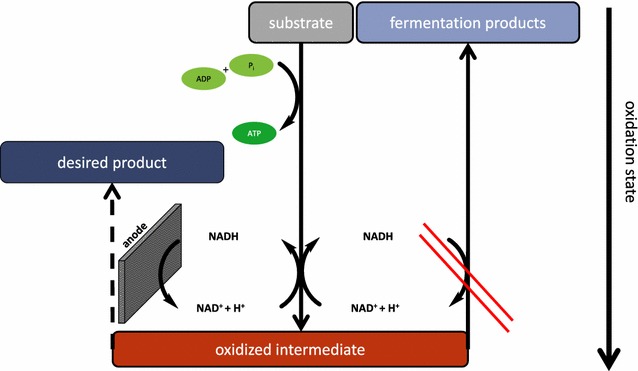
This paper describes the metabolic engineering of for the fermentation of glucose to acetoin. Acetoin has well-established applications in industrial food production and was suggested to be a platform chemical for a bio-based economy. However, the biotechnological production is often hampered by the simultaneous formation of several end products in the absence of an electron acceptor. Moreover, typical production strains are often potentially pathogenic. The goal of this study was to overcome these limitations by establishing an electrode-assisted fermentation process in . Here, the surplus of electrons released in the production process is transferred to an electrode as anoxic and non-depletable electron acceptor.
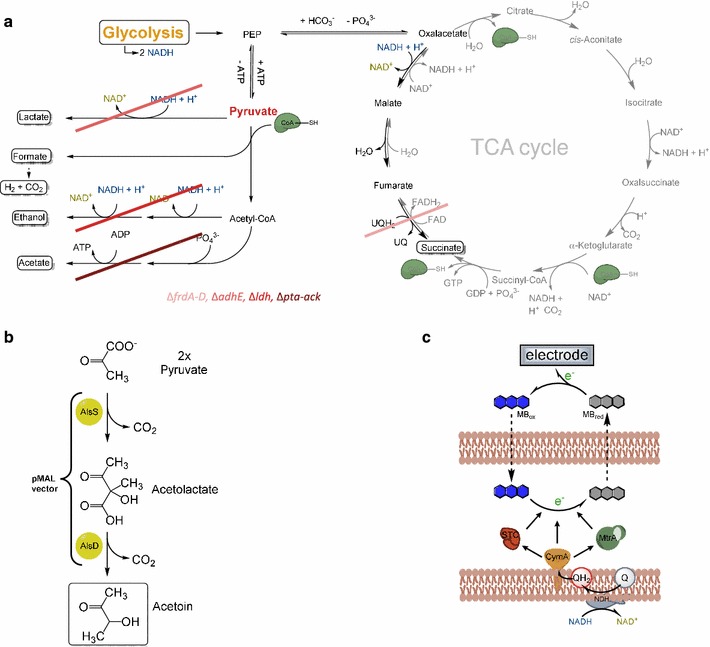
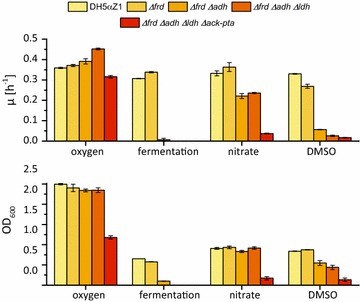
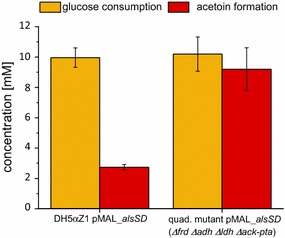
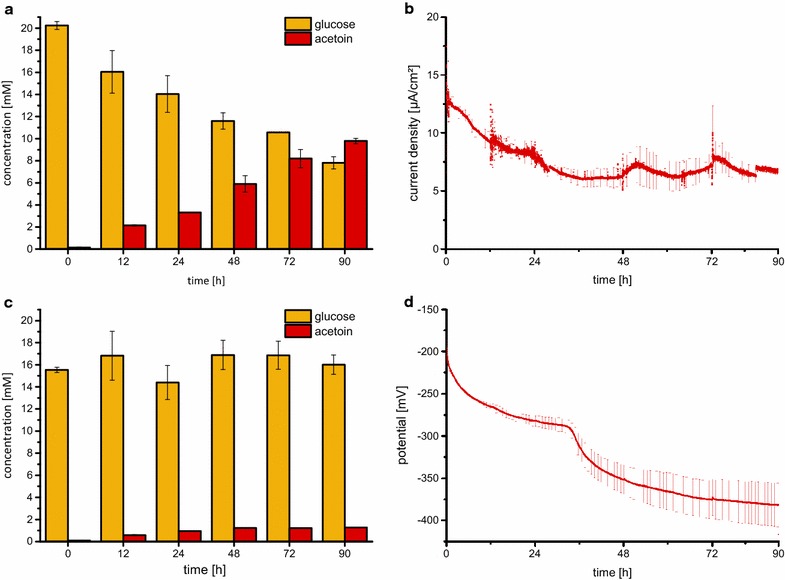
In a first step, the central metabolism was steered towards the production of pyruvate from glucose by deletion of genes encoding for enzymes of central reactions of the anaerobic carbon metabolism (Δ- Δ Δ Δ-). Thereafter, the genes for the acetolactate synthase () and the acetolactate decarboxylase () were expressed in this strain from a plasmid. Addition of nitrate as electron acceptor led to an anaerobic acetoin production with a yield of up to 0.9 mol acetoin per mol of glucose consumed (90% of the theoretical maximum). In a second step, the electron acceptor nitrate was replaced by a carbon electrode. This interaction necessitated the further expression of -type cytochromes from and the addition of the soluble redox shuttle methylene blue. The interaction with the non-depletable electron acceptor led to an acetoin formation with a yield of 79% of the theoretical maximum (0.79 mol acetoin per mol glucose).
Electrode-assisted fermentations are a new strategy to produce substances of biotechnological value that are more oxidized than the substrates. Here, we show for the first time a process in which the commonly used chassis strain was tailored for an electrode-assisted fermentation approach branching off from the central metabolite pyruvate. At this early stage, we see promising results regarding carbon and electron recovery and will use further strain development to increase the anaerobic metabolic turnover rate.
本文描述了用于将葡萄糖发酵为3-羟基丁酮的代谢工程。3-羟基丁酮在工业食品生产中有既定的应用,并且被认为是生物基经济的一种平台化学品。然而,在没有电子受体的情况下,生物技术生产常常受到几种终产物同时形成的阻碍。此外,典型的生产菌株往往具有潜在致病性。本研究的目标是通过在大肠杆菌中建立电极辅助发酵过程来克服这些限制。在此过程中,生产过程中释放的多余电子作为无氧且不可耗尽的电子受体转移到电极上。
第一步,通过缺失编码厌氧碳代谢中心反应酶的基因(ΔpflB ΔldhA ΔfrdA ΔadhE),将中心代谢导向从葡萄糖生产丙酮酸。此后,乙酰乳酸合酶(alsS)和乙酰乳酸脱羧酶(alsD)的基因在该菌株中通过质粒表达。添加硝酸盐作为电子受体导致厌氧生产3-羟基丁酮,每消耗1摩尔葡萄糖的产量高达0.9摩尔3-羟基丁酮(为理论最大值的90%)。第二步,将电子受体硝酸盐替换为碳电极。这种相互作用需要进一步表达来自嗜糖假单胞菌的细胞色素c型和添加可溶性氧化还原穿梭体亚甲蓝。与不可耗尽的电子受体的相互作用导致3-羟基丁酮的形成,产量为理论最大值的79%(每摩尔葡萄糖0.79摩尔3-羟基丁酮)。
电极辅助发酵是一种生产比底物氧化程度更高的生物技术有价值物质的新策略。在这里,我们首次展示了一个过程,其中常用的底盘菌株大肠杆菌经过改造,用于从中心代谢物丙酮酸分支的电极辅助发酵方法。在这个早期阶段,我们在碳和电子回收方面看到了有希望的结果,并将利用进一步的菌株开发来提高厌氧代谢周转率。