Department of Radiology and Nuclear Medicine, Radboud University Nijmegen Medical Center, Nijmegen, The Netherlands.
Department of Pulmonology Gentofte Hospital, University of Copenhagen, Hellerup, Denmark.
Eur Radiol. 2017 Oct;27(10):4019-4029. doi: 10.1007/s00330-017-4767-2. Epub 2017 Mar 14.
To compare the PanCan model, Lung-RADS and the 1.2016 National Comprehensive Cancer Network (NCCN) guidelines for discriminating malignant from benign pulmonary nodules on baseline screening CT scans and the impact diameter measurement methods have on performances.
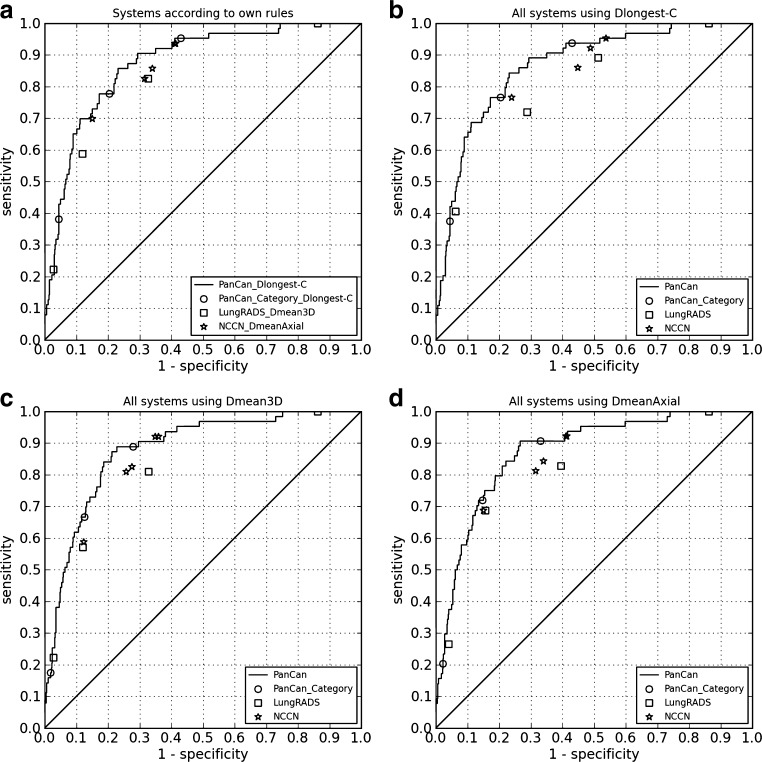
From the Danish Lung Cancer Screening Trial database, 64 CTs with malignant nodules and 549 baseline CTs with benign nodules were included. Performance of the systems was evaluated applying the system's original diameter definitions: D (PanCan), D (NCCN), both obtained from axial sections, and D (Lung-RADS). Subsequently all diameter definitions were applied uniformly to all systems. Areas under the ROC curves (AUC) were used to evaluate risk discrimination.
PanCan performed superiorly to Lung-RADS and NCCN (AUC 0.874 vs. 0.813, p = 0.003; 0.874 vs. 0.836, p = 0.010), using the original diameter specifications. When uniformly applying D, D and D, PanCan remained superior to Lung-RADS (p < 0.001 - p = 0.001) and NCCN (p < 0.001 - p = 0.016). Diameter definition significantly influenced NCCN's performance with D being the worst (D vs. D, p = 0.005; D vs. D, p = 0.016).
Without follow-up information, the PanCan model performs significantly superiorly to Lung-RADS and the 1.2016 NCCN guidelines for discriminating benign from malignant nodules. The NCCN guidelines are most sensitive to nodule size definition.
• PanCan model outperforms Lung-RADS and 1.2016 NCCN guidelines in identifying malignant pulmonary nodules. • Nodule size definition had no significant impact on Lung-RADS and PanCan model. • 1.2016 NCCN guidelines were significantly superior when using mean diameter to longest diameter. • Longest diameter achieved lowest performance for all models. • Mean diameter performed equivalently when derived from axial sections and from volumetry.
比较 PanCan 模型、Lung-RADS 和 2016 年 1 月国家综合癌症网络(NCCN)指南在基线筛查 CT 扫描中鉴别良恶性肺结节的性能,以及直径测量方法对性能的影响。
从丹麦肺癌筛查试验数据库中纳入 64 例恶性结节 CT 和 549 例基线良性结节 CT。应用系统的原始直径定义评估系统的性能:D(PanCan)、D(NCCN),均从轴向切片获得,以及 D(Lung-RADS)。随后,所有直径定义均应用于所有系统。受试者工作特征曲线下面积(AUC)用于评估风险判别。
PanCan 模型的性能优于 Lung-RADS 和 NCCN(AUC 0.874 比 0.813,p=0.003;0.874 比 0.836,p=0.010),使用原始直径规格。当均匀应用 D、D 和 D 时,PanCan 仍优于 Lung-RADS(p<0.001-p=0.001)和 NCCN(p<0.001-p=0.016)。直径定义显著影响 NCCN 的性能,D 最差(D 比 D,p=0.005;D 比 D,p=0.016)。
无随访信息时,PanCan 模型在鉴别良恶性结节方面的性能明显优于 Lung-RADS 和 2016 年 1 月 NCCN 指南。NCCN 指南对结节大小定义最敏感。
• PanCan 模型在识别恶性肺结节方面优于 Lung-RADS 和 2016 年 1 月 NCCN 指南。• 结节大小定义对 Lung-RADS 和 PanCan 模型没有显著影响。• 使用平均直径与最长直径时,2016 年 1 月 NCCN 指南的性能明显优于其他指南。• 所有模型的最长直径性能最低。• 当源自轴向切片和体层时,平均直径的性能相当。