Department of Computer Science and Technology, Tongji University, Shanghai 201804, China.
Department of Electronic Engineering, City University of Hong Kong, Kowloon 999077, Hong Kong.
Sci Rep. 2017 Mar 15;7:44085. doi: 10.1038/srep44085.
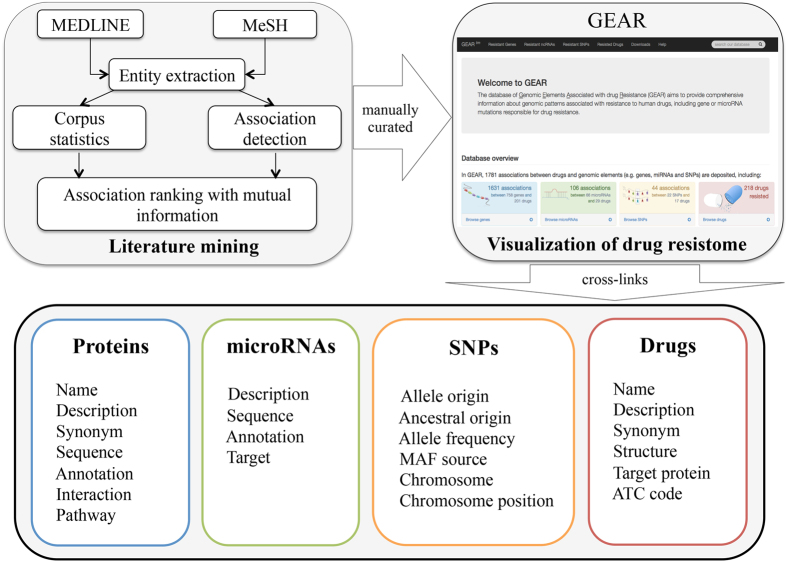
Drug resistance is becoming a serious problem that leads to the failure of standard treatments, which is generally developed because of genetic mutations of certain molecules. Here, we present GEAR (A database of Genomic Elements Associated with drug Resistance) that aims to provide comprehensive information about genomic elements (including genes, single-nucleotide polymorphisms and microRNAs) that are responsible for drug resistance. Right now, GEAR contains 1631 associations between 201 human drugs and 758 genes, 106 associations between 29 human drugs and 66 miRNAs, and 44 associations between 17 human drugs and 22 SNPs. These relationships are firstly extracted from primary literature with text mining and then manually curated. The drug resistome deposited in GEAR provides insights into the genetic factors underlying drug resistance. In addition, new indications and potential drug combinations can be identified based on the resistome. The GEAR database can be freely accessed through http://gear.comp-sysbio.org.
耐药性正在成为导致标准治疗失败的严重问题,这通常是由于某些分子的基因突变引起的。在这里,我们介绍 GEAR(与药物耐药性相关的基因组元素数据库),旨在提供负责耐药性的基因组元素(包括基因、单核苷酸多态性和 microRNA)的综合信息。目前,GEAR 包含 201 种人类药物与 758 个基因之间的 1631 种关联、29 种人类药物与 66 个 microRNA 之间的 106 种关联以及 17 种人类药物与 22 个 SNPs 之间的 44 种关联。这些关系最初是通过文本挖掘从主要文献中提取出来的,然后进行手动整理。存储在 GEAR 中的耐药基因组提供了对耐药性潜在遗传因素的深入了解。此外,还可以根据耐药基因组确定新的适应症和潜在的药物组合。GEAR 数据库可通过 http://gear.comp-sysbio.org 免费访问。