Department of Neurology, MS Center Amsterdam, VU University Medical Center, Amsterdam, The Netherlands.
Institute of Biomedical Research of Barcelona, CSIC-IDIBAPS, CIBERNED, Barcelona, Spain.
Mult Scler. 2018 Apr;24(4):472-480. doi: 10.1177/1352458517699874. Epub 2017 Mar 15.
Mitochondrial dysfunction is increasingly recognized as an important feature of multiple sclerosis (MS) pathology and may be relevant for clinical disease progression. However, it is unknown whether mitochondrial DNA (mtDNA) levels in the cerebrospinal fluid (CSF) associate with disease progression and therapeutic response.
To evaluate whether CSF concentrations of mtDNA in MS patients can serve as a marker of ongoing neuropathology and may be helpful to differentiate between MS disease subtypes. To explore the effect of disease-modifying therapies on mtDNA levels in the CSF.
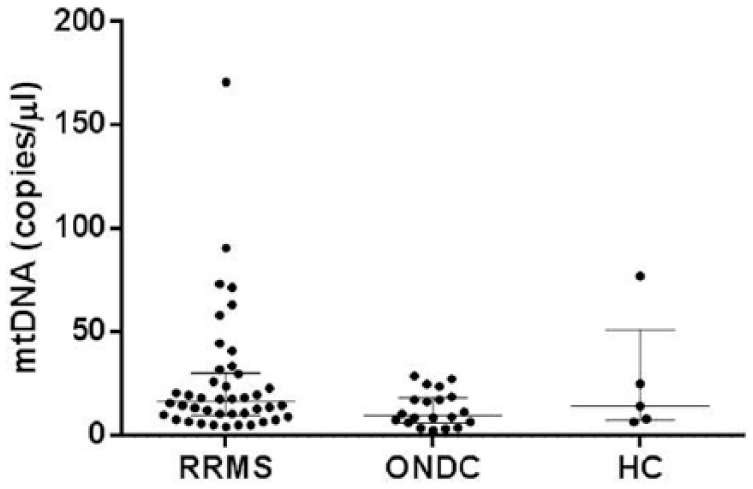
CSF mtDNA was measured using a digital polymerase chain reaction (PCR) CSF mtDNA in two independent MS cohorts. The cohorts included 92 relapsing-remitting multiple sclerosis (RRMS) patients, 40 progressive multiple sclerosis (PMS) patients (27 secondary progressive and 13 primary progressive), 50 various neurologic disease controls, and 5 healthy controls.
Patients with PMS showed a significant increase in CSF mtDNA compared to non-inflammatory neurologic disease controls. Patients with higher T2 lesion volumes and lower normalized brain volumes showed increased concentration of mtDNA. Patients treated with fingolimod had significantly lower mtDNA copy levels at follow-up compared to baseline.
Our results showed a non-specific elevation of concentration of mtDNA in PMS patients. mtDNA concentrations respond to fingolimod and may be used to monitor biological effect of this treatment.
线粒体功能障碍越来越被认为是多发性硬化症(MS)病理学的一个重要特征,并且可能与临床疾病进展有关。然而,脑脊液(CSF)中的线粒体 DNA(mtDNA)水平是否与疾病进展和治疗反应相关尚不清楚。
评估 MS 患者 CSF 中的 mtDNA 浓度是否可以作为正在进行的神经病理学的标志物,并且可能有助于区分 MS 疾病亚型。探索疾病修正疗法对 CSF 中 mtDNA 水平的影响。
使用数字聚合酶链反应(PCR)测量了两个独立的 MS 队列中的 CSF mtDNA。队列包括 92 例复发缓解型多发性硬化症(RRMS)患者、40 例进行性多发性硬化症(PMS)患者(27 例继发进展型和 13 例原发进展型)、50 例各种神经疾病对照者和 5 名健康对照者。
与非炎症性神经疾病对照组相比,PMS 患者的 CSF mtDNA 明显增加。T2 病变体积较高且正常化脑体积较低的患者 mtDNA 浓度增加。与基线相比,接受 fingolimod 治疗的患者在随访时 mtDNA 拷贝水平显著降低。
我们的结果显示 PMS 患者 mtDNA 浓度出现非特异性升高。mtDNA 浓度对 fingolimod 有反应,可用于监测该治疗的生物学效应。