Department of Neurosurgery/Neuro-Oncology, Sun Yat-sen University Cancer Center, State Key Laboratory of Oncology in South China, and Collaborative Innovation Center for Cancer Medicine, Guangzhou, Guangdong, People's Republic of China.
Department of Neurosurgery, Nongken Central Hospital of Guangdong, Zhanjiang, Guangdong, People's Republic of China.
Stem Cells Transl Med. 2017 Mar;6(3):830-839. doi: 10.5966/sctm.2016-0009. Epub 2016 Oct 7.
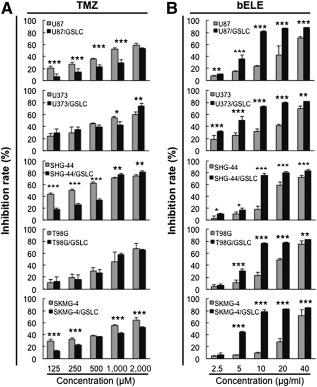
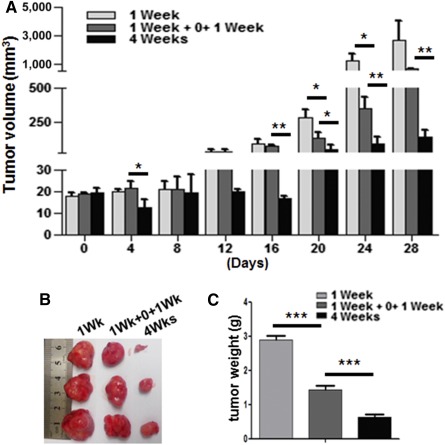
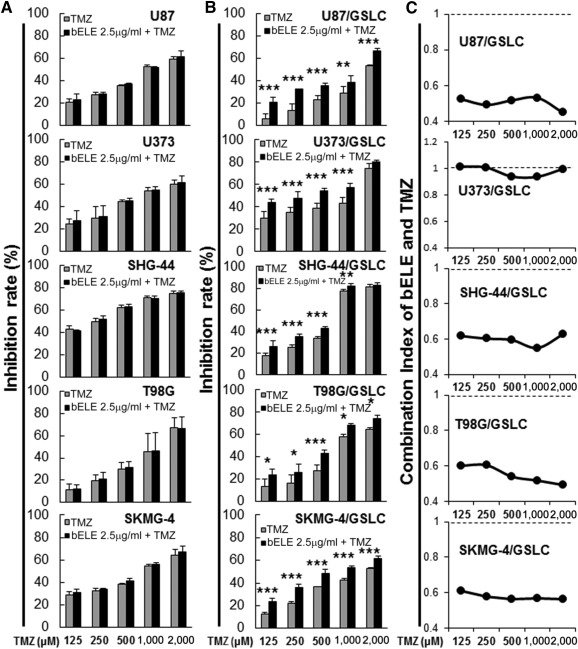
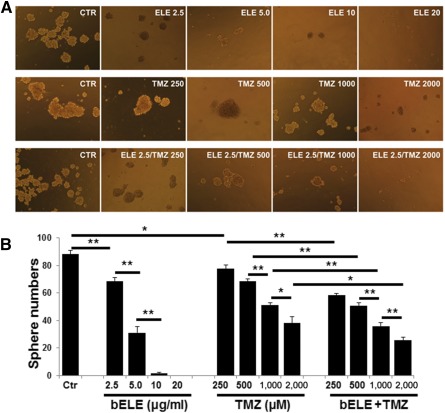
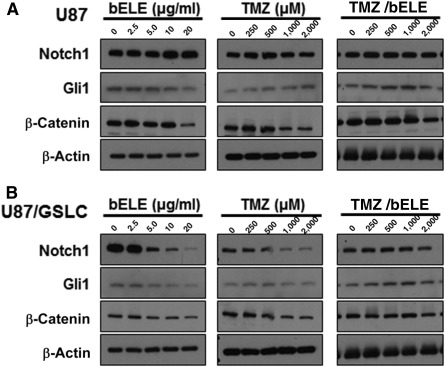
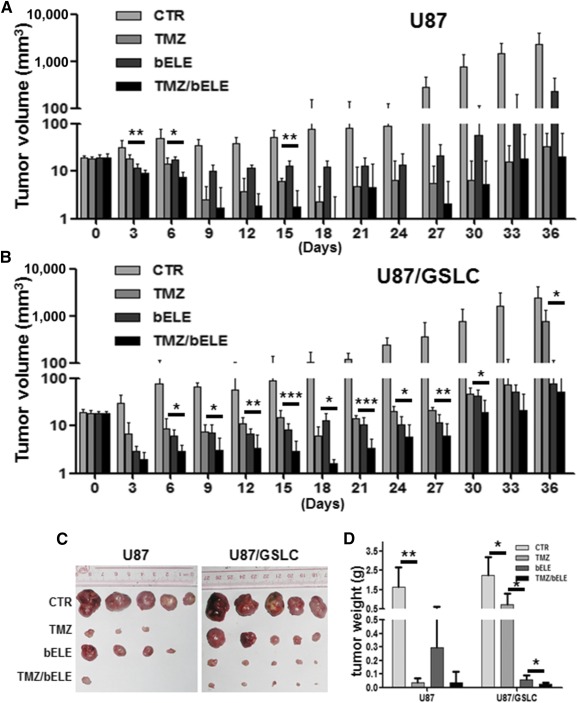
Glioma is the most frequent primary central nervous system tumor. Although the current first-line medicine, temozolomide (TMZ), promotes patient survival, drug resistance develops easily. Thus, it is important to investigate novel therapeutic reagents to solidify the treatment effect. β-Elemene (bELE) is a compound from a Chinese herb whose anticancer effect has been shown in various types of cancer. However, its role in the inhibition of glioma stem-like cells (GSLCs) has not yet been reported. We studied both the in vitro and the in vivo inhibitory effect of bELE and TMZ in GSLCs and parental cells and their combined effects. The molecular mechanisms were also investigated. We also optimized the delivery methods of bELE. We found that bELE selectively inhibits the proliferation and sphere formation of GSLCs, other than parental glioma cells, and TMZ exerts its effects on parental cells instead of GSLCs. The in vivo data confirmed that the combination of bELE and TMZ worked better in the xenografts of GSLCs, mimicking the situation of tumorigenesis of human cancer. Notch1 was downregulated with bELE treatment. Our data also demonstrated that the continuous administration of bELE produces an ideal effect to control tumor progression. Our findings have demonstrated, for the first time, that bELE could compensate for TMZ to kill both GSLCs and nonstem-like cancer cells, probably improving the prognosis of glioma patients tremendously. Notch1 might be a downstream target of bELE. Therefore, our data shed light on improving the outcomes of glioma patients by combining bELE and TMZ. Stem Cells Translational Medicine 2017;6:830-839.
脑胶质瘤是最常见的原发性中枢神经系统肿瘤。尽管目前的一线药物替莫唑胺(TMZ)能提高患者的生存率,但很容易产生耐药性。因此,研究新的治疗试剂以巩固治疗效果非常重要。β-榄香烯(bELE)是一种来自中国草药的化合物,其在多种类型的癌症中表现出抗癌作用。然而,其在抑制神经胶质瘤干细胞(GSLCs)中的作用尚未被报道。我们研究了 bELE 和 TMZ 在 GSLCs 和亲本细胞中的体外和体内抑制作用及其联合作用。还研究了分子机制。我们还优化了 bELE 的递药方法。我们发现,bELE 选择性地抑制 GSLCs 的增殖和球体形成,而不是亲本神经胶质瘤细胞,而 TMZ 对亲本细胞而不是 GSLCs 发挥作用。体内数据证实,bELE 和 TMZ 的联合应用在 GSLCs 的异种移植物中效果更好,模拟了人类癌症的肿瘤发生情况。Notch1 表达下调与 bELE 治疗有关。我们的数据还表明,bELE 的连续给药可产生理想的效果来控制肿瘤进展。我们的研究结果首次表明,bELE 可以补偿 TMZ 杀死 GSLCs 和非干细胞样癌细胞,可能极大地改善脑胶质瘤患者的预后。Notch1 可能是 bELE 的下游靶点。因此,我们的数据为通过联合使用 bELE 和 TMZ 改善脑胶质瘤患者的预后提供了依据。《干细胞转化医学》2017;6:830-839。