The Novo Nordisk Foundation Center for Biosustainability, Technical University of Denmark, 2800 Kgs, Lyngby, Denmark.
Department of Biology and Biological Engineering, Novo Nordisk Foundation Center for Biosustainability, Chalmers University of Technology, 412 96, Gothenburg, Sweden.
Microb Cell Fact. 2017 Mar 15;16(1):46. doi: 10.1186/s12934-017-0664-2.
Transcriptional reprogramming is a fundamental process of living cells in order to adapt to environmental and endogenous cues. In order to allow flexible and timely control over gene expression without the interference of native gene expression machinery, a large number of studies have focused on developing synthetic biology tools for orthogonal control of transcription. Most recently, the nuclease-deficient Cas9 (dCas9) has emerged as a flexible tool for controlling activation and repression of target genes, by the simple RNA-guided positioning of dCas9 in the vicinity of the target gene transcription start site.
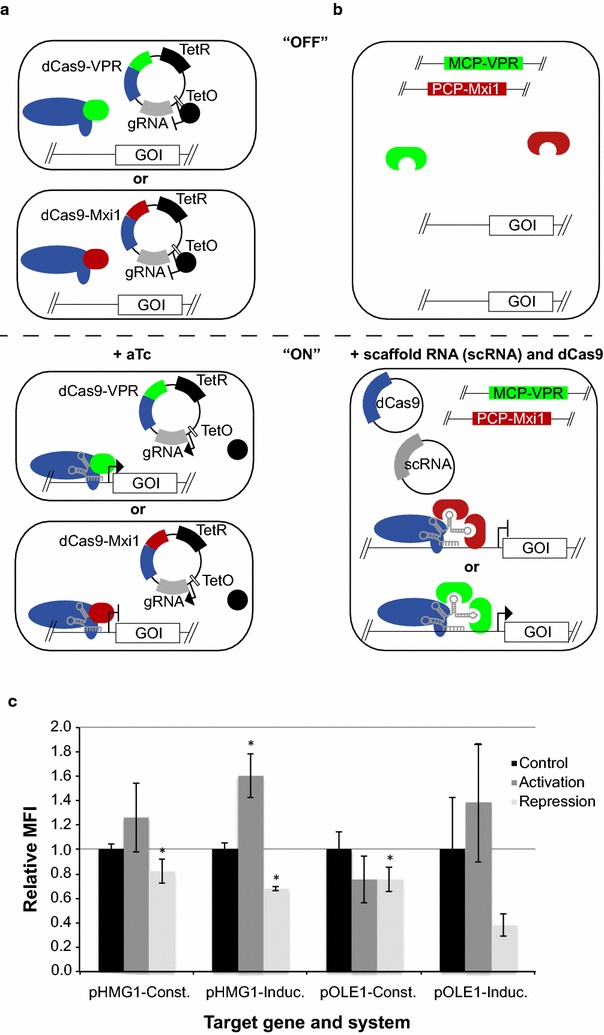
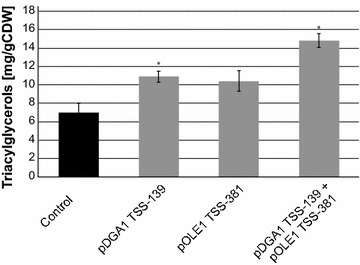
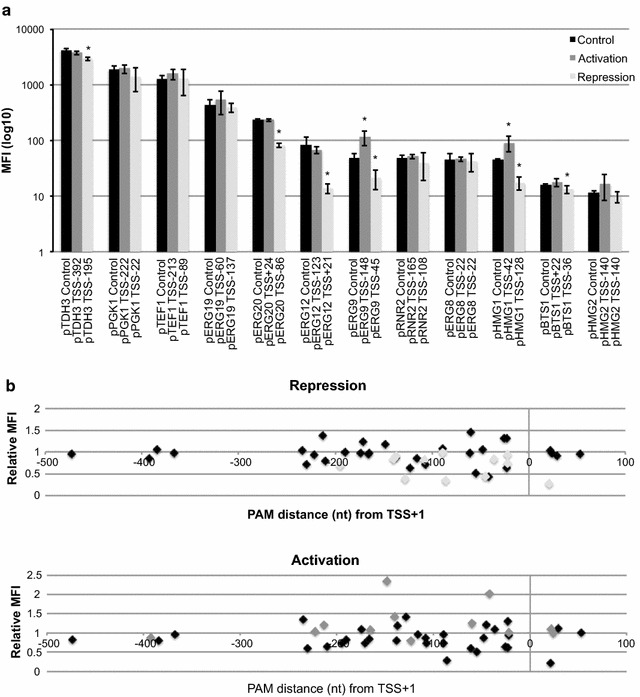
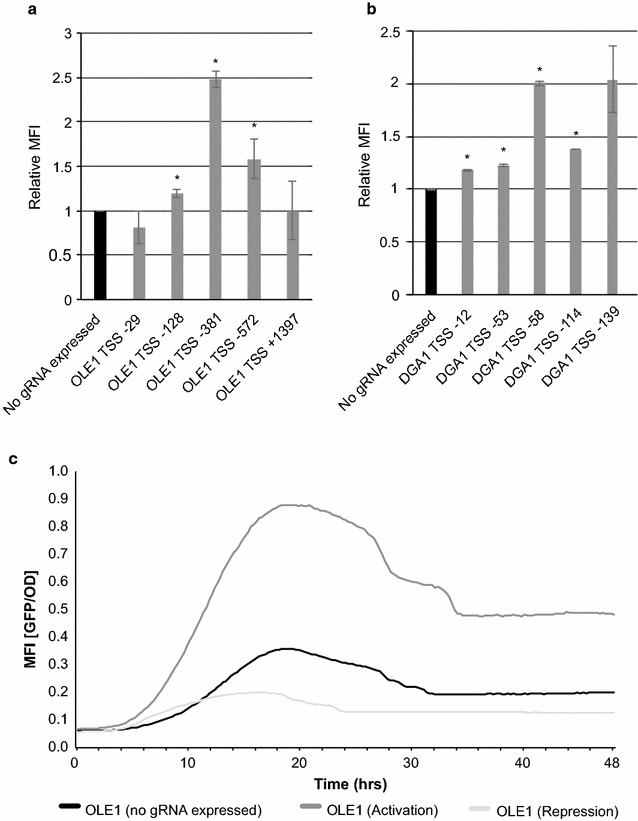
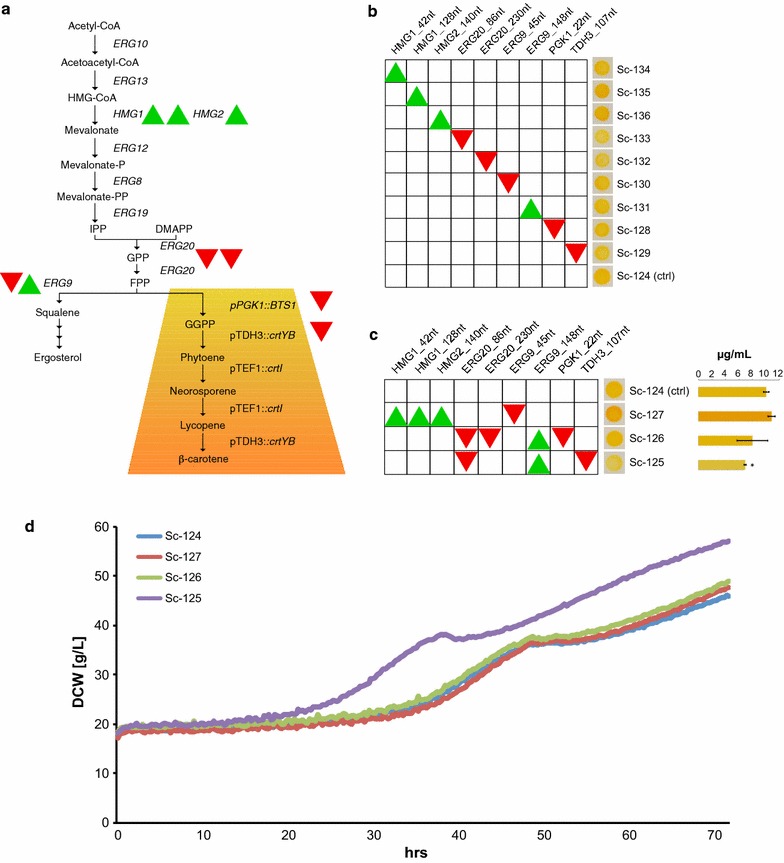
In this study we compared two different systems of dCas9-mediated transcriptional reprogramming, and applied them to genes controlling two biosynthetic pathways for biobased production of isoprenoids and triacylglycerols (TAGs) in baker's yeast Saccharomyces cerevisiae. By testing 101 guide-RNA (gRNA) structures on a total of 14 different yeast promoters, we identified the best-performing combinations based on reporter assays. Though a larger number of gRNA-promoter combinations do not perturb gene expression, some gRNAs support expression perturbations up to ~threefold. The best-performing gRNAs were used for single and multiplex reprogramming strategies for redirecting flux related to isoprenoid production and optimization of TAG profiles. From these studies, we identified both constitutive and inducible multiplex reprogramming strategies enabling significant changes in isoprenoid production and increases in TAG.
Taken together, we show similar performance for a constitutive and an inducible dCas9 approach, and identify multiplex gRNA designs that can significantly perturb isoprenoid production and TAG profiles in yeast without editing the genomic context of the target genes. We also identify a large number of gRNA positions in 14 native yeast target pomoters that do not affect expression, suggesting the need for further optimization of gRNA design tools and dCas9 engineering.
转录重编程是活细胞适应环境和内源性信号的基本过程。为了在不干扰天然基因表达机制的情况下,对基因表达进行灵活和及时的控制,大量研究集中在开发用于转录正交控制的合成生物学工具上。最近,无核酸酶 Cas9(dCas9)作为一种控制靶基因激活和抑制的灵活工具出现,通过简单的 RNA 引导 dCas9 定位到靶基因转录起始位点附近。
在这项研究中,我们比较了两种不同的 dCas9 介导的转录重编程系统,并将其应用于控制酵母酿酒酵母中生物基异戊二烯和三酰基甘油(TAG)生物合成两条途径的基因。通过在总共 14 个不同的酵母启动子上测试 101 个向导 RNA(gRNA)结构,我们根据报告基因检测鉴定了基于最佳性能的组合。虽然更多的 gRNA-启动子组合不会干扰基因表达,但有些 gRNA 支持高达~3 倍的表达扰动。使用最佳 gRNA 进行单重和多重重编程策略,用于重新定向与异戊二烯生产相关的通量和优化 TAG 谱。通过这些研究,我们确定了组成型和诱导型多重重编程策略,可显著改变异戊二烯生产和增加 TAG。
综上所述,我们展示了组成型和诱导型 dCas9 方法的相似性能,并确定了多重 gRNA 设计,可在不编辑靶基因基因组背景的情况下,显著改变酵母中的异戊二烯生产和 TAG 谱。我们还确定了 14 个天然酵母靶标启动子中的大量 gRNA 位置不会影响表达,这表明需要进一步优化 gRNA 设计工具和 dCas9 工程。